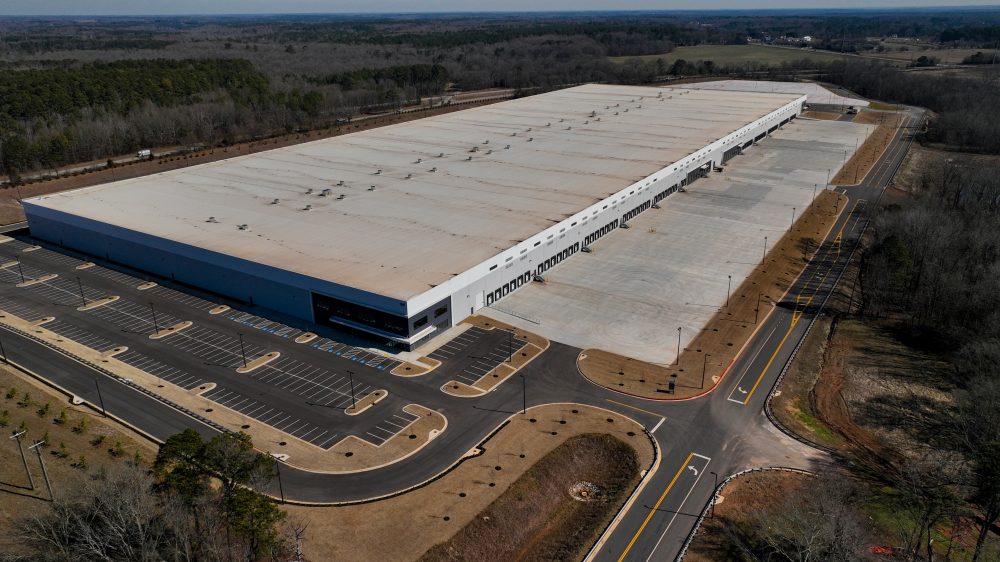

U.S. Immigration and Customs Enforcement is stepping back from a sweeping plan to convert large warehouses into mass immigrant detention centers, abandoning a central piece of a $38-billion initiative that former Homeland Security Secretary Kristi Noem championed to dramatically grow detention capacity this year.
The federal government, which faced a lawsuit from Michigan and a Detroit-area suburb, told a judge Monday that a warehouse it purchased in Romulus, Michigan, will be put up for sale. Similar plans are also falling apart in Social Circle, Georgia, and Socorro, a suburb of El Paso, Texas, according to local officials in those communities.
Those three cities are part of a group of 11 locations where the federal government collectively spent $1.074 billion purchasing warehouse properties.
The New York Times reported last week, citing internal documents it obtained, that federal immigration officials now intend to unload seven of those 11 warehouses — either by transferring them to other federal agencies or selling them on the open market.
The Department of Homeland Security did not directly confirm those reports, but released a statement saying the agency is “moving swiftly to utilize EXISTING detention space with our state and county partners.”
Claire Trickler-McNulty, a former ICE official who served under the Obama, Trump, and Biden administrations, had sharp words for the warehouse conversion idea, calling it “wildly foolhardy.”
Part of the backlash stemmed from how the purchases were handled. Noem’s team largely carried out the acquisitions away from public scrutiny, blindsiding many communities. In some cases, local leaders only found out about ICE’s intentions after the agency had already bought or leased space in their area.
After Noem was removed from her position, her successor, Markwayne Mullin, quickly put the brakes on any additional warehouse purchases.
Opposition came from multiple directions — some residents and officials objected on moral grounds to having an ICE detention facility in their neighborhoods, while others raised practical concerns about whether the facilities would strain local infrastructure like water and sewer systems.
Seven federal lawsuits were filed against the plans, and regulatory obstacles created additional headaches in other locations.
Financial questions also arose about how much the government paid. In one case, the agency paid double what a New Jersey warehouse was valued at in tax records. For the Social Circle, Georgia, property, the government paid nearly five times its assessed value. Those discrepancies triggered an internal audit.
Trickler-McNulty noted that while ICE does own a handful of facilities it inherited from its predecessor agency, the Immigration and Naturalization Service, the agency has historically contracted out its detention needs rather than owning and operating large facilities itself.
“Facilities over 2,000 people just break down. It’s very hard to run a very big facility, to keep it staffed, to keep all of it moving,” she said.
Mullin, who took over and expanded his family’s plumbing business before serving Oklahoma in both the U.S. House and Senate, acknowledged during his confirmation hearing that there had been problems with the warehouse plan. He pointed out that most municipalities simply don’t have the water and sewer infrastructure to support facilities housing thousands of people.
Water supply challenges proved particularly severe at the Salt Lake City warehouse — the most expensive of the bunch at $145.4 million. A federal lawsuit over that property revealed that ICE officials told the city’s mayor that trucking water and sewage to and from the facility might be needed as a temporary fix.
According to the New York Times report, the Salt Lake City warehouse is among those slated to be handed off or sold. Others on the list include the Romulus facility, one in New Jersey, two in Georgia, and two in Pennsylvania.
Michigan Attorney General Dana Nessel, a Democrat, said it would have been an “abomination” if the 249,000-square-foot Romulus warehouse had been converted into an immigrant detention center as originally planned when it was purchased for $34.7 million.
“The ICE warehouse proposal was every bit as ill-conceived as it was cruel and unnecessary, and I am relieved that this chapter is coming to a close,” Nessel said.
Social Circle, Georgia, announced last week that it received word from U.S. Rep. Mike Collins, a Republican, that the Department of Homeland Security has dropped its plans to build an ICE detention facility there.
In the El Paso region, acting ICE Director David Venturella visited the area earlier this month and informed local officials that the agency has revised its plans for three warehouses it purchased in nearby Socorro for $122 million, according to U.S. Rep. Veronica Escobar, who was present during the visit.
Escobar, a Democrat representing El Paso, said at a news conference that ICE is no longer planning to detain up to 8,500 immigrants at those facilities as originally envisioned. Instead, the property will be converted into an ICE campus that includes offices and training space, along with a smaller — though unspecified — number of detainees.
Despite some progress, many communities remain frustrated by a lack of communication from federal officials about what happens next.
In Pennsylvania, state and local officials said Tuesday they had not received any updated information from DHS regarding two warehouses purchased earlier this year. Both projects have been held up after the state denied permits, citing concerns that drinking water and sewer capacity would be insufficient for thousands of residents.
U.S. Rep. Dan Meuser, whose district covers both Pennsylvania warehouses, said he met with DHS personnel on Friday but that the agency had not yet decided whether to use the properties as detention centers or sell them.
In Oakwood, Georgia, the city manager said Tuesday he is reaching out to his congressional delegation trying to confirm rumors that a warehouse in his city will be sold. “I have not heard anything yet,” said B.R. White.
In Maryland, a judge has extended a halt on converting a large warehouse into an immigrant processing facility, while ICE continues to gather public comments about the environmental impact of the project. An announcement earlier this month provided additional details about the planned facility, including six secure outdoor recreation areas.
Patrick Dattilio, founder of Hagerstown Rapid Response — a group formed specifically to oppose housing ICE detainees in that warehouse — said there has been little communication beyond what has come out through the lawsuit. He said his group remains committed to preventing the facility from ever opening.
“It’s a big warehouse,” Dattilio said. “It’s not meant for people.”