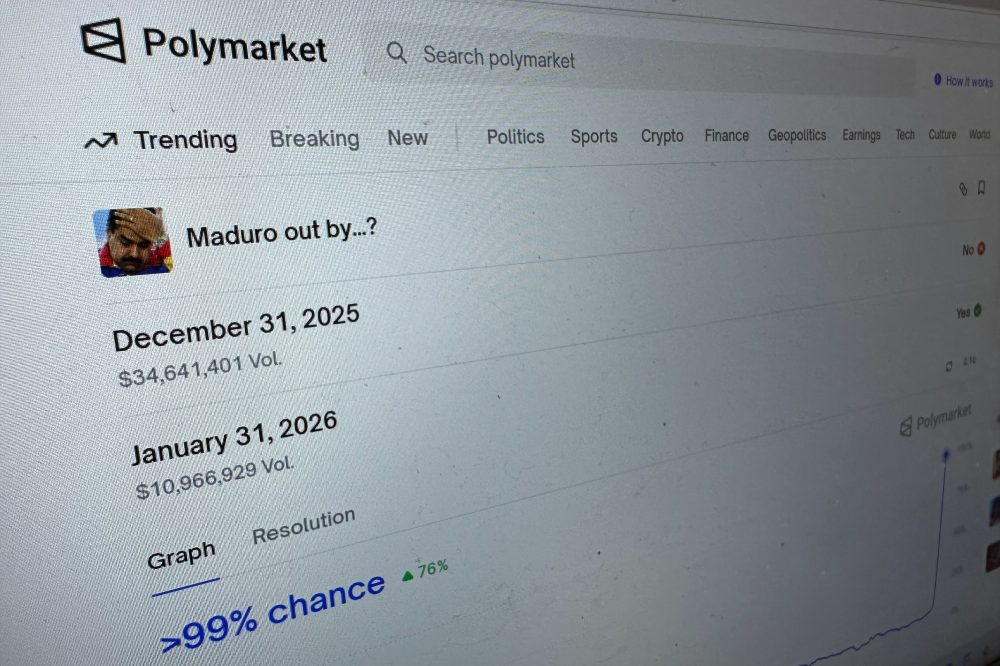

NEW YORK — Federal regulators under the Trump administration are siding with prediction market companies Kalshi and Polymarket as these platforms battle states seeking to shut down their operations.
Michael Selig, who was recently named to lead the Commodity Futures Trading Commission, announced the agency’s backing in what could reshape sports betting regulation across the nation. Should these prediction market companies win their legal fights, it might weaken states’ power to control gambling within their borders.
The federal decision could also create financial benefits for the Trump family. Donald Trump Jr. has put money into Polymarket through his investment firm and serves as a strategic advisor to Kalshi.
Currently, the CFTC oversees prediction markets, giving companies like Kalshi federal permission to operate nationwide, including in states where gambling is prohibited. Multiple states have filed lawsuits against both Polymarket and Kalshi, claiming these companies run illegal gambling operations that violate state laws, demanding they cease operations within state boundaries.
Writing in The Wall Street Journal, Selig declared: “The CFTC will no longer sit idly by while overzealous state governments undermine the agency’s exclusive jurisdiction over these markets by seeking to establish statewide prohibitions on these exciting products.”
These prediction market platforms let users purchase and sell contracts based on likely outcomes of future events. People can place bets on various scenarios, from tomorrow’s weather in Los Angeles to NBA championship winners to potential military conflicts between nations. Contract prices typically range from one cent to 99 cents, reflecting the percentage likelihood users assign to each outcome.
Sports betting dominates both platforms’ business models. About 90% of Kalshi’s trading activity involves sports wagers, while approximately half of Polymarket’s trades focus on sporting events. Kalshi reported over $1 billion in trading volume during the Super Bowl alone.
Nevada has launched the most significant legal challenge, with the Nevada Gaming Control Board taking enforcement action against both companies for allegedly running unlicensed sports betting businesses. A federal judge sided with Nevada officials and granted a temporary restraining order preventing Kalshi from operating in the state.
Kalshi has now appealed to the U.S. Court of Appeals for the 9th Circuit, prompting the CFTC to file what’s called a “friend of the court” brief supporting the company.
The CFTC traditionally regulates commodities, futures, and derivatives markets including oil futures, farm products, precious metals, and other financial instruments. With approximately 700 staff members, the agency is considerably smaller than the Securities and Exchange Commission’s roughly 5,000 employees. However, the CFTC has expanded its influence significantly over the past five years as cryptocurrency firms and prediction market supporters have gravitated toward its oversight.
By entering this lawsuit, the Trump administration is adopting an unusually expansive interpretation of what constitutes commodities and futures. Selig has changed his stance from his confirmation hearing testimony, where he told senators the CFTC should let courts handle the central legal questions facing Kalshi and Polymarket.
Selig now argues that prediction markets function similarly to traditional futures contracts, allowing customers to protect against weather risks or energy price fluctuations, rather than gambling against the house like traditional sportsbooks. States pursuing legal action counter that while these companies do offer betting on future events, sports wagering makes up the bulk of their business. Additionally, prediction markets typically allow users as young as 18, while state-regulated gambling requires participants to be at least 21.
Selig now maintains that states cannot override federal regulatory authority.
“To those who seek to challenge our authority in this space, let me be clear, we will see you in court,” Selig stated in a video announcement.
Some Republican officials have criticized Selig’s position, including Utah’s governor, whose state maintains some of America’s strictest anti-gambling laws.
“Mike, I appreciate you attempting this with a straight face, but I don’t remember the CFTC having authority over the ‘derivative market’ of LeBron James rebounds,” Governor Spencer Cox wrote on Twitter. “These prediction markets you are breathlessly defending are gambling — pure and simple.”