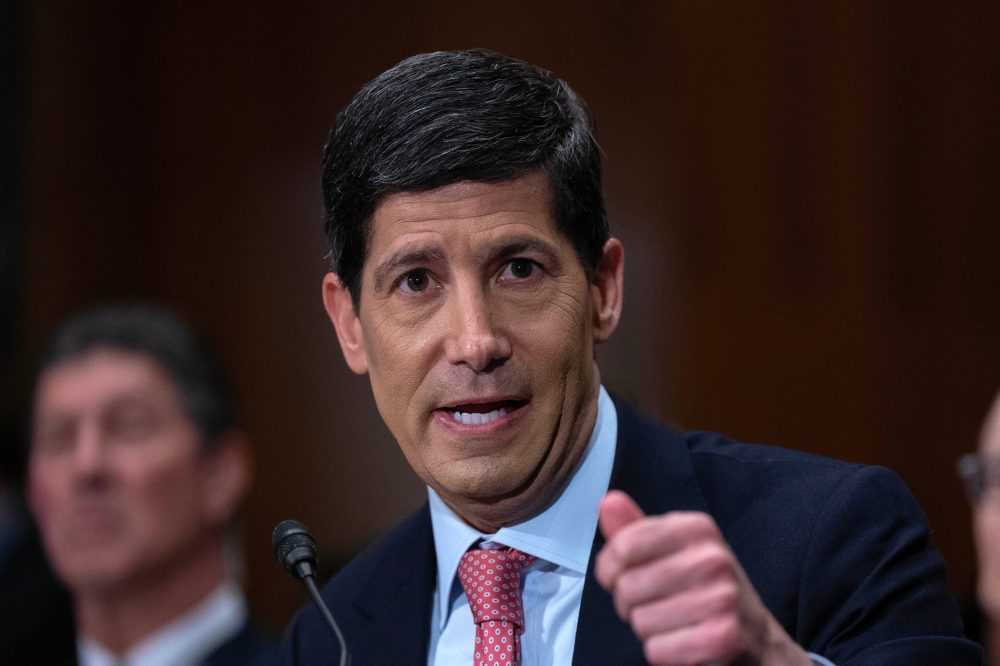

WASHINGTON (AP) — When Federal Reserve policymakers gather Tuesday and Wednesday, they are widely expected to leave the central bank’s key interest rate right where it is. But Fed Chair Kevin Warsh is facing growing pressure to raise rates in the near future — a move that could put him at odds with President Donald Trump, who selected him for the role.
Several forces are converging to push prices higher. The renewed outbreak of the Iran war has sent oil and gas prices climbing again, a trend that economists warn will fuel further inflation in the months ahead. A massive surge in spending on artificial intelligence infrastructure is driving up the cost of laptops, smartphones, and electricity. On top of that, tariffs imposed by Trump on numerous U.S. trading partners could mean additional price increases are still on the way.
While some analysts believe these pressures could lead to only short-lived price spikes rather than a prolonged bout of inflation like the one seen in 2021 and 2022, the Fed’s preferred inflation gauge has now been above its 2% target for more than five years. That track record makes it increasingly difficult for the central bank to brush off even temporary price increases. Core inflation — which strips out the more volatile food and energy categories — has been running at around 3% or higher since 2023 and has actually been rising since last December. Some Fed officials say that without meaningful progress soon, rate increases will be unavoidable.
Lorie Logan, president of the Federal Reserve Bank of Dallas and a voting member of the Fed’s rate-setting committee, recently stated, “Unfortunately, inflation does not appear to be headed sustainably back all the way to 2%. Modestly higher interest rates would better balance the outlook.”
Since stepping into the chair role in May, Warsh has repeatedly said the Fed is committed to bringing inflation back down to 2%, though he has stopped short of detailing exactly how that will happen. At his first press conference last month, he made it clear he would not offer the kind of forward guidance on upcoming decisions that his predecessors — especially Jerome Powell — were known for providing.
Still, Warsh’s words have carried weight. In congressional testimony earlier this month, he declared the Fed has “no tolerance” for higher inflation. And in the first rate policy statement released under his leadership, the Fed pledged it “will deliver price stability.”
Those statements, combined with the return of fighting in Iran and the resulting rise in energy prices, have already pushed borrowing costs upward. The yield on the 10-year Treasury note — a key driver of mortgage rates — briefly climbed above 4.7% last Thursday, reaching its highest point in roughly 18 months.
But current and former Fed officials caution that strong words can only go so far. James Bullard, a former president of the St. Louis Fed, said Warsh’s rhetoric “has been very effective” in building Fed credibility, but warned that “markets are going to ask, ‘Well, what have you done for me lately?’ And they’re going to demand action.”
Meanwhile, frustration appears to be growing within the Fed itself. Christopher Waller, an influential member of the Fed’s governing board, said in a July 13 speech, “Sternly staring at inflation until it melts before our withering gaze is not an option.” He added that if core inflation continues to rise, the rate-setting committee “will need to consider” hiking rates “in the near term.”
Beth Hammack, president of the Cleveland Fed, shared in a LinkedIn post earlier this month that she is now hearing something unusual — business leaders actually calling for higher interest rates, despite the fact that cheaper borrowing typically benefits them. She also noted she is hearing from everyday consumers “who can’t make ends meet about a growing sense of despair.”
Despite all of this, economists say there remains significant uncertainty about the right path forward. The most recent inflation report showed that core inflation cooled noticeably in June, and overall inflation dropped sharply as gas prices fell nearly 10% — a preview of what could happen if the Iran conflict is resolved. Apartment rental costs, which surged during the pandemic, are also rising much more slowly than in recent years.
John Williams, president of the New York Fed and vice chair of the rate-setting committee, said this month that “there are encouraging reasons to expect that inflation has peaked and should edge down in the coming quarters.” He pointed to the earlier drop in gas prices and argued that the inflationary impact of tariffs has largely already been absorbed — and that any new tariffs would likely have a similarly limited effect.
However, the return of Middle East hostilities has pushed the national average gas price back above $4 a gallon, up from just under $3.80 around the July 4th holiday. That jump is expected to drive headline inflation higher just ahead of the Fed’s next meeting in September. Complicating matters further, higher interest rates can cool consumer demand and ease price pressures, but they cannot fix supply disruptions caused by war.
“The Fed is looking at inflation well above goal, but mostly for reasons that it doesn’t have any influence on,” said Vincent Reinhart, chief economist at Dreyfus-Mellon and a former senior Fed economist.
In his congressional testimony this month, Warsh indicated that the Fed’s role is to prevent isolated price increases — like those for gasoline or computer equipment — from “broadening out” into other areas of the economy. Traditionally, the Fed would address that risk by raising rates when signs of spreading inflation emerge. But Warsh may be betting that his firm public stance, which has already nudged some borrowing costs higher, will be enough on its own.
“They are hoping and intending to talk the talk without having to walk the walk,” said Stephen Douglass, chief economist at NISA Investment Advisors and a former analyst at the New York Fed. He does not expect the Fed to raise rates at all this year.
Other economists disagree, arguing that inflation will not come down without concrete action. “There has never been a time when inflation gradually moderated without impetus from the Fed,” said Joseph Lavorgna, a former senior economist at the Treasury Department and chief economist at SMBC Americas. “In other words, core inflation is not going to magically slow.”