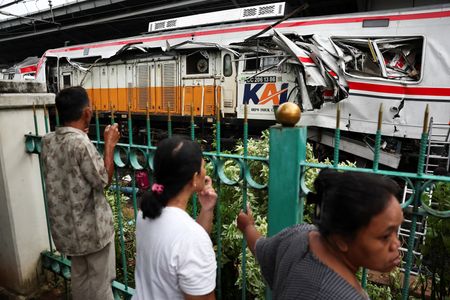

Rescue operations have concluded following a devastating train accident near Jakarta, Indonesia, with officials confirming 14 fatalities and 84 people wounded in the collision.
The tragic incident occurred Monday evening in Bekasi, located just outside Indonesia’s capital, when a commuter train and a long-distance train crashed into each other.
PT KAI, Indonesia’s state railway company, confirmed through CEO Bobby Rasyidin that the death count had reached 14 people.
Mohammad Syafii, who leads Indonesia’s search and rescue operations, announced Tuesday that all evacuation efforts had wrapped up. He described the complex nature of freeing passengers who were stuck inside the destroyed train cars.
“We needed to involve personnel with certain skills to perform a measured extrication,” Syafii explained, noting that while no additional passengers remain to be found, rescue workers will continue searching the debris for any remaining body parts.
The crash’s most severe damage occurred to a car designated exclusively for female passengers. According to Syafii, every person who died was a woman, with the majority crushed beneath twisted metal.
Emergency responders used specialized cutting equipment, including angle grinders, to slice through the metal compartments and reach those who survived before separating the trains.
Railway executive Bobby explained during a news briefing that the sequence of events began when the commuter train struck a taxi positioned on the railway tracks, followed by the long-distance train hitting the commuter train.
Green SM Indonesia, the taxi company involved, confirmed through social media that one of their vehicles was part of the accident. The company stated it provided information to investigators to help with their inquiry.
The taxi service operates as the Indonesian division of Green and Smart Mobility JSC, a Vietnamese electric vehicle company connected to Vingroup.
Following a visit to a Bekasi medical facility, President Prabowo Subianto announced plans to construct an overpass near the railway to address severe traffic problems in the area. He also promised a thorough investigation into the accident and acknowledged that significant portions of the country’s rail system lack proper maintenance.
The crash is currently under review by Indonesia’s National Transportation Safety Committee.
Family members and concerned individuals gathered at the train station Tuesday, many searching for missing relatives.
Heriyati, who was traveling on the train, shared that she had originally planned to board the women’s car but chose the one directly behind it instead. She was speaking with her husband by phone, arranging for him to collect her from the station, when the collision happened.
“I haven’t even finished with the call and the trains collided,” she recalled.
The commuter rail system serves as one of Jakarta’s busiest transportation networks in what ranks as the world’s most populated urban area. PT KAI announced that several commuter routes were shortened Tuesday due to the crash aftermath.
Adriansyah Yasin Sulaeman, who holds an executive position at the Forum Transport for Jakarta research organization, emphasized the need for government investment in upgrading the deteriorating railway infrastructure. He specifically recommended creating separate tracks for express long-distance services and local commuter trains.
“These commuter trains are a symbol for the working class,” Sulaeman stated. “It’s a big alarm for the government to seriously improve it.”
Transportation accidents involving land vehicles occur frequently throughout Indonesia. A separate train accident in West Java province during 2024 resulted in four deaths and numerous injuries.