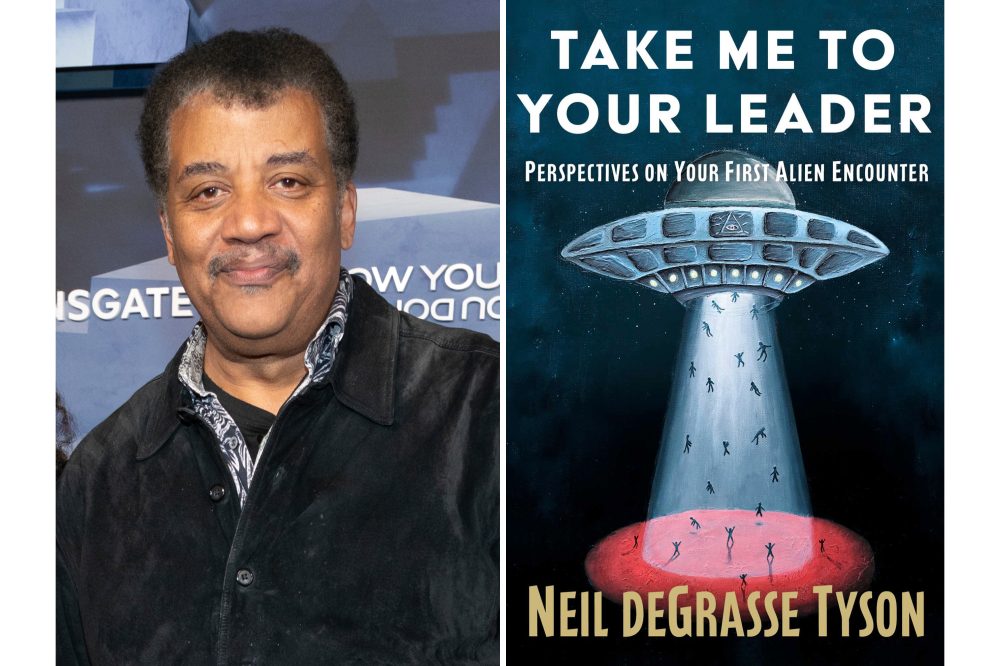

NEW YORK (AP) — Renowned astrophysicist Neil deGrasse Tyson harbors an unusual dream: he genuinely hopes to experience alien abduction during his lifetime.
“I even picture the scenario in my head: I’m sitting out there alone, and a beam of light comes down,” he explains. “It’s not a spacecraft that’s hovering over me. It’s just a beam of light from space. And I just get lifted up into that beam of light, and I appear in a new place.”
The beloved space scientist has channeled this enduring obsession into his latest work, “Take Me to Your Leader: Perspectives on Your First Alien Encounter,” which explores our current understanding of potential extraterrestrial beings and what humanity might expect should they visit Earth.
“Even if it doesn’t actually happen, there’s value to going through the thought experiment of what could happen,” he explains. “Maybe there’s some takeaways that offer insights into how you think about the world, how we think about each other and the future of our civilization.”
Released Tuesday, this publication provides an extraordinary glimpse into Tyson’s remarkable intellect, showcasing his talent for combining popular culture with complex scientific concepts. Tyson serves as director of the Hayden Planetarium at the American Museum of Natural History in New York City.
The work draws from evolutionary biologist Stephen Jay Gould alongside Cartoon Network’s “Rick and Morty,” weaving together concepts from French philosopher Voltaire and Katy Perry song lyrics. It combines invisibility physics with “Star Trek” references and includes tangents about multispectral vision, how Superman — being an alien himself — could eliminate humanity simply by passing gas, and the reason supersonic aircraft “look badass.”
Tyson determines that any aliens reaching Earth would possess far superior intelligence compared to humans. He compares the situation to attempting to teach complex mathematics to a chimpanzee.
“They’ll not only be brilliant, but they’ll be way more powerful than us in practically any way that matters, which is why it’s so laughable when you see in Hollywood movies some mothership arrives and people pull out their pistols and start shooting guns at it. Like, ‘Really? Have you thought this through?’”
For initial contact scenarios, he recommends avoiding handshakes or wave gestures. “Leave all your habits at home, until you learn a thing or two about theirs,” he advises in the book.
This publication emerges amid heightened public fascination with extraterrestrial life. Pentagon officials have started releasing additional UFO documentation, “Project Hail Mary” became a bestseller, Steven Spielberg is developing his alien film “Disclosure Day,” and former President Barack Obama stated on a podcast that aliens exist. (Obama later clarified he had witnessed no proof but believed “the odds are good there’s life out there.”)
Tyson was inspired to create this book after observing recent congressional UFO hearings, where he noticed bipartisan cooperation in seeking answers.
“They had a common subject that they’re both interested in,” he notes. “When I saw it hit that level, I realized I have something to contribute.”
This marks the inaugural release from Simon & Schuster’s new Simon Six imprint, overseen by Jonathan Karp, who edited Tyson’s work and dubbed the scientist “the Bruce Springsteen of astrophysicists.”
“You name a respected scientist who has ever written a book of etiquette on how to meet aliens. It hasn’t been done. This is truly terra incognita,” Karp states.
While visiting aliens wouldn’t understand Earth languages, Tyson believes communication remains possible through scientific principles — unchanging concepts like light speed, Newton’s motion laws, gravitational forces, and Einstein’s relativity theory. These beings might even recognize our periodic table structure — not our terminology or symbols — but the fundamental arrangement they likely developed themselves.
He also predicts they won’t be extremely small or large, referencing brain-to-body weight proportions. Excessive size would cause structural collapse, while insufficient size would prevent constructing space-capable vessels. “The laws of physics greatly restrict the likelihood of Earth being visited by, much less invaded by tiny aliens,” he writes.
Should they be observing us currently, there’s reasonable probability they’d request meeting our apparent leader — Taylor Swift. However, Karp suggests Tyson should represent humanity, with this book serving as his credentials.
“I think this is the funniest factual book that anyone will ever read on aliens and that’s quite a statement,” Karp declares. “There’s so much chaos and conflict in the world, and it’s a book on aliens that has the potential to bring us all together. He’s clearly been thinking about aliens his entire life, and he’s managed to write about them with the acuity of a scientist and the appeal of an entertainer. That’s a powerful combination.”