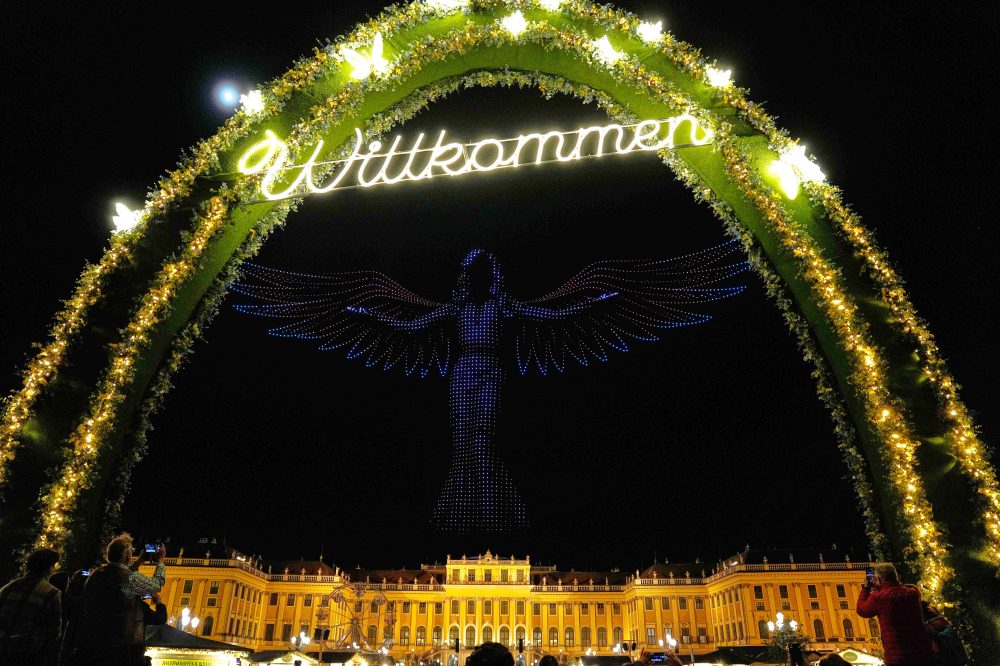

The Eurovision Song Contest reaches a milestone 70th anniversary this year, though political tensions are casting shadows over the celebrated musical competition.
Vienna, Austria will host the spectacular event from May 12-16, featuring performers from 35 nations vying for Europe’s most prestigious musical title. However, notable countries have chosen to boycott the competition in protest of Israel’s continued participation.
The international singing competition began in 1956 as a way to test emerging live broadcast technology while promoting unity following World War II’s devastation. What started with seven participating countries has expanded to include dozens of European nations, plus Israel and Australia from beyond the continent’s borders.
The competition blends theatrical spectacle with genuine celebration of cultural diversity and national identity, attracting a massive global following. Last year’s event drew 166 million viewers worldwide, while fans from 75 countries purchased tickets to attend this year’s live performances in Vienna.
Eurovision has produced both wonderfully absurd moments—with winning songs like “La, La, La” and “Boom Bang-a-Bang”—alongside genuine pop masterpieces such as ABBA’s 1974 triumph “Waterloo.”
Notable past champions include Canadian singer Celine Dion representing Switzerland in 1988, Austrian drag performer Conchita Wurst in 2014, Italian rock group Måneskin in 2021, and Ukrainian folk-rap ensemble Kalush Orchestra in 2022.
Despite its “United by Music” slogan, Eurovision frequently becomes entangled in global politics. Russia faced expulsion in 2022 following its invasion of Ukraine.
The 2024 competition in Malmo, Sweden, and last year’s event in Basel, Switzerland, witnessed pro-Palestinian demonstrations demanding Israel’s removal over its Gaza military operations and alleged vote manipulation attempts.
Political tensions peaked in December when Iceland, Ireland, the Netherlands, Slovenia and Spain withdrew after organizers permitted Israel to continue competing.
Bulgaria, Moldova and Romania have rejoined after missing recent years due to artistic or financial constraints, bringing this year’s total to 35 countries, down from 37 in 2025. Multiple pro-Palestinian demonstrations are scheduled during Eurovision week.
Eurovision expert Dean Vuletic described the contest as “Europe’s biggest election,” with winners determined through combined national jury panels and public voting.
Finland leads betting odds with “Liekinheitin” (“Flamethrower”), an energetic collaboration between violinist Linda Lampenius and pop artist Pete Parkkonen.
Other strong contenders include 17-year-old French performer Monroe with the pop-opera love song “Regarde!” and Denmark’s Søren Torpegaard Lund performing the seductive “Før Vi Går Hjem” (“Before We Go Home”).
Australia, an enthusiastic Eurovision participant despite geographic distance from Europe, has selected established artist Delta Goodrem with “Eclipse,” a polished mid-tempo ballad. Greece’s Akylas is gaining fan support with the party-rap number “Ferto” (“Bring It”).
Vuletic also highlighted Cyprus’ entry, the folk-influenced dance-pop track “Jalla” by Antigoni. The song has already gained YouTube popularity and “could be the up-tempo feelgood song that people vote for,” he noted.
Israel, a four-time Eurovision champion and 2025 runner-up, has selected vocalist Noam Bettan with the ballad “Michelle.” Singer Senhit, representing San Marino, has recruited 1980s star Boy George for a guest appearance on party anthem “Superstar.”
Paul Jordan, known as Dr. Eurovision, explained that the competition has evolved beyond its “sugary pop” reputation. This year’s entries span from classical “popera” to electronic pop, power ballads and folk-inspired compositions.
“There’s not a lot of cheesy pop numbers,” Jordan observed. “There’s such diversity that I don’t think there is such a thing as a ‘Eurovision sound’ anymore.”
Typically, the previous year’s winning country hosts the following competition. Last year’s champion was Austrian performer JJ with the pop-opera piece “Wasted Love.” The 2026 contest takes place at Vienna’s Wiener Stadthalle, marking the third time Austria’s capital has welcomed Eurovision.
National broadcasters in participating countries will air the competition, along with streaming service Peacock in the United States and the Eurovision YouTube channel in select regions.
Each participating nation presents a singer or group performing an original composition lasting no more than three minutes, often featuring elaborate stage productions.
Two semifinal rounds on May 12 and 14 will narrow the field to 25 finalists for the grand finale on May 16, hosted by Austrian singer and crystal heiress Victoria Swarovski alongside actor Michael Ostrowski.
Viewers in participating countries can vote during the live final via phone or text, though they cannot support their own nation’s entry. Audiences in the United States and other non-participating countries can vote online at www.esc.vote.
Each country’s public votes convert to points on a one-to-twelve scale for top-performing acts.
The European Broadcasting Union, Eurovision’s organizing body, has strengthened voting procedures following vote-manipulation allegations, reducing votes per payment to 10 and implementing stronger protections against “suspicious or coordinated voting activity.”
Following a voting intermission, each country announces its jury and public vote results in sequence, with points displayed on-screen until a winner emerges. The rapidly shifting rankings and suspense over which country might receive the dreaded zero points add to the excitement.
The departure of countries including seven-time winner Ireland and Spain—one of the “big five” nations providing major funding—represents a significant setback as public broadcasters face financial pressures and social media competes for audience attention.
Eurovision is expanding globally, with the inaugural Eurovision Song Contest Asia scheduled for Bangkok in November.
Jordan believes that at 70 years old, Eurovision remains “part of our European culture” and can survive current challenges.
“It still gets people talking. It still brings us all together. It still gets huge viewing figures, it’s still creating hits,” he stated. “At a time when broadcasting is changing, people still make a date with their television set on that Saturday night.”