
The European Union made significant progress Wednesday toward completing a trade agreement with the United States, reaching a preliminary deal on legislation that would eliminate import taxes on American products.
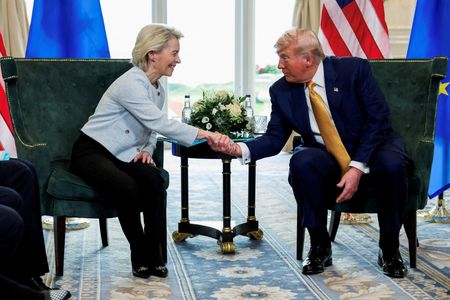
The agreement stems from a trade framework negotiated at U.S. President Donald Trump’s Turnberry golf resort in Scotland last July. Under that arrangement, the EU committed to eliminating import taxes on U.S. industrial products and providing favorable access for American agricultural and seafood items, while the U.S. maintains 15% tariffs on most European goods.
After nearly 10 months since the initial framework was established, the European Parliament and the Council representing EU member nations reached consensus on legislative language to implement the EU’s tariff reductions. Following five hours of discussions, negotiators also established stronger provisions to halt the concessions if Trump abandons the agreement and included an expiration clause ending the deal at 2029’s close unless new legislation extends it.
This internal EU agreement should help stabilize the world’s most significant trading partnership, which involves $2 trillion annually in goods and services exchanges. The development comes one week after Trump’s China visit, which featured positive rhetoric but yielded no substantial progress. European exports to America represent approximately 20% of the EU’s goods shipments, though Trump seeks to use tariffs to narrow the goods trade deficit with Europe, which exceeds $200 billion.
“I am proud to announce that Europe has avoided a damaging escalation of transatlantic trade tensions and protected European companies, investments and millions of jobs on both sides of the Atlantic,” Zeljana Zovko, the lead trade negotiator in the European People’s Party on the U.S. deal, said in an X post.
“The EU walks the talk, while defending our interests. Once approved, it’ll boost transatlantic stability and cooperation,” European Trade Commissioner Maros Sefcovic wrote on X.
Trump established a July 4 deadline, threatening to implement significantly higher tariffs on European products including automobiles if the EU fails to fulfill its trade commitments by that date. He previously warned of increasing tariffs on EU automotive imports to 25% from the existing 15%.
European legislators had previously delayed the necessary legislation twice following Trump’s threats to impose additional tariffs on European allies who didn’t support his proposed Greenland acquisition and after the U.S. Supreme Court overturned his global tariffs.
The bloc appears positioned to meet Trump’s July 4 timeline, with final approval voting in the European Parliament anticipated in mid-June.
EU lawmakers had sought stronger guarantees, but negotiators rejected their proposed “sunrise clause” that would have delayed EU duty cuts until the U.S. met its obligations, and the “sunset clause” was extended from March 2028’s end to December 2029.
The European Commission retains authority to suspend tariff preferences by year’s end if the U.S. maintains tariffs above 15% on steel and aluminum “derivative” products such as wind turbines and refrigerators.
EU member governments showed less enthusiasm for including such provisions, worried they might provoke the Trump administration and create business uncertainty for European companies.