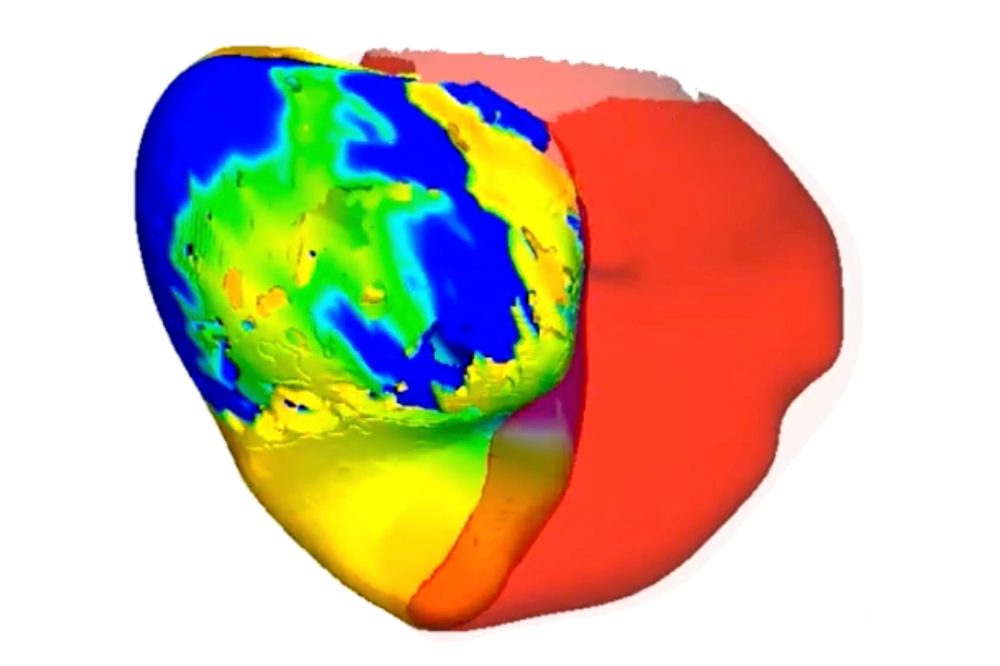

Medical researchers have developed precise virtual copies of patients’ hearts that allow doctors to test treatments for dangerous irregular heartbeats before performing actual procedures on the real organ.
The groundbreaking approach targets ventricular tachycardia, a challenging heart rhythm disorder that triggers approximately 300,000 deaths annually in the United States and serves as a leading cause of sudden cardiac arrest.
Johns Hopkins University researchers conducted a small initial study using this digital twin technology, with FDA approval to guide treatment for 10 patients. The findings were published Wednesday in the New England Journal of Medicine, though larger studies will be necessary to validate the approach.
The research represents part of a growing trend where doctors explore how digital twin technology, previously used in aerospace and manufacturing, could revolutionize medical care.
Dr. Jeffrey Goldberger, a cardiac specialist at the University of Miami not connected to the research, worked with earlier versions of similar technology 15 years ago and commended the new developments. “This is what we envisioned,” he said.
While physicians have traditionally relied on 3D models for disease simulation and technique practice, Hopkins biomedical engineer Natalia Trayanova explained that genuine digital twins can forecast how actual organs will respond to various treatments. Her laboratory creates vibrant, interactive models using advanced MRI scans and additional patient data.
“We treat the twin before we treat the patient,” Trayanova said. “Did it work? And if it did, are there new things that arise” that will require more or different care?
Ventricular tachycardia occurs when the heart’s electrical system malfunctions, creating an extremely rapid heartbeat as electrical signals become trapped in the heart’s lower chambers, preventing proper blood circulation throughout the body.
“You see this heart that is basically quivering,” Trayanova said.
While medications can provide some relief, the primary treatment involves ablation procedures where physicians guide catheters to the heart and destroy problematic tissue. However, this process often requires trial-and-error methods, with patients enduring lengthy periods under anesthesia as doctors identify optimal treatment locations. Multiple ablation procedures are frequently necessary, and many patients require backup defibrillator implants.
Trayanova’s digital heart replicas display colorful patterns on computer screens, with blue, green, yellow and orange hues illustrating electrical wave movement through healthy heart regions before becoming trapped on damaged tissue in a circular pattern resembling hurricane swirls.
“It allows me to recreate the functioning of the patient’s organ and then predict what is the best way to ablate,” she said.
The technology identifies problematic areas where electrical waves repeatedly impact tissue. Virtual ablation testing reveals whether targeting specific regions resolves the issue or creates additional arrhythmias requiring treatment. “Then we poke it again,” she explained.
Researchers developed personalized ablation plans for all 10 study participants. Cardiologists transferred these targets to their mapping systems and focused exclusively on predetermined locations rather than searching independently.
After more than one year, eight patients showed no arrhythmias while two experienced only single brief episodes during recovery periods, surpassing the typical 60% success rate, according to Dr. Jonathan Chrispin, a Hopkins cardiologist who led the study. Eight patients also discontinued their anti-arrhythmia medications.
Perhaps most significantly, cardiologists may be able to minimize tissue damage by focusing on “specifically the areas that we think are critically important,” Chrispin said. “We could potentially make these procedures shorter, safer, more effective.”
The Hopkins research team plans to expand their digital twin studies to include additional hospitals and has initiated trials using the technology for atrial fibrillation, a more common irregular heartbeat condition. Other research groups are investigating digital twin applications for cancer treatment.