
WASHINGTON (AP) — Following the Supreme Court’s decision to overturn President Donald Trump’s international trade tariffs less than a week ago, New York Governor Kathy Hochul met with a business owner who had challenged the policy in court to hear about its economic impact on his company.
Victor Schwartz, who runs VOS Selections, explained to Hochul while touring his wine import facility that stocks products from 16 nations: “This is a heavy tax and you have to pay it up front.”
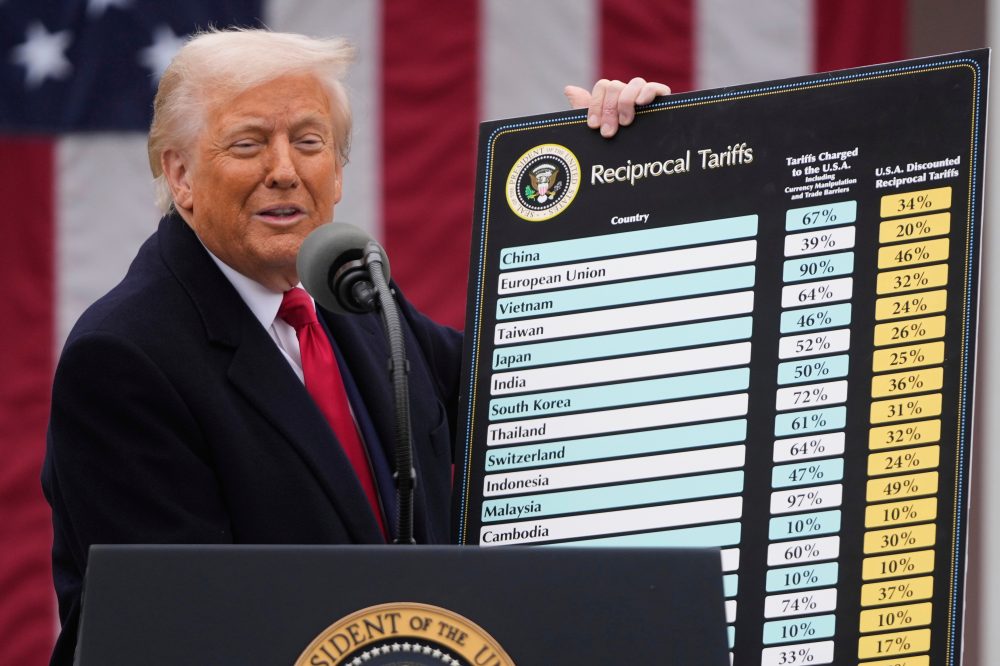
Hochul, who is running for reelection, describes the effects of Trump’s trade policies as the “centerpiece” of her campaign messaging. She has demanded the current administration provide New York residents with $13.5 billion in tariff reimbursements after the high court’s ruling. This week, she launched a television advertisement attacking her GOP opponent Bruce Blakeman for backing the trade measures and appearing at the White House ceremony where Trump announced them using a large display showing rates for different nations.
“This is a lethal issue for Republicans this November,” Hochul stated during an interview. “You can be sure we’re going to make sure people know who did this to them.”
Hochul’s strategy reflects a broader Democratic approach. Gubernatorial candidates from the party nationwide are placing tariff criticism at the heart of their voter outreach efforts. They’re wagering that amid an election cycle focused on various concerns from border security to Middle Eastern conflicts, increased expenses linked to trade policies will drive voter turnout.
“That picture of (Trump) with the tariff board is going to be front and center in every single one of our campaigns,” said Kentucky Governor Andy Beshear, who chairs the Democratic Governors Association this cycle.
White House representative Kush Desai responded that “what Democrats are really running against are President Trump’s Most-Favored-Nations deals to slash prescription drug prices by up to 90 percent, trillions in investments to bring manufacturing back to America, and new trade deals that level the playing field for American workers.”
“All of these historic victories were possible because of tariffs.”
The GOP faces a difficult electoral landscape as they address public concerns about rising costs — something Trump promised to address during his 2024 campaign — while dealing with the typical pattern of the incumbent president’s party losing seats in off-year elections.
While much attention has focused on congressional races, where Democrats need only a few additional seats to control the House, the party also seeks to expand its influence beyond the nation’s capital. They aim to retain governorships in Arizona, Michigan and Wisconsin while targeting Republican-controlled positions in Nevada, Georgia and Iowa.
During recent conversations, Democratic candidates in several of these states indicated that tariffs and broader affordability concerns will dominate their campaign messages.
Nevada’s Attorney General Aaron Ford previously filed legal action against the administration’s first wave of tariffs and is pursuing new litigation as Trump attempts to reinstate them. Competing for the Democratic nomination to face Republican Governor Joe Lombardo, Ford labeled the tariffs “illegal” and held them responsible for restaurant shutdowns and reduced tourism in his state.
“Tariffs are at the very top of the conversation because Nevadans every single day are feeling the impacts,” Ford explained.
Arizona’s Democratic Governor Katie Hobbs is campaigning for reelection in a state Trump carried by more than 5 percentage points in 2024, emphasizing cost-of-living issues. She condemned GOP Representatives Andy Biggs and David Schweikert, who are competing for their party’s nomination to challenge her, for “cheering on these reckless tariffs.” Both legislators opposed legislation last month that would have terminated the national emergency Trump declared to implement tariffs on Canada.
Hobbs noted that cost concerns extend beyond tariffs, mentioning Medicaid reductions, increasing healthcare expenses, and gasoline price jumps following the Iranian conflict.
“They’re being hit everywhere,” she observed.
Republicans generally dismiss the tariff attacks and attempt to redirect affordability concerns toward Democrats, particularly in expensive states under Democratic leadership. Blakeman, for example, released a statement claiming Hochul bears “sole responsibility for the affordability crisis in New York, with crushing electric bills, soaring insurance rates and the highest taxes in America.”
During an interview, Schweikert contended that “it was only a few years ago in a previous administration that the Democrats actually liked tariffs. So this seems to be if Trump’s for it, they’re against it.”
Trump continues pursuing his tariff agenda despite the setback. After describing the Supreme Court’s ruling as “unfortunate,” his administration is exploring alternative methods to restore the trade measures. The president has already implemented a 10% tariff through different authority, though this faces court challenges, and seeks to increase rates to 15%.
However, Trump’s forecast of a manufacturing boom from companies relocating production domestically to avoid tariffs hasn’t occurred. His second term’s first year saw 98,000 manufacturing jobs disappear. Tariff revenues have done little to address the federal deficit, which economists predict will grow over the coming decade.
Public opinion research indicates discomfort with Trump’s aggressive tariff implementation. A January AP-NORC survey conducted before the Supreme Court decision found approximately 60% of American adults believed Trump overreached in imposing new tariffs and exercising presidential authority.
Republicans now face the challenge of acknowledging public concerns while avoiding conflict with Trump, who maintains strong support among GOP voters.
Lombardo’s comments about tariffs during a local television appearance last year continue providing Democratic ammunition. The governor stated, “We need to maybe feel a little pain in the short term and hopefully in the long term it’s a huge benefit for us.”
“We’re feeling it,” Ford said regarding the pain, “and Nevadans are ready for new leadership.”
Drew Galang, Lombardo’s communications director, responded in a statement that “while the governor cannot control federal trade policy, he has prioritized policies to drive growth in Nevada — diversifying the state’s economy, cutting red tape, and attracting billions of dollars of business investments.”
The conflicting pressures on Lombardo appeared in correspondence he sent Trump last year, requesting the president remove tariffs on lithium. He argued that since “domestic processing is not yet a viable option, the current environment poses a serious risk to jobs in Nevada and across the country.”
Yet he avoided rejecting Trump’s broader tariff strategy, expressing “sincere appreciation for your efforts to return manufacturing jobs back to United States soil.”