
Delaware businesses are facing continued uncertainty following a Supreme Court decision that eliminated certain federal tariffs, only to see President Trump immediately promise new trade restrictions within hours of the ruling.
The high court’s Friday decision struck down tariffs that Trump had implemented using emergency powers legislation. However, the president quickly announced plans to impose a 10% duty on all imported goods for 150 days using different legal authority, while exploring additional trade penalties against nations he claims use unfair practices.
According to the Trump administration, these trade measures support domestic manufacturing and help narrow America’s trade deficit. However, numerous companies throughout the U.S. have been forced to increase prices and make operational changes to handle the additional costs these tariffs create.
“Any economic benefit from reducing tariffs in the short term will likely be partially negated by an extended period of uncertainty,” explained Michael Pearce, an economist with Oxford Economics. “Since the administration will probably rebuild tariffs using other, more permanent methods, the total tariff level could still end up near current rates.”
Companies attempting to recover the estimated $133 billion to $175 billion in tariffs previously collected that are now considered unlawful face a complex process that will likely benefit larger corporations with greater resources. Regular consumers seeking refunds are unlikely to receive compensation.
Given Trump’s firm stance on trade policy, many companies are preparing for extended legal disputes.
Basic Fun, a Florida toy manufacturer that produces Lincoln Logs and Tonka trucks, recently joined numerous other companies in legal action to recover tariffs paid to the federal government.
Company CEO Jay Foreman expressed concern about potential new tariffs Trump might implement, though he believes toys won’t be targeted. Nevertheless, he stated, “I do worry about some type of perpetual fight over this, at least for the next three years.”
The fresh 10% tariff Trump announced Friday immediately created concerns for Daniel Posner, who owns Grapes The Wine Co. in White Plains, New York. With wine shipments requiring approximately two weeks to travel across the Atlantic, he’s uncertain whether a delivery arriving Monday will face the new charges.
“We’re reactive to what’s become a very unstable situation,” Posner explained.
Ron Kurnik operates Superior Coffee Roasting Co. in Sault Ste. Marie, Michigan, near the Canadian border. Beyond dealing with U.S. tariffs, Kurnik also confronted retaliatory Canadian tariffs for most of last year when exporting his coffee.
“It’s like a nightmare we just want to wake up from,” said Kurnik, whose business has implemented two 6% price increases since tariffs took effect. Although he welcomes the Supreme Court’s decision, he doubts he’ll ever receive a refund.
Various industries, including retail, technology, and agriculture, used the Supreme Court ruling to highlight how Trump’s trade policies have impacted their operations.
The Business Roundtable, representing over 200 American companies, issued a statement urging the administration to focus future tariffs specifically on unfair trade practices and national security issues.
Retail businesses have adopted various strategies to manage tariff effects, including absorbing costs internally, reducing expenses, and diversifying supply chains. However, they’ve still had to pass along some price increases during a time when consumers are especially concerned about inflation.
Dave French, executive vice president of government relations for The National Retail Federation, the country’s largest retail trade organization, expressed hope that lower courts would ensure “a seamless process” for tariff refunds. Friday’s ruling didn’t address this matter.
Trump’s tariffs created significant challenges for the technology industry, as many products are manufactured overseas or rely on imported components. The Computer & Communications Industry Association, representing technology companies that employ more than 1.6 million people, expressed optimism that the decision will reduce trade tensions.
“With this decision behind us, we look forward to bringing more stability to trade policy,” said Jonathan McHale, the association’s vice president for digital trade.
Agricultural producers, who have suffered from higher equipment and fertilizer costs since tariffs began, plus reduced export demand, also voiced their concerns.
“We strongly encourage the president to avoid using any other available authorities to impose tariffs on agricultural inputs that would further increase costs,” stated American Farm Bureau Federation President Zippy Duvall.
The Supreme Court ruled 6-3 that the International Emergency Economic Powers Act didn’t authorize the president to tax imports, a power reserved for Congress. However, the decision only applies to tariffs imposed under that specific law, leaving some industries without any relief.
The ruling maintains tariffs on steel, upholstered furniture, kitchen cabinets, and bathroom vanities, according to the Home Furnishings Association, which represents 15,000 furniture retailers across North America.
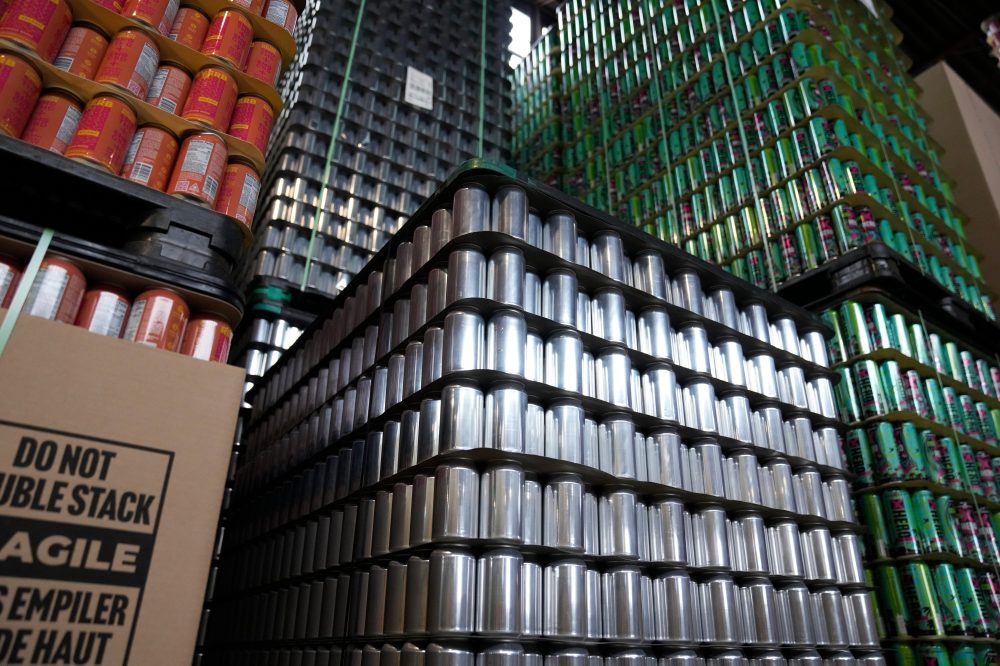
At Revolution Brewing in Chicago, aluminum used for cans costs as much as the beer ingredients due to metal tariffs Trump imposed that aren’t affected by the Supreme Court decision. Although the cans are manufactured in Chicago, the aluminum originates from Canada, explained Josh Deth, the brewery’s managing partner.
Tariffs represent just one challenge for his business, which also deals with fluctuating barley prices and declining craft beer demand.
“Everything kind of adds up,” he noted. “The beverage industry needs relief here. We’re getting crushed by the prices of aluminum.”
Italian wine producers severely affected by the tariffs received the Supreme Court decision with doubt, cautioning that it might only increase trade uncertainty with the United States.
The U.S. represents Italy’s largest wine market, with sales tripling in value over the past two decades. Potential EU tariffs, which the Trump administration initially threatened could reach 200%, caused widespread industry concern that persisted even after the U.S. reduced, delayed, and negotiated lower rates.
“There is a more than likely risk that tariffs will be reimposed through alternative legal channels, compounded by the uncertainty this ruling may generate in commercial relations between Europe and the United States,” explained Lamberto Frescobaldi, president of UIV, a trade organization representing over 800 winemakers.
Throughout Europe, initial responses centered on renewed disruption and confusion regarding costs for businesses exporting to America.
Trump’s tariffs could affect pharmaceuticals, chemicals, and automotive parts, noted Carsten Brzeski, an ING bank economist. “Europe should not be mistaken, this ruling will not bring relief,” he warned. “The legal authority may be different, but the economic impact could be identical or worse.”