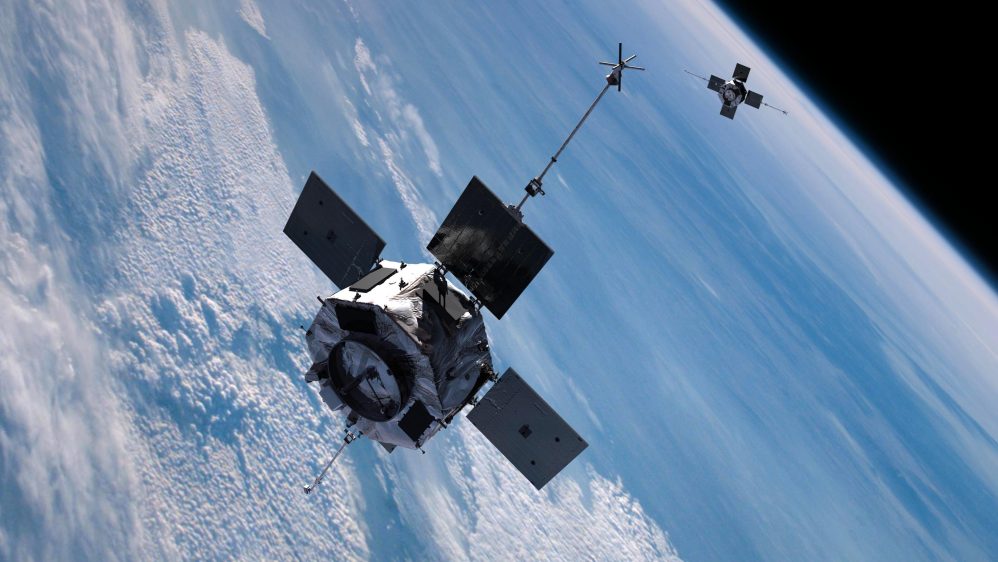

CAPE CANAVERAL, Fla. (AP) — A decommissioned NASA research satellite made an uncontrolled descent from space Wednesday, crashing into the Pacific Ocean.
According to the U.S. Space Force, the Van Allen Probe A satellite fell to Earth in waters located west of the Galapagos Islands.
NASA officials predicted that portions of the 1,323-pound (600-kilogram) satellite would survive atmospheric reentry, though the majority would incinerate during its fall through Earth’s atmosphere. The agency calculated the odds of the debris causing injury to people at 1-in-4,200.
The satellite’s companion spacecraft, Van Allen Probe B, continues to circle Earth but is no longer operational.
Both satellites began their mission in 2012, traveling through Earth’s surrounding Van Allen radiation belts to conduct scientific research for seven years until they stopped working.
After the spacecraft exhausted their fuel supplies in 2019, NASA projected they would continue orbiting until 2034. However, heightened solar activity in recent years accelerated the A probe’s return to Earth, according to the space agency. The B probe is projected to fall back to Earth no earlier than 2030.
According to Dutch scientist Marco Langbroek, predicting satellite reentries is always challenging, but this particular case proved exceptionally difficult due to the spacecraft’s irregular, elliptical orbital path.