
Twenty-five-year-old Shula Jassell from Southern California feels self-conscious about her chin size and has thought about getting filler injections to enhance it.
However, when she considers the reality of repeating the cosmetic treatment annually — since the effects wear off after about a year — she contemplates whether a surgical implant might be more sensible, despite her fear of going under the knife.
“I just try to remember self-love, you know? Beauty is in the eye of the beholder,” she says while working through her internal conflict and deciding against any procedures for the time being.
Recent technological progress has made different types of body modification more available to the general public — and unavoidable on social media feeds.
With treatments like Botox injections, plastic surgery procedures, and weight-loss drugs such as Ozempic becoming more widespread, individuals — predominantly but not solely women — are wrestling with the moral and philosophical questions surrounding these interventions in their endless pursuit of attractiveness, youthfulness, and social acceptance.
“We need to have a wider conversation about how to think about this in a way where we’re not putting the burden squarely on women, while also not taking away their moral agency,” said Natalie Carnes, a feminist theologian at Duke Divinity School. “Beauty is something that’s good. And beauty is something that is good to pursue. Botox and Ozempic and face-lifts, they’re all ways of really narrowing the cultural ideals of beauty.”
Major religious institutions have provided minimal formal guidance or clear restrictions regarding these procedures. However, an increasing number of theologians, philosophers, and bioethicists are advocating for more discussions about these treatments and operations.
This past March, the Vatican issued a statement on Christian anthropology condemning the “cult of the body.” “Once modified, often with relentless frenzy, the body becomes a body-object in which the person-subject mirrors themselves, creating a relationship in which the person is no longer his or her body but ‘owns’ a body,” it said.
Interest in aesthetic surgery throughout the United States has grown recently among people of all ages and ethnic groups, according to Dr. C. Bob Basu, president of the American Society of Plastic Surgeons. “Forty years ago, perhaps people would think, ‘Cosmetic surgery is for the superrich or the celebrity elite. It’s not for regular folk.’ That’s not the case anymore.”
Among the most significant trends he’s observed is younger individuals choosing these interventions.
“They’re being proactive and thinking about preventive measures, whether it be baby Botox at a younger age to prevent wrinkles from starting or maybe considering a deep plane face-and-neck-lift in the late 30s or early 40s, rather than waiting until you’re in your 60s,” he said.
Despite becoming increasingly common, many bioethicists report that plastic surgery receives little attention during their education.
“If you’re getting into bioethics and you rotate to learn about medicine, you go to the ICU, you go to places where the palliative care is for dying people, you’re looking at transplants. Nobody rotates to plastic surgery,” said Arthur Caplan, founding head of the Division of Medical Ethics at New York University Grossman School of Medicine.
Consequently, plastic surgeons frequently must establish their own ethical guidelines for acceptable procedures without extensive specialized moral training.
Numerous faiths discourage vanity while encouraging humility, which can shape perspectives on cosmetic procedures.
Dr. Jerry Chidester, a member of The Church of Jesus Christ of Latter-day Saints, observes varied viewpoints on plastic surgery within his religious community. While some conservative interpretations might discourage such interventions, Chidester notes this perspective conflicts with the general cultural environment of Salt Lake City, where he practices. Multiple research studies indicate the region has an unusually high concentration of plastic surgeons and procedures relative to population.
When patients struggle with surgical decisions, Chidester advises them to ignore others’ opinions.
“I’m like, ‘Look, if you want to do this or not, it’s up to you,’” he said. “It’s literally your body. Who cares if they think you’re doing it for vanity or for function or whatever? It is none of their business.”
Dr. Sheila Nazarian, a Jewish board-certified plastic surgeon, draws upon her understanding of Torah passages when considering appropriate circumstances for body modification.
“If it’s bringing distress, then it’s OK,” she said. “My patient population, they’re all pretty well adjusted, happy, successful, intelligent people. But they need help with one little thing that they’d just rather not think about anymore.”
Dr. Michael Obeng, a Christian practitioner, has witnessed a remarkable change in how people view cosmetic procedures during his nearly two decades of practice.
“Now people are not even hiding it. They show their plastic surgery as a badge of honor, like somebody wearing their expensive bag,” he said. “We are aging slower and of course we are working much longer than our moms and grandmothers worked. In the marketplace, we have to look presentable.”
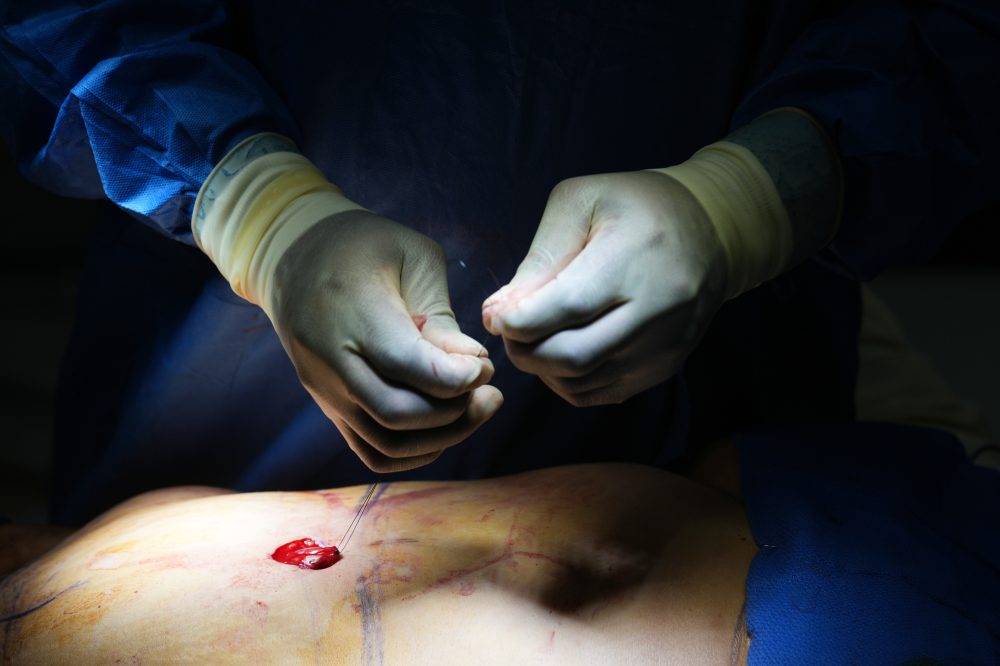
Obeng, a board-certified surgeon practicing in Beverly Hills, performs various operations from abdominoplasties and Brazilian butt lifts to rib removal procedures. He reports rarely experiencing conflict between his religious beliefs and professional duties. This changed in 2018 when he reached a “crossroads” while considering his willingness to perform certain gender transition surgeries.
He consulted multiple pastors and religious leaders for guidance. “Nobody could give me an answer,” he recalled.
His faith eventually guided him to restrict his practice to certain gender-related procedures like breast augmentation while avoiding genital gender-affirming surgeries, which he considers more difficult to reverse.
Ivory Kellogg, a 29-year-old actress in Los Angeles, struggles with conflicting feelings as a woman considering cosmetic treatments.
“There’s this expectation that once you hit 35, you think about doing a mini face-lift. That’s a lot of pressure,” she said. “At the same time, I do want women to feel like they’re allowed to do whatever they want. Like if you want to have a face-lift, that’s your prerogative.”
While choosing these procedures is frequently presented as an individual choice, many specialists argue the situation is far more complex.
“It’s important to think about how those choices are constrained and to think about the social pressures,” said Abigail Saguy, a sociologist at the University of California, Los Angeles. “This is a social issue. It is a collective problem. But it’s continually treated as an individual issue and what individual people should do.”
Sometimes, as with medications like Ozempic, these treatments can provide genuine health advantages. However, as their application extends beyond medical necessity, concerns emerge about healthcare resource allocation.
Dr. Aasim Padela, who researches bioethics and Islamic philosophy at the Medical College of Wisconsin, believes broader discussions are essential. His main concerns involve how the medical profession suffers and how resources become misallocated when society prioritizes cosmetic surgery.
“The profession is supposed to be about restoring health or preventing loss of health,” he said. “Certain types of procedures, body modifications, interventions — whatever you want to call them — may not meet those goals or even be aimed at those goals.”