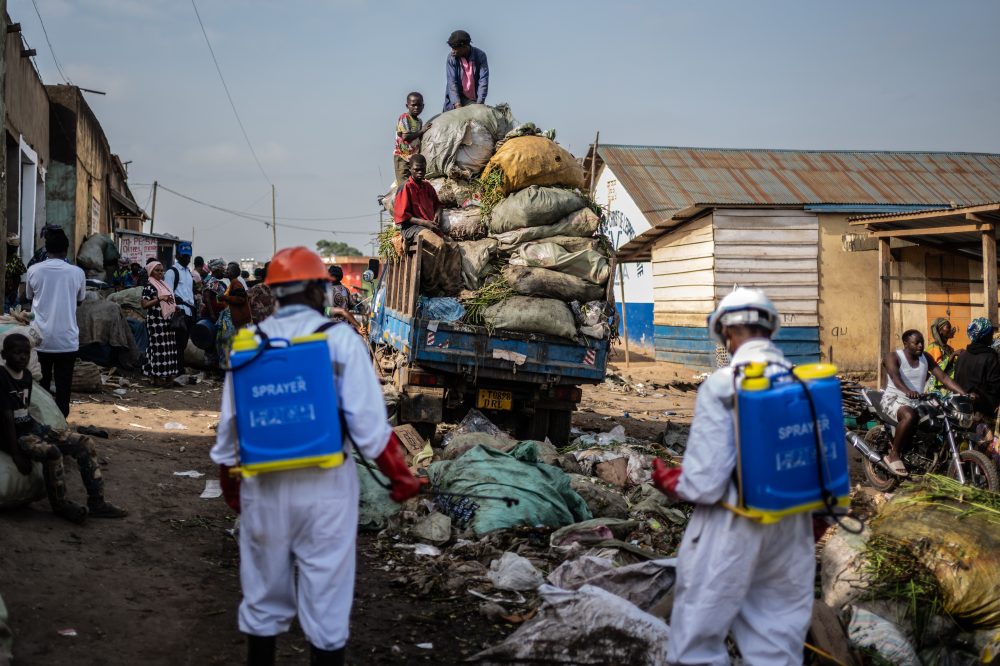

Fire attacks on Ebola treatment facilities in eastern Congo demonstrate how health officials confront multiple severe challenges — including community resistance — while attempting to contain an outbreak of an infectious disease that has been designated a global health emergency.
The destruction of treatment centers in two communities at the outbreak’s center reflects frustration in an area plagued by violence from armed rebel groups, massive population displacement, governmental breakdown and international aid reductions that experts say have weakened health facilities in at-risk communities.
“A devastating set of emergencies are converging,” said the Physicians for Human Rights nonprofit.
Here’s an examination of the ongoing crises in eastern Congo that have created one of the world’s most severe humanitarian disasters, and how they are now impacting efforts to combat a rare strain of Ebola:
Eastern Congo has experienced violence from dozens of different rebel groups for years, some with connections to foreign nations or Islamic State.
The Rwanda-backed M23 rebels maintain control over portions of the region. Although the Congolese government retains significant control over northeastern Ituri Province, where the Ebola outbreak is centered, that authority remains fragile. The Allied Democratic Forces, a Ugandan Islamist organization connected to Islamic State, ranks among the dominant rebel groups there and has conducted violent attacks on civilian populations.
Prior to the outbreak, Doctors Without Borders reported in their evaluation of Ituri’s situation that security had deteriorated recently, forcing medical personnel to evacuate and creating overwhelmed healthcare facilities with “catastrophic” conditions in certain areas.
Almost 1 million residents in Ituri have been forced from their homes due to conflict, according to the United Nations humanitarian office.
This means the current Ebola outbreak is “unfolding in communities already facing insecurity, displacement and fragile health care systems,” said Gabriela Arenas, Regional Operations Coordinator at the International Federation of Red Cross and Red Crescent Societies.
There’s significant worry that the disease could reach the large displacement camps near the city of Bunia, where initial cases were identified.
Officials have reported over 700 suspected Ebola cases and more than 170 suspected deaths, primarily in Ituri. However, cases have emerged in two additional eastern provinces, North Kivu and South Kivu, where M23 maintains control, and also in neighboring Uganda.
This means portions of the Congo outbreak are being handled by the government while other areas are managed by rebel authorities, with various aid organizations providing assistance.
Health experts indicate that international aid reductions last year by the United States and other wealthy countries were catastrophic for eastern Congo due to its numerous challenges.
The reductions “reduced the capacity to detect and respond to infectious disease outbreaks,” said Thomas McHale, public health director at Physicians for Human Rights. Congo has experienced more than a dozen previous Ebola outbreaks.
Relief organizations combating this outbreak report lacking necessary equipment, including face shields and protective suits for health workers, testing supplies, and body bags plus other materials required to safely handle victims’ remains, which can be extremely contagious.
“We have made requests to different partners, but we have not yet really received anything,” said Julienne Lusenge, president of Women’s Solidarity for Inclusive Peace and Development, an aid group operating a small hospital near Bunia.
“We only have hand sanitizer and a few masks for the nurses.”
The Bundibugyo strain of Ebola virus causing the outbreak has no approved vaccine or treatment.
The destruction of two treatment centers by residents in the Rwampara and Mongbwalu areas — which report the highest case numbers — demonstrates how community opposition is further hampering response efforts.
Colin Thomas-Jensen, director of impact at the Aurora Humanitarian Initiative, suggested the attacks may reflect the “built-in skepticism and anger” of eastern Congo residents regarding how their region has been handled, enduring years of violence from foreign-connected rebel groups and failures by their government and international peacekeepers to provide protection.
Another source of frustration involves strict procedures surrounding burial of suspected Ebola victims, which authorities are overseeing wherever possible to prevent additional disease transmission when families handle bodies and people gather for funerals.
The initial burning of an Ebola center in Rwampara involved local youth attempting to recover their deceased friend’s body, according to witnesses and police. The witnesses reported the crowd accused the foreign aid organization of deceiving them about Ebola.
Officials in northeastern Congo have prohibited funeral wakes and gatherings exceeding 50 people to limit transmission, with armed soldiers and police now protecting some burials conducted by aid workers.