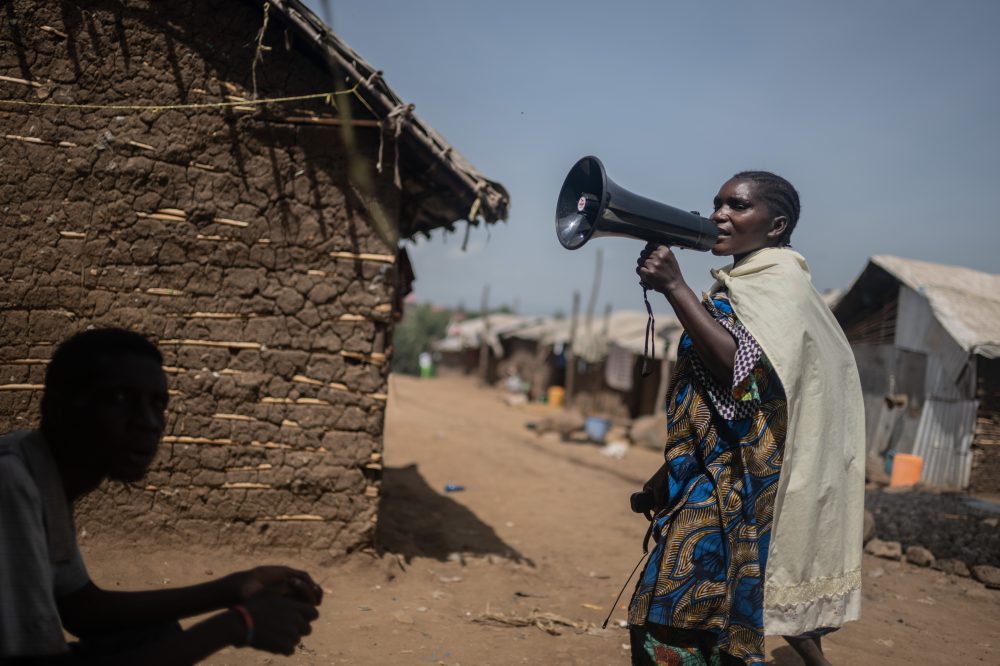

BUNIA, Congo — A massive displacement camp housing 10,000 residents in eastern Congo is battling an Ebola outbreak with severely limited resources: just a single handwashing station and one infrared thermometer.
Camp officials instruct residents to clean their hands before meals using soap when available. Those without soap are told to substitute with oatmeal or sand for hand cleaning.
“My fear is that we are here with nothing to protect ourselves. We have no protection, no water or soap, and we live near garbage,” said Francine Leve Janguzi, a resident of the ISP camp, speaking to reporters while demonstrating a non-functioning water tap surrounded by makeshift shelters.
Emergency supplies are being transported to Ituri province as relief organizations and medical teams work to control the infectious disease outbreak, which has been classified as a global health emergency.
However, emergency responders worry the virus could reach the crowded displacement facilities near Bunia, where thousands live in cramped conditions lacking basic sanitation resources.
“Eastern DRC’s years of conflict and displacement have left health systems on their knees, and that makes containing this outbreak all the harder,” stated Heather Kerr, Congo director with the International Rescue Committee.
Conflict in Ituri has forced nearly one million people from their homes, according to United Nations data.
This means the Ebola crisis is “unfolding in communities already facing insecurity, displacement and fragile healthcare systems,” explained Gabriela Arenas, a regional coordinator at the International Federation of Red Cross and Red Crescent Societies.
Most ISP camp residents — named for its location near the Higher Pedagogical Institute, or Institut Superieur Pedagogique in French — fled their villages in Djugu territory after attacks by CODECO, among several armed groups active in the area.
“I’ve been here for eight and a half years. Now we’re hearing about Ebola,” camp resident Janguzi said. “Look at the state of where we’re sleeping. We don’t have any help whatsoever. We don’t have soap or water, yet we’re told to wash our hands regularly and be clean.”
No vaccine or treatment exists for the uncommon Bundibugyo variant of Ebola, which has been circulating undetected for weeks in eastern Congo. Traditional testing methods have difficulty identifying the Bundibugyo strain.
More than 1,000 suspected cases and at least 220 fatalities have been documented through Tuesday, including seven confirmed cases in Uganda. The World Health Organization and field aid groups believe the actual outbreak scope is significantly larger.
Ebola spreads through contact with bodily fluids including vomit, blood or semen. The resulting illness is uncommon but serious and frequently deadly. Signs include fever, headache, muscle pain, weakness, diarrhea, vomiting, stomach pain and unexplained bleeding or bruising.
Eastern Congo has endured years of violence from numerous separate rebel and militant organizations, some connected to foreign nations or the extremist Islamic State group.
The Rwanda-backed M23 rebels control portions of the region. Though the Congolese government maintains general authority over northeastern Ituri Province, the Ebola outbreak’s center, that authority remains fragile. The Allied Democratic Forces, a Ugandan Islamist organization linked to IS, dominates as a rebel group there and conducts violent attacks on civilian populations.
Prior to the outbreak, humanitarian organization Doctors Without Borders reported in an evaluation that Ituri’s security situation had deteriorated recently, forcing medical staff to evacuate and creating overwhelmed health centers and “catastrophic conditions” in some areas.
Gérard Maki, a community leader in the camp, told reporters the disease creates tremendous fear. “I’ve learned that there’s no cure, which is why it scares me. … Our government should also do everything possible to find a solution to this disease.”