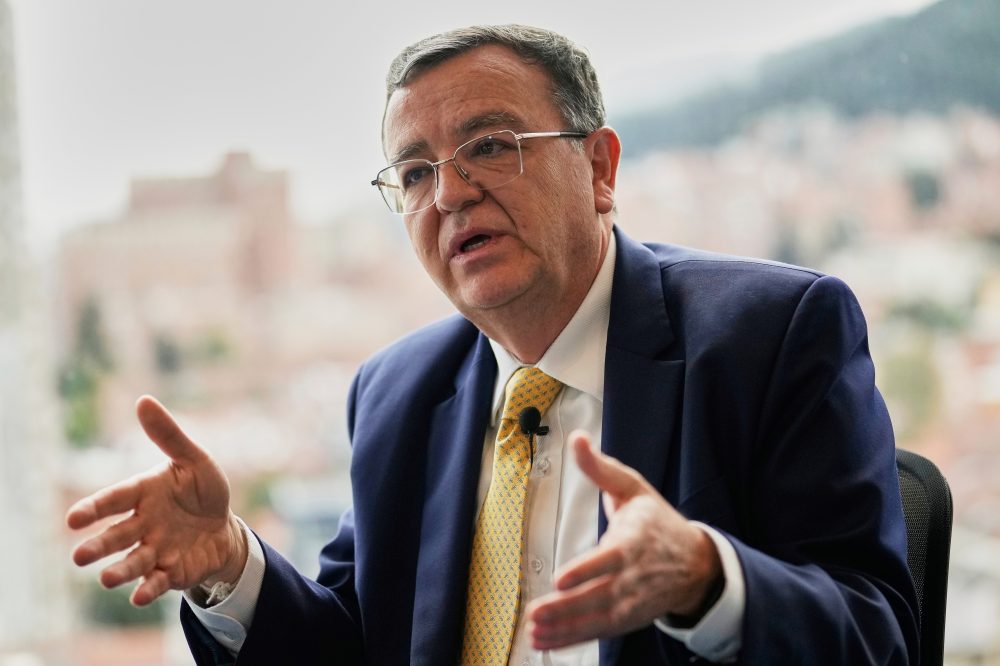

BOGOTA, Colombia — A decade after Colombia reached a landmark peace agreement with a now-defunct rebel organization, the court established to address crimes from that conflict is in jeopardy — threatened by a newly elected president who wants to shut it down.
The court, officially called the Special Jurisdiction for Peace, or SJP, has been a source of national controversy ever since it was created, much like the peace deal itself with the rebel group known as the Revolutionary Armed Forces of Colombia, or FARC.
Colombia’s president-elect, Abelardo de la Espriella — who has received an endorsement from U.S. President Donald Trump — has called the tribunal a “failed” institution. However, analysts and legal professionals caution that dismantling it will be far from straightforward, given both constitutional protections and international legal commitments.
The court is shielded by Colombia’s Constitution and has the backing of the International Criminal Court, the world’s foremost international justice body. That court wrapped up its own nearly 20-year preliminary investigation into Colombia back in 2021, determining that the country was fulfilling its global justice responsibilities — a conclusion largely based on the Colombian tribunal’s progress.
Alejandro Ramelli, who leads the tribunal, told The Associated Press that the closure of the international investigation was conditional on the SJP continuing its operations. Without that, he said, Colombia would be in violation of its obligations to the world court.
The SJP’s mission is to investigate war crimes and crimes against humanity through 2028, followed by an additional five-year window for trials. After that, Colombia’s Congress would weigh in on whether to extend the court’s term by another five years.
Despite the peace agreement, Colombia has not fully escaped its cycle of violence. Armed criminal groups continue battling over drug trafficking revenues and illegal mining operations. These include FARC splinter factions that rejected the peace deal, the National Liberation Army — known as the ELN — and the Clan del Golfo cartel.
Those who support the tribunal view it as a historic achievement that helped bring Latin America’s longest-running guerrilla conflict to an end and brought accountability for serious atrocities. Critics, on the other hand, contend the court is unfairly biased against former military members.
Since beginning operations in 2018, the SJP has taken on cases involving more than 14,000 individuals accused of crimes tied to the conflict. Roughly 70% of those are former FARC fighters, 29% are former members of the country’s security forces, and the remainder are civilians.
Iván Cancino, designated by de la Espriella to serve as justice minister, told radio station Caracol Radio on Wednesday that he has no plans to eliminate the SJP outright, but intends to hold it accountable for results and scrutinize how it spends its budget.
Outgoing President Gustavo Petro has also been critical of the SJP during his time in office, though this week he posted on X that the tribunal’s budget “must be strengthened,” adding that “establishing the judicial truth about the conflict is fundamental to national reconciliation.”
Ramelli warned the AP that cutting the court’s funding “would seriously affect the fundamental right of access to justice,” particularly for victims of the armed conflict. He also cautioned that an “abrupt termination” of the court would leave the legal process in limbo.
He highlighted key rulings the court has already delivered — including findings against the former FARC leadership for more than 21,000 kidnappings, and against a group of former military personnel for more than 100 extrajudicial killings. In both instances, those found responsible acknowledged their actions and received alternative sentences — no prison time, but requirements to carry out projects that benefit victims. The court has also issued a 20-year prison sentence to a former soldier who denied involvement in extrajudicial killings.
“What is the value of the truths uncovered through the judicial process?” Ramelli said. “We now know the true scale of FARC kidnappings, the recruitment of more than 18,677 children, the sexual violence committed by the FARC and the extrajudicial killings carried out by security forces.”
“The country simply did not know the full extent of these crimes,” he added.