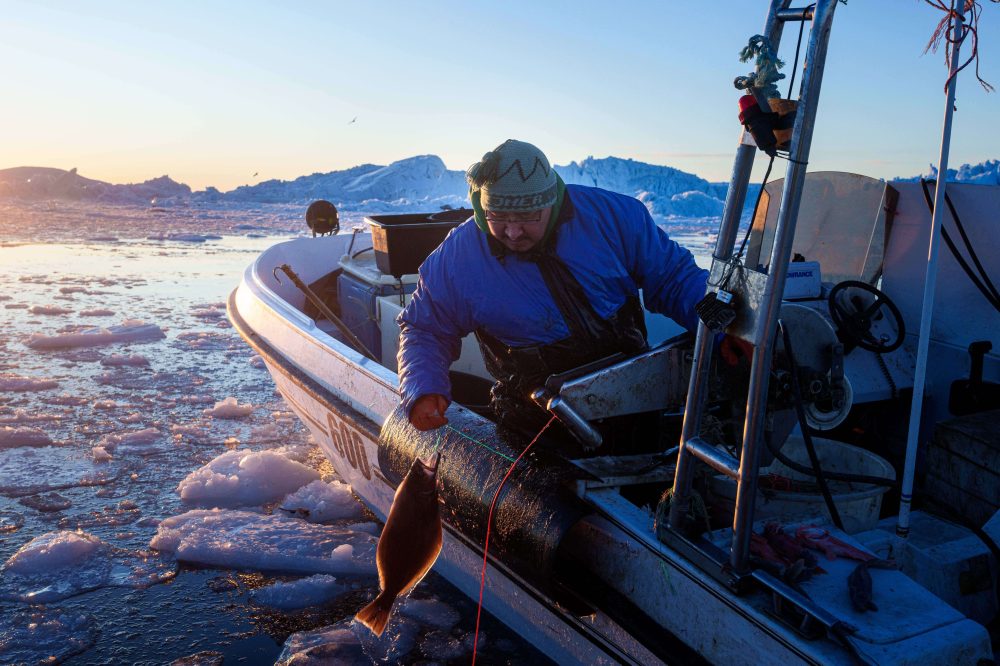

ILULISSAT, Greenland — Fisherman Helgi Áargil can no longer predict what conditions await him during his five-day fishing trips on Greenland’s fjords, accompanied only by his dog Molly and the shifting northern lights overhead.
A year ago, his vessel became trapped in glacier ice that had broken away. This season brought unusually wet conditions instead. His earnings fluctuate wildly — sometimes netting around 100,000 Danish kroner (approximately $15,700) per trip, other times returning empty-handed.
The rapidly shifting Arctic climate is creating new uncertainties for Greenland, Denmark’s semiautonomous territory that has drawn attention from U.S. President Donald Trump regarding potential ownership.
Despite changing political approaches to Greenland, global efforts to address climate change have fallen short. The Arctic region experiences warming at a rate exceeding all other areas worldwide, fueled by fossil fuel consumption.
The implications for Greenland’s fishing-dependent economy remain unclear. The industry generates up to 95% of the territory’s exports, with major markets including China, the United States, Japan, and Europe.
Bundled in wool against the bitter wind, Áargil described his methods for catching halibut and cod. Other valuable species include shrimp and snow crab, which can span over a meter (3 feet) including their legs.
Ice fishermen, who comprise half the local fishing sector, face the most severe disruptions to their traditional practices.
“My father was fishing from the sea ice” measuring one and a half meters (nearly 5 feet) thick, remembered Karl Sandgreen, director of the Icefjord Center, which tracks regional climate impacts from Ilulissat.
According to Sandgreen, that sea ice began vanishing around 1997, prompting fishermen who previously drilled through ice to transition to boat-based operations. While boats enable access to broader fishing areas, they bring additional expenses and contribute to pollution that worsens global warming.
Fishing defines Greenland’s communities. Each town and village centers around harbors where fishermen dock to market their catches. Prior to departing, some collect containers from local fishing companies for storing their haul, which gets lifted by winch from boats to processing facilities in the capital city of Nuuk.
Toke Binzer, who leads Royal Greenland — the island’s largest employer — expresses growing concern about a future with severely reduced sea ice. Such conditions could drive traditional fishermen toward bigger settlements and commercial fishing operations.
The current dilemma involves supporting traditional fishermen when conditions present “too much ice to sail, too little to go out on,” Binzer explained. This unpredictability has already created a “huge” challenge.
Royal Greenland currently provides loans to fishermen for boat purchases, which they repay through catch sales, according to Binzer.
A widespread shift to boat fishing might boost the economy but risks overfishing, warned Boris Worm, a marine biodiversity specialist at Dalhousie University in Canada.
Greenland already shows evidence of excessive near-shore fishing, with halibut sizes decreasing, Binzer noted. Worm concurred, identifying this as a typical overfishing indicator where larger fish are harvested, leaving smaller, younger specimens.
This issue may intensify as receding ice increases fish accessibility. Fish populations might grow as warmer temperatures increase rainfall and ice melt, delivering more nutrients to plankton that fish consume, Worm explained.
However, he cautioned that fish behavior may become less “predictable” than previously, potentially seeking alternative food sources if they can no longer consume algae that develops beneath sea ice.
Aboard his vessel near Nuuk, Áargil identified another obstacle: Rising temperatures force some fish species deeper as they seek cooler waters, making them harder to catch.
“It’s too warm,” he observed, gazing at the surrounding fjord hills. “I don’t know where the fish is going, but there’s not so much.”
Alternative economic opportunities remain limited in Greenland. Tourism is expanding but represents a small fraction of the overall economy.
Cultural traditions also factor into climate change concerns. Dog sledders now face land restrictions when sea ice is absent.
“It’s really important for many Greenlanders to have the ability to go out and sail,” stated Ken Jakobsen, manager of Royal Greenland’s Nuuk facility. Fishing remains the “most important” activity.
In the capital city alone, over 1,000 boats occupy the harbor during summer months — within a territory whose entire population barely exceeds 50,000 people.