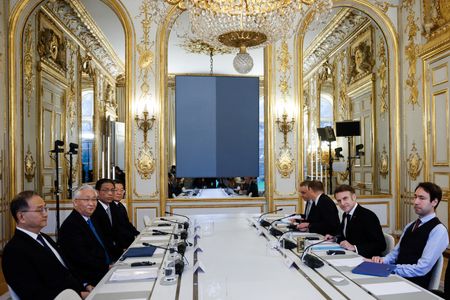

Chinese Vice Premier Zhang Guoqing participated in a video conference Thursday hosted by French President Emmanuel Macron focused on worldwide economic imbalances, occurring just days before G7 countries convene in France to address concerns about inexpensive Chinese exports flooding their markets.
The French leader, who will host the Group of Seven summit next week in Evian-les-Bains, has attempted to work with Beijing in a final effort at cooperation before the European Union determines whether to strengthen its trade policies regarding China, according to French officials.
“Our common goal should be clear. It is to put the global economy back on a stronger growth path. I think we all share this objective. In order to deliver, we need obviously some domestic policies and effective international co-operation,” Macron stated as the video conference began.
“Co-ordination is key, and if they (global imbalances) are not addressed through a co-ordinated approach among the world’s major economies, these imbalances risk unwinding in a disorderly manner, leading to abrupt economic and financial adjustments,” he continued.
European Union leaders will convene directly following the June 15 to 17 G7 meeting, with China expected to be a major topic of discussion.
Zhang’s participation in the video conference titled “Global Convergence for Growth,” which was confirmed by a Chinese foreign ministry spokesperson, represents an uncommon example of China working with the G7 nations of France, Britain, Canada, Germany, Italy, Japan and the United States, along with the EU.
Beijing has consistently criticized the organization as illegitimate for addressing global issues and for failing to represent the world order properly.
European concerns are mounting over China’s record trade surplus and advancement in higher-value industries, as its exports of electric vehicles, lithium-ion batteries and other advanced technology products pose threats to European manufacturers, in what experts call a “second China shock” after its control of lower-value sectors in the 2000s.
China has stood by its industrial policies and dismissed claims that Chinese exporters receive unfair advantages from government subsidies. It maintains that other nations are violating international trade regulations by implementing unilateral tariffs.
Since December, the Chinese capital has welcomed leaders from five G7 countries in a series of high-level diplomatic meetings. Macron met with Chinese President Xi Jinping in Beijing during that period, urging him that China should assist in rebalancing economic relationships through cooperation, or Europe would face limited options beyond implementing more protective trade measures.
Nevertheless, EU countries remain split on their approach to China. Germany, Europe’s biggest trading economy, has traditionally resisted imposing tariffs on one of its primary export destinations. However, as Chinese automobile manufacturers compete more aggressively with German companies, some German legislators have started advocating for a firmer position toward Beijing.