
Four decades after the world’s most devastating nuclear disaster, a Ukrainian cleanup worker reflects on how radiation exposure forever changed his life and health.
Petro Hurin, now 76, was among the hundreds of thousands of workers known as ‘liquidators’ who were deployed to contain the aftermath of the Chernobyl nuclear plant explosion on April 26, 1986. The catastrophic reactor four blast released radioactive clouds that spread across much of Europe.
Hurin’s employer, a company providing excavation equipment and construction machinery, dispatched him to the Chernobyl exclusion zone in June 1986. Of the four dozen workers his company sent to the site, only five remain alive today, according to Hurin.
“Not a single Chornobyl person is in good health,” the 76-year-old explained. “It’s death by a thousand cuts.”
The initial blast and radiation exposure killed 31 power plant employees and firefighters within days, primarily from severe radiation poisoning. Since then, thousands more have died from radiation-linked diseases including cancer, though experts continue to debate the total casualty count and lasting health impacts.
Soviet leadership worked to minimize public knowledge of the disaster’s scope, even proceeding with the traditional May 1 parade in Kyiv, located approximately 60 miles south of the plant. Ukraine’s present-day government has criticized how Soviet officials mishandled the crisis and attempted to hide its severity.
While some of Hurin’s coworkers obtained medical exemptions to avoid Chernobyl duty, he volunteered to participate in the cleanup efforts.
“I realised that, however small my contribution might be, I was doing my bit to help tame this atomic beast,” he recalled.
During grueling 12-hour work periods, Hurin operated heavy machinery to move dry concrete mixed with lead – delivered to the site via river transport – onto trucks. The material was then taken to the reactor area where it was used to construct an enormous protective barrier designed to seal in the radiation.
“The dust was terrible,” Hurin remembered. “You’d work for half an hour in a respirator, and it would end up looking (brown) like an onion.”
Within four days of starting work, Hurin developed alarming symptoms including severe headaches, chest pain, internal bleeding, and a metallic taste in his mouth. Medical staff provided treatment, but after returning to work, he became so weak he could barely stand and feared death was imminent.
“I was brought to the hospital, and the doctors did a blood test first,” Hurin said. “They pricked all my fingers and a pale liquid came out, but no blood.”
Soviet medical officials refused to officially diagnose radiation poisoning, which was reportedly forbidden at the time. Instead, doctors attributed his condition to vegetative-vascular dystonia, a stress-related nervous system disorder.
Prior to the nuclear accident, Hurin had maintained perfect attendance at work, never requiring medical leave. Following his exposure, he spent approximately seven months moving between different medical facilities for treatment, including receiving blood transfusions.
His current medical conditions include anemia – frequently associated with radiation exposure – along with heart disease, pancreatic inflammation, and multiple other ailments.
Despite his health challenges, Hurin has exceeded typical life expectancy for Ukrainian men. World Health Organization data shows male life expectancy in Ukraine was 66 years in 2021, having dropped during the pandemic.
Today, Hurin and his wife Olha reside in Ukraine’s Cherkasy region. Though dealing with ongoing health issues, he continues playing the bayan, a traditional accordion, and composes music and poetry.
He remains in legal battles to obtain special disability benefits designated for nuclear disaster cleanup workers.
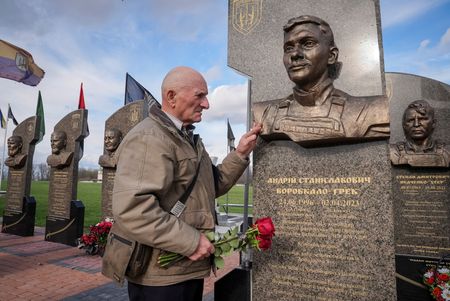
A more recent tragedy – Russia’s 2022 military invasion – has overshadowed much of his daily life. Hurin and Olha frequently visit a nearby memorial at Kholodnyi Yar honoring their grandson, Andrii Vorobkalo, a Ukrainian military member killed in combat at age 26.
The couple raised Andrii from age four after his mother relocated to Europe for work. When Russia launched its invasion in 2022, Andrii abandoned his employment in Greece to return home.
“He left everything behind and came to defend Ukraine,” Hurin stated while standing beside the memorial stone bearing his grandson’s name. “We think of Andrii all the time.”