
LONDON (AP) — Renowned British painter David Hockney, whose vibrant depictions of swimming pools bathed in California sunlight became defining images of modern art, passed away on Thursday, according to his representative. He was 88 years old.
Born in northern England, Hockney spent a significant portion of his career living in Southern California, where the bright, sun-soaked suburban landscapes became a central theme in his artwork.
In his later years, he relocated back to Europe, drawing fresh creative energy from the forested hills of Yorkshire where he grew up and the countryside of France’s Normandy region. He rose to become one of Britain’s most celebrated artists, with his pieces commanding record-breaking prices at art auctions.
Art historian Simon Schama observed that “the popularity and durability of David Hockney’s art, through all his shape-shifts and restlessly inventive experiments, are really no mystery.”
“His work is admired — loved is not too strong a word — by the millions who, worldwide, flock to see it because it presupposes an expectation of pleasure,” Schama wrote in an essay accompanying a 2025 Hockney exhibition in Paris.
His representative, Erica Bolton, confirmed he passed away just weeks before what would have been his 89th birthday.
Recognizable by his signature circular eyeglasses and platinum blonde hair, Hockney became a prominent figure in the dynamic British and American art communities of the 1960s before turning 30. His artwork was equally recognizable, often creating surreal environments of geometric light reflecting off water surfaces and windows, featuring human subjects portrayed in flattened, streamlined forms using matte acrylic paints.
“I’m excited every day,” he shared with the Los Angeles Times in 1979. “London has lots of dreary parts but I never find anything dreary in Los Angeles.”
Born on July 9, 1937, in Bradford, a major industrial center known for wool textile production, Hockney lived there for his first twenty years before attending London’s Royal College of Art. He gained recognition even before completing his studies, and art dealer John Kasmin signed him to his roster in 1961.
His creative inspirations spanned from Renaissance portrait painters to 19th-century English landscape artist J.M.W. Turner, Pablo Picasso’s Cubist innovations, and 20th-century American pop art movements.
During a visit to America in 1963-64, Hockney attracted attention with his contemporary interpretation of “A Rake’s Progress,” updating 18th-century artist William Hogarth’s painting series about a wealthy playboy’s adventures and ultimate ruin. The New York Times noted in 1964 that Hockney “brings Hogarth up-to-date with a vengeance and furnishes a good example of how younger artists like to marry text and picture with benefit to each.”
He shared with fellow pop artists a fascination with the sleek appearance of contemporary life. Similar to Andy Warhol’s use of Brillo boxes and Campbell’s soup cans, Hockney sometimes included commercial imagery, such as a British Typhoo Tea package featured in his 1961 “Tea Painting in an Illusionistic Style.”
Speaking to The New York Times in 1964, he expressed appreciation for New York’s emerging pop art movement while questioning his place within it.
“I’m just an ordinary artist,” he said. “I do admire American pop — in fact it seems that everything fresh-looking and vital in England these days has been coming from the U.S.” However, he maintained that he was still “very much an artist in the English tradition,” as he stated in 1995.
He compared his California relocation to historical precedent, noting that previous generations of English artists had traveled to Italy seeking brilliant light.
As an openly homosexual artist, Hockney examined sensual subjects, applying the same careful attention to young male figures that artists had traditionally given to female nudes for generations. Close friends and romantic partners often served as subjects, and some pieces drew inspiration from photographs in male fitness publications.
Early pieces like “We Two Boys Together Clinging” and “Two Men in a Shower” honored same-sex relationships during a time when homosexuality remained criminalized in Britain.
During his early career, the Museum of Modern Art in New York acquired two of his drawings.
“The moment I first sold pictures to earn a living, I felt rich. I’ve been rich ever since,” he shared with The Associated Press in 1995. “I didn’t have much money but I did what I wanted. … You are a rich man if you do the things you want to do.”
This artistic independence brought Hockney both critical praise and financial success, with his pieces selling for unprecedented amounts. In 2018, his 1972 work “Portrait of an Artist (Pool with Two Figures)” sold at Christie’s for $90.3 million, setting a record for a living artist at that time. In February 2020, another pool-themed painting, “The Splash” from 1966, brought 23.1 million pounds ($30 million) at Sotheby’s.
Beyond creating paintings of pools, Hockney also physically painted a pool when he designed the bottom of the swimming pool at the historic Hollywood Roosevelt Hotel in Los Angeles.
Though his most famous works featured American settings, he also captured British themes. He created multiple portraits of his parents. “Mr. and Mrs. Clark and Percy,” a 1971 double portrait featuring two English friends and their cat, ranked fifth in a 2005 BBC Radio-National Gallery online survey of Britain’s greatest paintings. It was the sole work by a living painter in the top ten.
Like many classical artists, he viewed drawing as an essential skill and regretted that it wasn’t taught as thoroughly as in the past.
“Human beings are the most interesting things we see, so they’re the hardest to draw,” he explained in a 1996 AP interview, noting that the finest drawings emerge when empathy exists between artist and subject.
His creative work extended beyond drawing and painting. He designed costumes and sets for theatrical and operatic productions, including a renowned “Tristan und Isolde” that premiered in 1987 at the Los Angeles Opera.
As a constant innovator, Hockney worked across drawing, painting, printmaking, photo collage, and video throughout his seven-decade career.
When he explored photography, he blended artistic forms, creating intricate collages like “Pearblossom Highway, 11-18th April, 1986,” composed of separate photographs of a desert road intersection.
“My photographer friends said it was a painting,” Hockney shared with the AP in 2001. “I said it’s a photograph; I used a camera.”
His photographic experiments inspired him to research and publish a 2001 book, “Secret Knowledge: Rediscovering the Lost Techniques of the Old Masters.” He proposed that throughout history, artists employed lenses and optical instruments to assist their drawing far more frequently than most art historians acknowledge.
Eventually, he began creating art on iPads, which became his preferred medium.
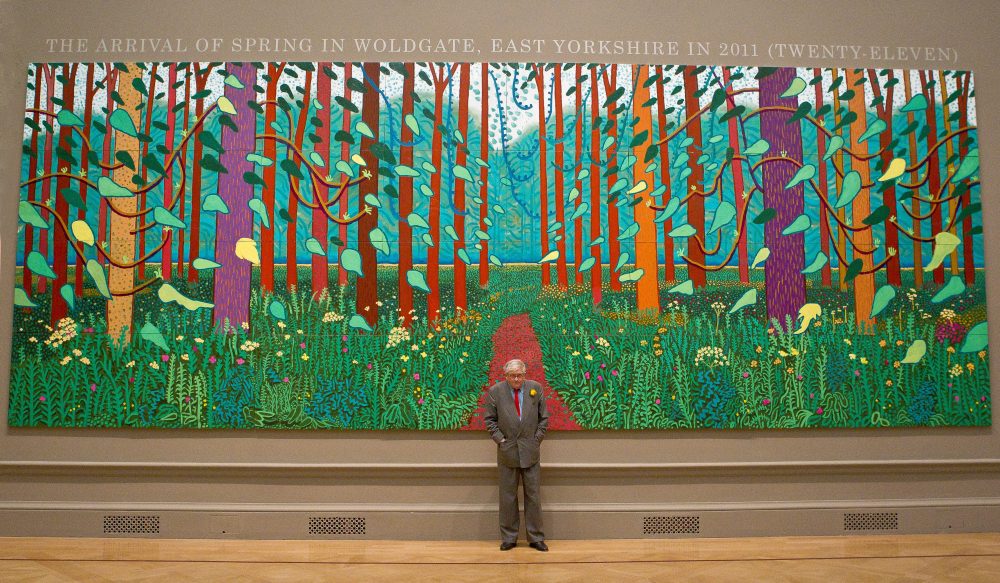
In the early 2000s, he revisited the countryside and forests of Yorkshire through a collection of vibrant landscape paintings that merged vivid colors with detailed attention to elements like snow on hillsides or flowers on hawthorn bushes. These works were featured in a 2017 exhibition at Tate Britain in London that drew half a million visitors and later traveled to the Pompidou Center in Paris and the Metropolitan Museum in New York.
Hockney drew upon English countryside imagery for his stained-glass window design at Westminster Abbey honoring the extended reign of Queen Elizabeth II. Finished in 2018, the Queen’s Window shows a landscape of flowering hawthorn trees in shades of blue, green, yellow, orange, pink, and red.
By this period, Hockney was widely regarded as Britain’s foremost living artist and a national icon. In 1997, the queen appointed him a Companion of Honour, a distinction reserved for 65 individuals “of distinction.”
In 2019, he relocated to Normandy, France, where during the 2020 coronavirus restrictions he created cheerful iPad illustrations of springtime for his friends. His message — “Do remember they can’t cancel the spring” — was displayed in neon lights across the Fondation Louis Vuitton in Paris when it presented a major Hockney exhibition that opened in April 2025.
The exhibition spanned from his first sold painting — a 1955 portrait of his father — through Los Angeles swimming pools to Yorkshire forests, friend portraits, opera stage designs, and numerous images celebrating spring’s arrival in Normandy.
Art curator Norman Rosenthal, who helped organize the Paris exhibition, described Hockney as “the Picasso of our times.”
“When I say that, people laugh at me, as Picasso was the archetypal artist of the 20th century,” Rosenthal explained to the Independent newspaper. “But David Hockney is also an incredibly popular artist whose work changes how we see things.”
A committed cigarette smoker who criticized government anti-smoking policies, Hockney protested when a poster for the 2025 exhibition was prohibited from the Paris Metro because it showed him with a cigarette.
Hockney experienced a minor stroke in 2012 and faced increasing hearing loss in his final years — something he claimed enhanced his visual abilities.
“If you lose one sense, you gain other senses, and I feel I could see space clearer,” he shared with the AP in 2017.
He maintained his artistic practice throughout his life.
“It’s my work that keeps me young,” Hockney told the Sun newspaper in 2017. “I’ve been a professional painter for 60 years. Sixty years of getting up every day and doing exactly what I want to do.”