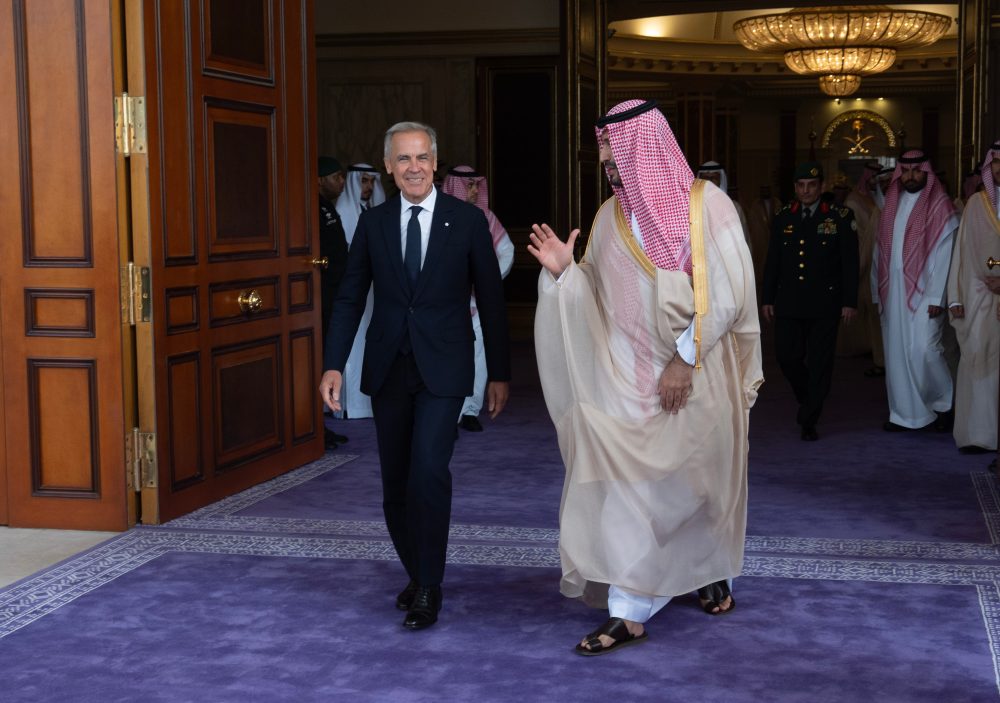

Canadian Prime Minister Mark Carney is standing behind his decision to visit Saudi Arabia, pushing back against critics and arguing that condemning nations from a distance accomplishes little. Speaking Thursday from the Saudi city of Jeddah, Carney called out-of-country lecturing “an ineffective strategy” — one that may feel good but produces no real results.
The trip marks the first time a Canadian head of government has traveled to Saudi Arabia in 26 years. While there, Carney sat down with Saudi Crown Prince Mohammed bin Salman, who holds the real power in the kingdom.
The visit comes as Carney works to broaden Canada’s economic relationships beyond its heavy dependence on the United States, looking for new trade partners and investment sources as U.S. President Donald Trump’s tariffs and threats to the U.S.-Mexico-Canada trade agreement put pressure on the existing arrangement.
“Lecturing countries from afar is an ineffective strategy,” Carney told reporters in Jeddah. “It’s satisfying, but it’s ineffective.” He was careful to add that direct engagement “doesn’t mean that we agree with everything that a country is doing.”
Saudi Arabia’s human rights record has been under an international microscope since the 2018 murder of Washington Post columnist Jamal Khashoggi. A U.S. intelligence assessment determined that Crown Prince Mohammed likely gave the green light for the operation — something Saudi Arabia continues to deny.
Carney also told reporters in Jeddah that the global landscape is growing more unstable and fragmented, making it essential for Canada to build stronger ties with partners outside the United States, its biggest trading partner.
The approach stands in sharp contrast to that of former Prime Minister Justin Trudeau, whose government openly criticized Saudi Arabia’s human rights practices in 2018. That public rebuke triggered a five-year diplomatic falling-out, during which Riyadh expelled Canada’s ambassador, froze new trade and investment deals, and pulled thousands of Saudi students from Canadian schools. The two countries didn’t fully restore diplomatic relations until 2023.
Carney insisted he takes human rights seriously, pointing to a consular case he raised personally with Turkish President Recep Tayyip Erdogan on the sidelines of the NATO summit in Ankara, Turkey’s capital, earlier this week. “Because I was with the president, it was addressed favorably. If I sat in Ottawa … I wouldn’t have had that conversation. I wouldn’t have had that impact. That’s a small example,” he said.
Canada’s Foreign Affairs Minister Anita Anand, who traveled with Carney to Saudi Arabia, said she also brought up human rights concerns and consular cases in her own meetings.
Saudi Arabia, for its part, has been eager to draw in foreign investment as Crown Prince Mohammed pushes an ambitious plan to shift the kingdom’s economy away from its reliance on oil. Saudi Investment Minister Fahad Al-Saif described Canada as “a trusted long-term partner” and said Saudi investors bring “patient capital” to the table.
On Thursday, Carney took part in a signing ceremony for 13 commercial deals and memorandums of understanding between Canadian and Saudi companies and institutions — including engineering firms Hatch and AtkinsRéalis. The prime minister’s office said those agreements are valued at more than 1 billion Canadian dollars, or roughly $710 million U.S.
Nelson Wiseman, a professor emeritus at the University of Toronto, offered perspective on Carney’s approach. “Carney says he is taking the world as it is,” Wiseman said. “It doesn’t mean looking beyond human rights; it means being realistic about what preaching about it to authoritarian leaders can accomplish.”
Carney is scheduled to return to Canada on Friday.