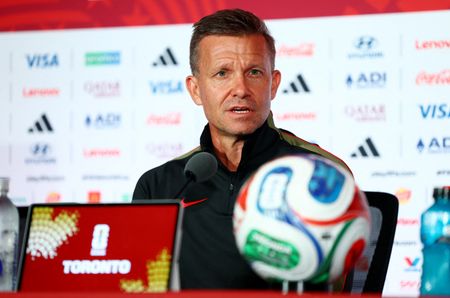

Canada’s national soccer team coach Jesse Marsch has a straightforward response for those questioning whether his squad can handle the expectations of hosting World Cup matches: his players don’t just accept the pressure, they welcome it.
The Canadian team will take the field at Toronto Stadium on Friday for their opening World Cup match on home turf, carrying the hopes of an entire nation. Their preparation has been marked by significant time spent dealing with injuries rather than focusing solely on training, but Marsch remains confident.
“If you do this for a living, this is where you want to be,” Marsch stated on Thursday before the Group B matchup with Bosnia and Herzegovina.
“I came to Canada to be the coach because I liked these guys and I believed they could fit the way I wanted to play, but I came here to lead them in the World Cup — in the home World Cup. I wanted this responsibility.”
The team’s most significant injury worry centers on captain Alphonso Davies, who won’t play Friday due to a hamstring problem he sustained during Bayern Munich’s Champions League semi-final match last month. However, Marsch indicated that Wednesday’s MRI results were positive.
“We’re getting ready to ramp things up,” the American coach explained.
“He will not be available for tomorrow, but he’s showing, like he always has, a real good ability to recover from muscle injuries. We’re really hopeful that over the next days and weeks we can accelerate things and give him a chance to contribute here soon.”
Midfielder Ismael Kone caused momentary concern when he departed Wednesday’s training session early before it had truly started, but Marsch quickly addressed those worries with some frustration.
“He just felt a little sick, so we sent him home because we were doing nothing on the day, and it was like a five-star red alert,” Marsch explained. “Ismael trained today, he’s totally fine, he’s ready to go.”
Defender Moise Bombito, whose comeback from a broken leg seemed to hit a setback after playing only 30 minutes in a preparation game against Uzbekistan, will also be available if needed.
“He’s not fully at 100%, but he’s reached his top speed,” Marsch noted. “I don’t see any reason that a week from now he’s not ready to even be considered as a starter.”
Player discipline will also be a focus for Marsch. Canada has received several red cards in their previous 11 matches, and with the excitement of a home tournament opener, Marsch acknowledged the potential danger.
“Certainly one of the best ways to derail a tournament for any team is red cards,” he said.
“We do need to be aggressive and play our way with speed and power, but we also need to make sure that we keep our heads and don’t have any reckless tackles, extracurricular situations, or emotional reactions that get us in any kind of trouble with cards.”
Canada has shown marked improvement since Marsch assumed control in 2024, particularly reaching the Copa America semi-finals that same year. This marks Canada’s first appearance in consecutive World Cups, though they continue seeking their first tournament point following six losses across the 1986 and 2022 competitions.
Marsch expressed confidence in his team’s preparation. “We are ready to play some big games,” said Marsch. “We are ready to make our country proud, make our fans proud. We are ready to go after this.”