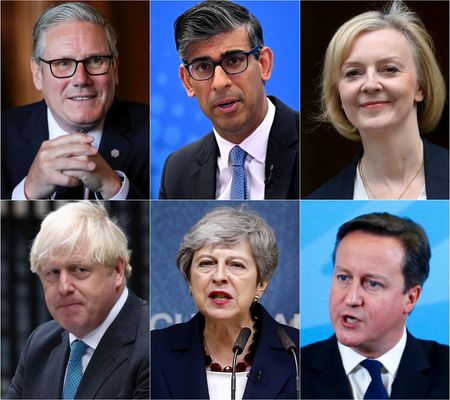

On a Monday morning in London, Keir Starmer stepped out into the sunlight on Downing Street, surrounded by his staff and his wife, his voice breaking with emotion as he announced he was no longer the right person to lead the United Kingdom.
Starmer, who came to power in one of the largest electoral landslides in British political history, is leaving office after fewer than two years — making him the sixth British prime minister to resign in just a decade. That rate of leadership turnover is the highest the country has seen in nearly 200 years.
Like those who came before him, Starmer was unable to quiet widespread public frustration over living standards that have barely moved since the 2008 financial crisis. At the same time, a swelling national debt — driven by global crises including the COVID-19 pandemic — has severely limited what any government can spend. The ongoing failure to address illegal immigration has added another layer of political tension and division.
Anthony Seldon, a historian who has written extensively about British prime ministers in works including “The Impossible Office,” told Reuters that Britain finds itself in a very deep hole after Starmer and predecessors such as Liz Truss and Boris Johnson all failed to establish the public trust and clear direction the country needs.
Looking ahead to who might follow Starmer, Seldon offered a sobering assessment: “If Andy Burnham fails as prime minister, the outlook for Britain is bleak.”
There was a time not long ago when Britain was considered a model of political and economic stability — home to leaders like Margaret Thatcher and Tony Blair, whose combined 21 years in power helped define modern Britain. But the global financial crisis hit the country especially hard, given how heavily the British economy leaned on its financial sector. The years of public sector austerity that followed left the nation poorly equipped to handle the challenges that came next.
In fact, the last prime minister to win an outright election victory — without relying on another party’s support — and serve a full term was Blair, between 2001 and 2005. Britain, which once laughed at Italy’s famously unstable parade of leaders, now finds itself looking at Italian Prime Minister Giorgia Meloni with something closer to envy. She is on track to become the longest-serving head of government in the history of the Italian Republic, with nearly four years in power.
While many political observers trace Britain’s instability to the Brexit vote a decade ago to leave the European Union, Jill Rutter — a former finance ministry official and senior fellow at the Institute of Government think tank — argues the trouble really began with the financial crash.
“There has just been a general sense that we don’t see our lives getting better and we don’t see the lives of our children getting better,” she said. “And each government since has seemed to be unable to change that.”
The 2016 decision to exit the EU upended Britain’s long-standing foreign policy approach and reignited the independence movement in Scotland, where voters had chosen to remain in the bloc. The financial toll of responding to the COVID-19 pandemic and Russia’s full-scale invasion of Ukraine then pushed national debt to just under 100% of the country’s GDP.
While countries like Japan, Italy, the United States, and France all carry higher debt-to-GDP ratios, Britain faces steeper borrowing costs — partly due to persistent inflation and investor concerns about the country’s reliance on foreign capital to cover its deficit. That squeeze on government finances has taken a real toll on everyday living standards.
Data released in 2025 from a major supermarket chain and the Centre for Economics and Business Research revealed that while average real disposable income in the UK was technically rising, the bottom 40% of earners actually had less purchasing power than they did in 2021.
Sam Freedman, a former government adviser, argued in his recent book “Failed State: Why Nothing Works and How We Fix It” that Britain’s problems stem partly from a system that is too centralized, with key government offices too understaffed to handle the demands placed on them.
Rutter and Roger Gale — one of Britain’s longest-serving lawmakers, who first entered parliament in 1983 — both pointed to a deteriorating political culture as another major factor. The constant pressure of rolling television news and social media has pushed politicians into making hasty decisions rather than thoughtful ones.
Gale, a Conservative lawmaker, told Reuters that the government simply needs to slow down. “There is too much legislation. A lot of it is bad and a lot of it is badly drafted,” he said. “We need more grown up government.”
Starmer himself drew criticism for taking office without a well-defined plan for tackling a long list of urgent challenges — from skyrocketing electricity costs to spurring economic investment, overhauling the health service, and boosting defence spending.
His likely successor, Burnham — a career politician who most recently served as mayor of Greater Manchester — could potentially step into the role within weeks. He will need to quickly assemble a cabinet and lay out a compelling vision for the country’s future.
Rishi Sunak, the last Conservative prime minister, who lost the 2024 general election to Starmer, weighed in with a warning for Burnham. Writing in the Sunday Times, Sunak said Burnham must come in with a clear plan. “Without that, he will become yet another prime minister lying awake fretting about why it isn’t working,” Sunak wrote.