
For many car shoppers, electric vehicles still carry a price tag that puts them out of reach. But a handful of more budget-friendly options are available that still deliver solid range and everyday practicality. The Nissan Leaf is one of the best examples — it first hit the market for the 2011 model year, making it the longest-running EV on sale today, and it remains one of the cheapest ways to make the switch to electric. The 2026 model has been completely redesigned with a sharper look and an EPA-estimated maximum range of over 300 miles.
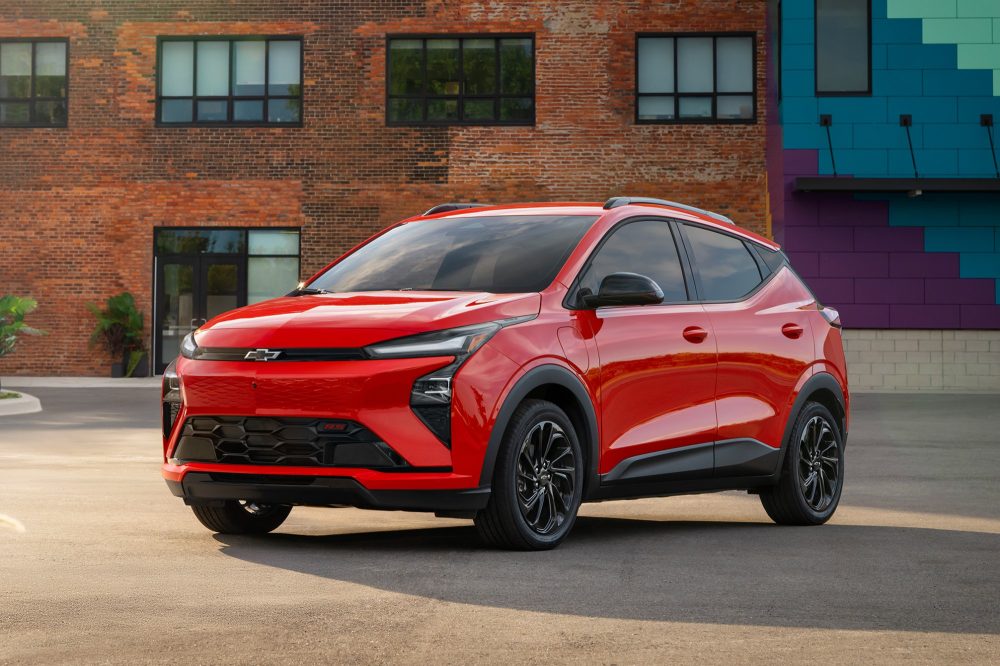
Returning to challenge the Leaf is the Chevrolet Bolt, which is back for 2027 after sitting out for three years. The revamped Bolt brings improved technology and greater range. Both compact EVs carry starting prices near $30,000, making them attractive alternatives if vehicles from Hyundai, Tesla, or Toyota are beyond your budget. Automotive experts at Edmunds put both cars through their paces to help determine which one comes out ahead.
Range
The EPA estimates the 2027 Bolt can travel 262 miles on a full charge — more than enough for daily commutes and the occasional longer trip. The Leaf has a potential advantage with an EPA-estimated maximum of 303 miles. In Edmunds’ own real-world range testing, however, the two were closer: the Bolt covered 290 miles while the Leaf managed 310 miles.
Both vehicles accelerate at a similar pace, each going from zero to 60 mph in roughly 7 seconds during Edmunds’ evaluations. Still, Edmunds’ testers gave the nod to the Bolt when it came to the overall driving experience. Its responsive handling makes it well-suited for navigating tight urban streets, whereas the Leaf felt somewhat stiff and bouncy on uneven road surfaces.
At public fast-charging stations, the Bolt also showed an edge, recovering range more quickly than the Leaf in Edmunds’ testing.
Winner: Bolt
Technology
Drivers who prioritize in-car technology will likely lean toward the Leaf. It features a 12.3-inch touchscreen alongside a second 12.3-inch digital gauge display, with an option to upgrade both screens to 14.3 inches. The Leaf also supports wireless Apple CarPlay and Android Auto, letting drivers access their smartphone apps directly on the touchscreen without plugging anything in.
The Bolt comes with dual 11-inch screens but does not offer a size upgrade. It also does not support Apple CarPlay or Android Auto, relying instead on Google Built-In, an integrated Android-based system. Apps like Waze and Apple Music can be downloaded through the Google app store, but Edmunds found the CarPlay and Android Auto experience more convenient overall.
One area where the Bolt stands out is its available Super Cruise feature, which allows hands-free highway driving to ease driver fatigue in stop-and-go traffic or during long stretches on the road. Even so, the Leaf holds the overall technology advantage.
Winner: Leaf
Interior and Cargo Space
Both vehicles share a crossover-inspired design with elevated rooflines, comfortable cabin room, and comparable headroom. Rear-seat passengers have more room to stretch out in the Bolt, which offers 7.3 additional inches of legroom compared to the Leaf — a bonus for families needing to fit rear-facing child safety seats.
The Leaf makes up ground in cargo capacity, offering 20 cubic feet of space behind the rear seats versus the Bolt’s 16.2 cubic feet. Nissan also adds a convenient underfloor storage compartment, providing a secure spot for valuables or smaller items.
Winner: Leaf
Value and Pricing
The Bolt LT kicks off at $28,995 including the destination charge, currently making it the least expensive new electric vehicle available. Standard features include core convenience items along with driver assistance technologies such as adaptive cruise control and blind-spot warning and intervention. Stepping up to the Bolt RS adds amenities like synthetic leather seating, a power-adjustable driver’s seat, and a heated steering wheel for a few thousand dollars more.
The Leaf S+ trim starts at $31,535 and also comes well-equipped with driver aids and a standard surround-view camera system useful for parking in confined spaces. However, buyers will generally spend more on a Leaf — a fully optioned Leaf Platinum+ runs around $40,000, compared to approximately $37,500 for a fully loaded Bolt RS.
Winner: Bolt
Bottom Line
Both the Bolt and the Leaf are strong contenders in the affordable EV segment — so much so that Edmunds gave them identical overall scores. If you want more range, better tech features, and extra cargo room, the Leaf is the way to go. If you prefer sharper handling around town and a lower price point, the Bolt is the smarter pick.
This comparison was provided to The Associated Press by the automotive website Edmunds. Dan Frio is a contributor at Edmunds.