
Members of Belfast’s ethnic minority communities report they’re too frightened to venture outside after witnessing masked gangs attacking neighborhoods and targeting homes and businesses owned by immigrants.
“Women and kids are terrified and in shock,” said Twasul Mohammed, who arrived in Northern Ireland from Sudan as a refugee in 2016. “We are keeping our kids at home, I haven’t sent my kids to school since this has happened.”
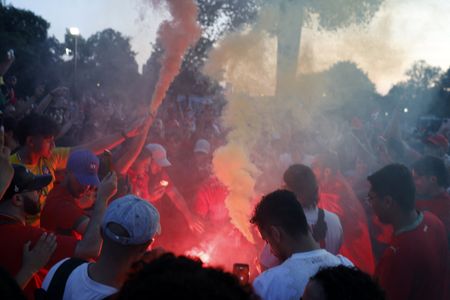
The unrest began Tuesday in the wake of a stabbing incident that led to attempted murder charges against a Sudanese man. That same night, masked groups swept through Belfast neighborhoods, igniting homes and vehicles while focusing their attacks on ethnic minorities. Additional smaller incidents occurred Wednesday, with concerns that more violence may follow.
Britain’s minister for Northern Ireland condemned the anti-migrant violence as “racist thuggery.”
The chaos has reawakened painful memories for many who sought refuge in Belfast after fleeing conflict in their homelands.
“You have to remember we are talking about communities where people have fled war in their own country and people have experienced this kind of thing again and again,” Mohammed explained to Reuters.
“Immigrants are not the problem, we are not causing the housing crisis or the health service. Every one of us wants to be a part of this community and help build it.”
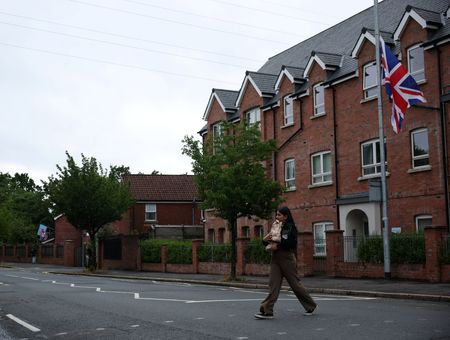
Northern Ireland experienced three decades of violence between primarily Catholic Irish nationalists and mainly Protestant pro-British loyalists. Community leaders note that in recent times, traditional sectarian divisions have increasingly given way to animosity toward ethnic minorities.
“This is a deeply divided society already,” explained Patricia McKeown, regional secretary for the public sector union Unison. “This is a society that is not yet post conflict, and…the most base instincts of ordinary people is being appealed to by some very dark and sinister forces.”
Union volunteers assisted in moving at least 15 families from their residences Tuesday and another 15 Wednesday due to safety concerns, McKeown reported.
Healthcare and other essential workers have also encountered vigilante groups conducting street patrols, particularly around medical facilities, she noted.
“We have workers being stopped by vigilante patrols in the streets of Belfast, particularly outside hospitals, … checking their ethnicity, videoing their registration numbers,” she explained.
“We have workers being followed to and from work. And last night we had a nurse chased by four masked men in one of the large hospitals in the east of the city … This is hatred that is putting lives at risk.”
Despite the targeting of ethnic minorities in a region that is 97% white according to 2021 census data, McKeown noted the crisis has also inspired community solidarity.
Ruchira Rangaprasad, who relocated to Northern Ireland from India three years ago, described being overwhelmed with assistance offers after announcing on social media her plan to prepare meals for affected families.
More than 30 volunteers, mostly people she’d never met, came forward to help deliver dozens of food packages Wednesday, she said.
“People are scared to step out of their home, and food is like a basic need, and especially like nutritious home-cooked food … so that’s why I thought, let me cook and help feed people,” she explained.
Kashif Akram, a member of the executive committee at the Belfast Islamic Centre, said the community response revealed another aspect of the city.
“It’s heartbreaking. At the same time Belfast is full of a lot of decent people,” said Akram, 44, who was born in Northern Ireland and has lived there his entire life. “The people who are spreading the hate at the moment, they are a minority, there are very few.”