
When Yoomi Lee arrived at her polling location to vote in South Korea’s local elections, she expected a quick visit. Instead, she found herself waiting for hours after the station ran out of ballot papers, leading to heated disputes with election workers.
“They should have prepared the right amount,” Lee said. “They know the number of the voters (expected).”
The ballot paper crisis at over 90 voting locations last week has sparked South Korea’s largest political demonstrations since the country’s martial law emergency in 2024.
The situation escalated with voters clashing with law enforcement, widespread conspiracy theories about election manipulation, and the eventual resignation of the election authority’s leader. President Lee Jae Myung Lee has launched an investigation and promised to reform voting procedures.
Interviews conducted by Reuters with six affected voters and more than a dozen demonstrators reveal how what should have been a clear victory for Lee’s ruling party instead turned into a damaging controversy.
The crisis also highlights how decisions made by the independent National Election Commission resulted in printing fewer ballots compared to previous election cycles.
THREAT TO DEMOCRATIC TRUST
Just two days after the voting problems, massive crowds sometimes reaching 40,000 people started assembling daily near a Seoul stadium, calling for new elections.
A rerun could jeopardize important victories for both Lee’s left-leaning Democratic Party (DP) and the conservative People Power Party (PPP), despite calls for investigation.
“If the response is perceived as inadequate or defensive, it could become a source of criticism and weaken public confidence,” said Joan Cho, a professor at Wesleyan University who studies the Korean democracy movement.
However, if the Lee administration responds transparently and provides a clear account of what happened, it could reinforce public confidence, she added.
The controversy appears to have helped the opposition, with the first Realmeter poll following the election showing the gap in support narrowed to under 1% compared to the DP’s nearly 25% advantage in late March.
Realmeter attributed this shift partly to perceptions of “administrative responsibility for the ballot shortage.”
Opposition leader Jang Dong-hyeok of the PPP noted that ballot shortages were particularly acute in conservative-leaning areas.
FIRST-TIME PROTESTERS EMERGE
Many demonstrators said this marked their initial involvement in political protests, as the election commission’s explanations failed to satisfy them and they viewed the situation as an attack on their basic voting rights.
“At first it was concern about the ballot shortage,” said one newcomer to protesting, 41-year-old office worker Cha Ye-rin.
“But after coming here and talking to people, I am more certain about how democracy is under threat by the people in power.”
The demonstrations have continued throughout the week, with participation typically increasing during evening hours and attracting far-right YouTube personalities along with PPP officials.
South Koreans have fought hard for their democratic freedoms, making them particularly sensitive to any perceived threats, including the 2024 martial law attempt.
Democracy Day on June 10 commemorates the citizen-led nationwide demonstrations of 1987 that successfully ended decades of military control and forced the government to conduct direct presidential elections.
RESIGNATION DOESN’T CALM PROTESTERS
Even the Thursday resignation of Rho Tae-ak, a former Supreme Court justice who had led the NEC since April 2022 before Lee assumed power last year, did not satisfy the protesters.
Tensions escalated on election day in Seoul’s southeastern Songpa district, where ballot shortages extended voting by four hours until 10 p.m., according to voters at a polling station located in a senior citizens’ center. Even with the extension, few people could cast their votes.
Cho Eun-kyung, 67, said she joined the protests before a confrontation with polling station workers as more people arrived to prevent officials from removing ballot boxes for counting.
Police dispersed human chains around the polling station on Friday, she said, while videos from other residents showed officers removing several dozen protesters who were blocking entrances.
Seoul police declined to provide additional comment regarding the confrontations with protesters at the voting location.
People traveled from across the capital to join crowds outside the stadium where ballot boxes were collected for counting, as social media and students from prestigious universities warned of democratic threats.
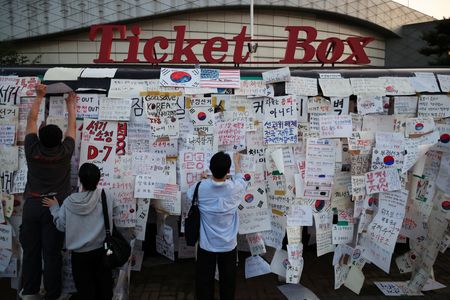
Young families with infants in strollers, gig economy workers, and university students were among those carrying handwritten signs demanding “Election Rerun,” a phrase they chanted while raising their fists.
Some expressed growing frustration as vote counting began at 6 p.m. on election day while others remained unable to cast ballots.
The possibility of election manipulation features in conspiracy theories circulating on social media, with even the conservative mayor of the port city of Incheon questioning some results.
REDUCED BALLOT PRINTING
When asked about the number of people unable to vote, an NEC official said the commission lacked that information, as it was uncertain whether complete records were maintained of those who departed without voting due to shortages.
The official requested anonymity, citing that allegations of election fraud and related issues represented sensitive topics.
For Wednesday’s election, the NEC established a minimum ballot printing guideline of 50% of eligible voters, the official explained.
This differs from the traditional minimum of 70% printed for presidential elections and 60% for local elections, which typically see lower participation, the official noted.
The 50% guideline received support from a task force created last year to enhance procedures, following a similar 2022 study that examined ballot quantities.
Increased early voting and accusations of “concealing evidence of election fraud” stemming from large numbers of unused ballots in previous years also played a role, the official added.
“These various factors combined and led to the result we have today.”
GROWING RERUN DEMANDS
Lee’s Democratic Party won most positions in the elections for mayors, provincial governors, county officials, and local assembly members, but lost the important Seoul mayoral position to the opposition incumbent.
The only solution would be “to hold a nationwide re-election,” the PPP’s Jang stated, though some party members oppose this approach, including Seoul’s re-elected mayor, Oh Se-hoon.
The NEC official said the relevant legislation, the Public Official Election Act, did not list ballot shortages among conditions warranting an election rerun, making it challenging for the commission to initiate one independently.
“At the very least, our basic rights must be protected,” said Gu Young-gwang, 33, a protester outside the stadium who said he was participating in a political demonstration for the first time.
“The goal is not revenge,” said another protester, Lee Hee-won, 25, calling for a fair and transparent rerun. “The goal is to restore trust in democracy.”