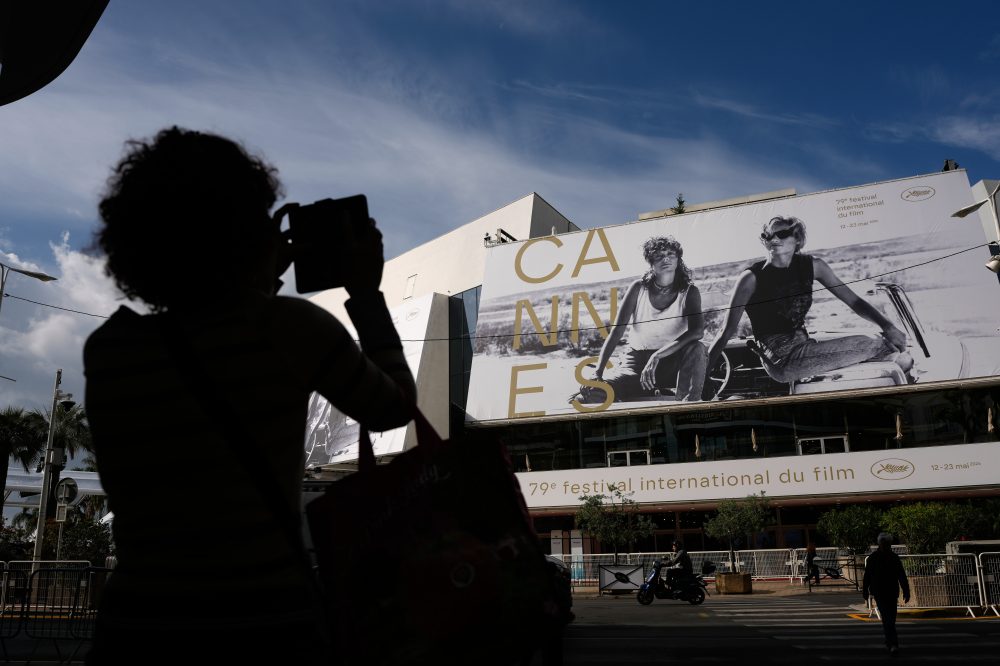

CANNES, France — The world’s most prestigious film festival has become a gathering place where movie industry concerns bubble to the surface, and this year artificial intelligence dominates the conversation.
The 79th edition of the festival may be remembered as the first time this celebrated event seriously confronted AI’s impact — its influence has swept across the French Riviera like a massive wave. Since the festival began, there’s been continuous discussion about AI’s power to transform cinema, whether positively or negatively.
However, attitudes appear to be shifting in many circles.
“The buzz in Cannes and the buzz in the industry, it does feel like it’s definitely a turning point,” said Scott Mann, co-chief executive of Flawless, a company that specializes in assistive AI programs for post-production.
AI technology has become much more visible both in films and behind the scenes.
This marks the first time the festival has entered into a partnership with Meta through a new multiyear agreement. The tech company has established a presence at the Majestic Hotel. Meta’s AI technology was utilized in creating a festival submission: Steven Soderbergh’s “John Lennon: The Last Interview.”
The film documents an extensive and revealing conversation that Lennon and Yoko Ono conducted on the same day Lennon was murdered in 1980. To create visual elements accompanying Lennon’s words, Soderbergh employed Meta’s artificial intelligence software to generate dreamlike imagery.
This decision drew harsh criticism from many festival reviewers, but Soderbergh, a skilled pioneer who has filmed movies using iPhones, feels the time has come for such creative exploration.
“We haven’t seen yet someone with a certain amount of creative credibility go full-metal AI on something, and see how people react. I think it’s necessary,” Soderbergh said in an interview. “How do you know where the line is until somebody crosses it? I don’t think what I’m doing crosses it. Some people may disagree. I don’t know where my line is yet. I’m waiting to see.”
Industry professionals attending the festival have been establishing their own boundaries and making public statements about artificial intelligence.
During the opening ceremony, jury member Demi Moore declared that opposing AI “is a battle we will lose.” The following day, honorary Palme d’Or winner Peter Jackson stated: “I don’t dislike it at all. To me, it’s just a special effect. It’s no different from other special effects.”
Director James Gray, whose star-studded family story “Paper Tiger” emerged as a weekend highlight, expressed confidence about the technology.
“In some cases, it can be a very helpful tool,” said Gray in an interview. “I don’t think in our lifetime, or even our children’s lifetimes, it will come close to mirroring the only true infinite we know, which is the soul.”
“The answer I think is that most young people should be studying the humanities,” added Gray. “People should be reading Tolstoy in their spare time to understand the human soul.”
The festival is taking place following several major AI-related developments in Hollywood.
This month, the Academy of Motion Picture Arts and Science announced new policies, declaring that only performances “demonstrably performed by humans with their consent” will be eligible for acting awards.
Simultaneously, the Oscar organization stated that AI tools “neither help nor harm the chance of a nomination.”
The Screen Actors Guild-American Federation of Television and Radio Artists recently secured a preliminary deal with studios that outlines and clarifies AI protections regarding digital doubles and computer-generated performers.
Certain technological advances have caused alarm throughout Hollywood. The introduction of Tilly Norwood, a completely AI-generated “actress,” triggered industry-wide anger. This year, the first preview of a digital recreation of Val Kilmer after his death, created with his family’s approval, generated another wave of controversy.
Although more extreme applications of generative AI continue causing concern, other versions are gaining acceptance.
“It is going to be a part of our business,” Kent Sanderson, Bleecker Street chief executive, said in a panel discussion. “It is going to lower production costs, and yes, you probably will be able to make something that looks like a Marvel movie in your basement in a couple of years.”
Despite having strict regulations about red carpet attire, the festival isn’t implementing any rules prohibiting AI in film entries — at least not yet.
Before the festival commenced, artistic director Thierry Frémaux responded cleverly to an AI question, observing that he had also heard James Cameron used special effects for “Avatar.”
“What I can say with certainty in relation to artificial intelligence is that we are on the side of the artists, the screenwriters, actors and voice actors,” said Frémaux. “We stand with everyone whose job could be negatively impacted by artificial intelligence. It requires legislation. We need to control this.”
Mann, the Flawless executive, was positioned on the festival beach outside a celebration his company was hosting at one of the waterfront venues that frequently hold film industry gatherings. Since 2019, Flawless has worked to show that AI can be applied responsibly.
He firmly opposes unlicensed generative AI.
“But what we’ve found is that the way people don’t understand is part of the problem. AI as a term is seen as a catchall, but it’s not that simple,” says Scott. “The truth is, our industry needs saving. It needs a technological evolution, and this is offering it.”