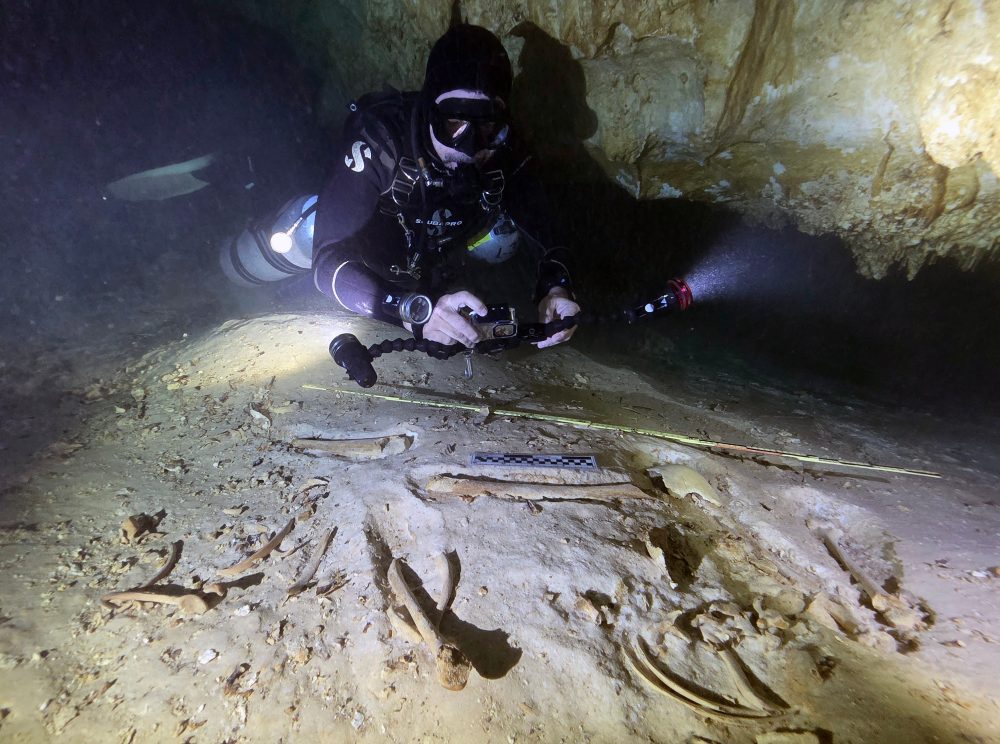

MEXICO CITY — Cave-diving archaeologists have made a remarkable discovery along Mexico’s Caribbean coastline, uncovering ancient human remains deep within flooded underground caverns that were submerged when the last ice age ended 8,000 years ago.
Octavio del Río, working alongside Mexico’s National Institute of Anthropology and History, reports this marks the 11th ancient skeleton discovered in these underwater cave networks over the past thirty years in the region between Tulum and Playa del Carmen. These sinkhole caves, called “cenotes,” have yielded some of North America’s most ancient human remains, with certain specimens dating back approximately 13,000 years.
Speaking with The Associated Press recently, del Río described finding the skeleton in a submerged cavern located 26 feet beneath the surface, accessible only after navigating 656 feet through the underwater cave system. The archaeological team retrieved the remains in late 2025, and analysis is currently underway.
“Given the distance from the cave entrance and the depth, this individual could only have been placed there when the cave was completely dry, which means at least 8,000 years ago,” del Río explained. Today, accessing these chambers requires expert diving skills and specialized equipment.
The remains were discovered resting on sediment deposits within a narrow section of an inner chamber, leading del Río to conclude that “this suggests it was a funereal deposit where the body was placed intentionally, perhaps as part of a ritual practice.”
Despite three decades of similar discoveries, del Río says the excitement never fades. “You can shout even under water,” he said with a smile, describing how he begins visualizing the ancient cave environment and contemplating how this person came to rest there.
Luis Alberto Martos, who heads archaeological studies at the National Institute of Anthropology and History, believes this latest discovery will advance understanding of how ancient peoples reached Mexico’s Yucatán Peninsula. During that era, the region was a clifftop plain rather than today’s jungle and beach landscape, and researchers are learning more about how these early inhabitants utilized the cave systems.
Genetic evidence increasingly supports theories that some ancient peoples traveled from Asia via a land bridge where the Bering Strait exists today, though some evidence points to possible migration routes from South America. “The puzzle of Yucatan prehistory is becoming better understood,” Martos noted.
The extensive network of underground rivers and cave systems beneath the Caribbean coast suffered significant damage during recent construction of the Maya Train under former President Andrés Manuel López Obrador’s administration. The project required clearing large jungle areas and installing support pillars that penetrated the cave systems to accommodate the tourist railway.
Del Río, who vocally opposed that project, reports that Mexican officials are now pursuing designation of the entire area as a nationally protected zone. Mexico’s Environmental Ministry has confirmed to the AP that achieving this protection status is targeted for 2026.
Environmental scientists have spent years advocating for preservation of these fragile cave systems as development and contamination increasingly endanger the underwater waterways.
Beyond the area’s environmental significance, Martos argues the National Institute of Anthropology and History supports protection based on cultural heritage value. The caves serve as “archaeological windows,” revealing not only ancient remains but also more recent historical artifacts including small cannons and rifles from the 1800s.
Passionate cave divers continue discovering fossils throughout the flooded caverns, researchers report, though archaeologists have not yet begun systematic recovery of these specimens.