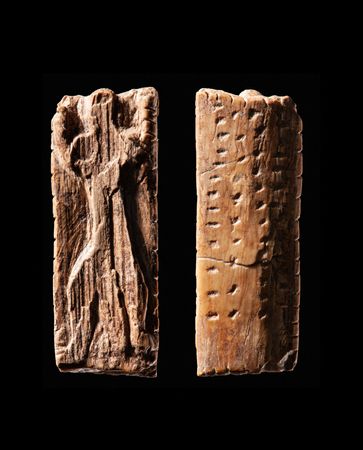

Scientists examining ancient artifacts unearthed from German caves decades ago believe they’ve discovered evidence of humanity’s earliest attempts at systematic communication through symbols.
The artifacts, dating back approximately 40,000 years, feature carefully carved sequences of marks including notches, dots, lines, crosses, and star-shaped symbols. Among the most notable pieces is the Adorant figurine – a small mammoth ivory carving depicting a creature that appears part lion, part human – found in 1979 at Geissenklösterle Cave in Baden-Württemberg.
According to new research published in the Proceedings of the National Academy of Sciences, these markings don’t constitute true written language but share striking similarities with proto-cuneiform symbols that appeared around 3300 BC in ancient Mesopotamia, which later developed into one of humanity’s first writing systems.
Christian Bentz, a linguist at Saarland University who led the study, explained the significance of their findings: “We would argue that these sign sequences go beyond decoration that was aesthetically pleasing to particular individuals. Namely, our statistical results show that these signs were applied selectively and conventionally.”
The research team examined over 200 Stone Age items bearing these mysterious symbols, all originating from four cave locations in southwestern Germany between 43,000 and 34,000 years ago. These artifacts belonged to the Aurignacian culture, among Europe’s earliest distinct civilizations.
What makes these findings particularly intriguing is the apparent systematic nature of the symbol placement. Researchers discovered that crosses appeared exclusively on tools and animal carvings, never on human figures, suggesting deliberate cultural rules governed their use.
“The convention to carve certain sign types only into surfaces of certain artifacts must have been handed down over many generations, otherwise we would not find these statistical patterns in the data,” Bentz noted.
The scientists analyzed what they call “information density” – how much meaning each symbol potentially conveyed. Their computational analysis revealed remarkable similarities between these ancient German markings and the earliest Mesopotamian proto-cuneiform examples, despite being separated by tens of thousands of years.
These discoveries shed new light on the cognitive abilities of early humans who were spreading across Europe as hunter-gatherer groups after migrating from Africa, encountering Neanderthals along their journey.
The Aurignacian people created some of humanity’s oldest known representational art, crafting figurines from mammoth ivory, animal bones, and antlers. Their creations included depictions of mammoths, cave lions, horses, and hybrid human-animal beings, along with tools, jewelry, and even musical instruments like flutes.
While researchers haven’t deciphered the actual meaning of these symbols, they believe the markings represent a crucial step in human communication development, bridging the gap between simple decoration and true writing systems.
Study co-author Ewa Dutkiewicz from Berlin’s Museum of Prehistory and Early History emphasized the linguistic capabilities of these ancient people: “We can only speculate about the status of spoken languages at the time. In general, archaeologists and linguists would certainly assume that modern humans 40,000 years ago had spoken languages structurally similar to those spoken around the world today.”
The research suggests these early Europeans possessed sophisticated cognitive abilities, developing conventional symbol systems that could be passed down through generations – a remarkable achievement that predates known writing by tens of thousands of years.