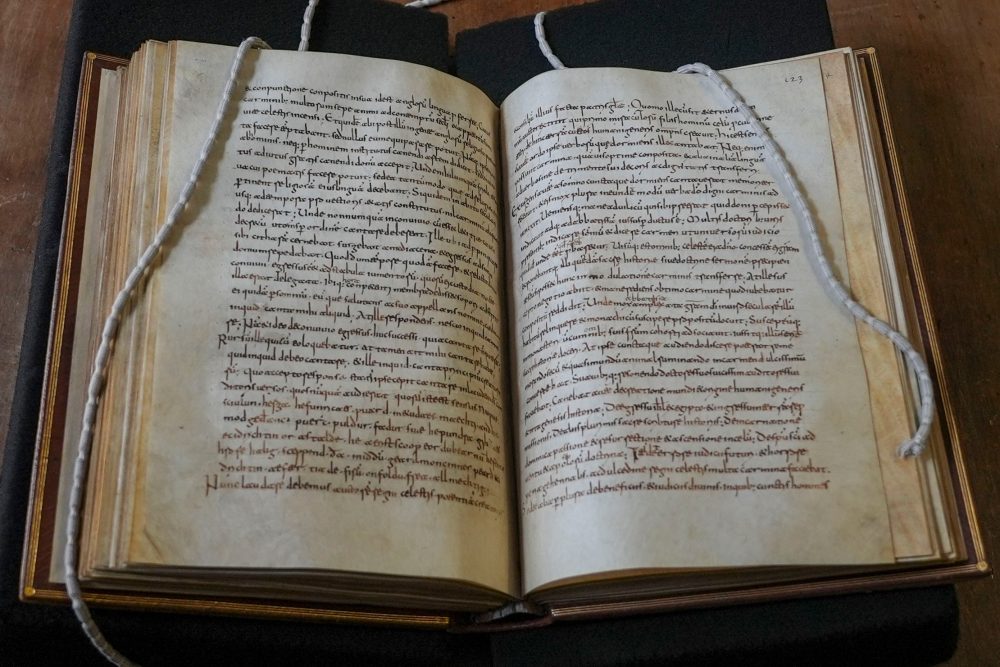

ROME (AP) — Irish scholars staring at their computer monitors couldn’t believe what they were seeing as they examined a centuries-old manuscript from a library in Rome. As they scrolled through the digital pages, they discovered an incredible find: the earliest known English poem still in existence.
“We were extremely surprised. We were speechless. We couldn’t believe our eyes when we first saw that,” Elisabetta Magnanti, a visiting research fellow at Trinity College Dublin’s school of English, told The Associated Press.
Even more remarkable, she explained, the poem appeared integrated into the primary Latin text: “It was extraordinary.”
Created in Old English by a Northumbrian farm laborer during the 7th century, “Caedmon’s Hymn” is found in certain versions of the “Ecclesiastical History of the English People,” a Latin work authored by a monk and saint called the Venerable Bede. This historical account ranks among the most frequently copied texts from medieval times, with more than 200 manuscripts existing, according to Mark Faulkner, Magnanti’s research partner and an associate professor of medieval literature at Trinity.
Faulkner views Caedmon’s work as the beginning of English literary tradition.
The manuscript discovered by the pair dates back to the 9th century, making it among the earliest versions. While two older copies include the poem in Old English, those versions were added as secondary elements — converted from Latin and written in margins by subsequent scribes or attached separately rather than incorporated into the main text, the researchers explained.
This finding reveals how widely the English language had spread much earlier than scholars previously believed, Faulkner explained during his visit to Rome, where both researchers traveled to examine the actual text for the first time.
“Prior to the discovery of the Rome manuscript, the earliest one was from the early 12th century. So this is three centuries earlier than that. And so it attests to the importance that was already being attached to the English in the early 9th century,” Faulkner said.
The fact that they located it at all seems almost miraculous.
According to tradition, Caedmon created the poem while employed at Whitby Abbey in North Yorkshire, after dinner guests began sharing poetry, Faulkner explained.
“Embarrassed that he didn’t know anything suitable, Caedmon left the feast and went to bed,” he said. “A figure then appeared to him in his dreams telling him to sing about creation, which Caedmon miraculously did, producing the nine-line hymn.”
Nearly 1,400 years later, this version of his poem turned up in Rome’s primary public library — but only after journeying across the Atlantic Ocean multiple times and passing through numerous owners.
Religious scribes created this version of Bede’s historical work in the writing room of the Benedictine abbey of Nonantola, a major manuscript production facility during medieval times, situated near present-day Modena in northern Italy, explained Valentina Longo, who oversees medieval and modern manuscripts at Rome’s National Central Library.
During the 17th century, as the abbey lost significance, its extensive manuscript collection was transferred to another Roman abbey, then relocated to the Vatican and eventually to a small church.
During these moves, some texts disappeared, only to resurface in the early 1800s owned by famous international collectors, Longo noted.
This particular copy of Bede’s history ended up with well-known English antiquarian Thomas Phillipps. When he encountered financial difficulties and began selling portions of his collection, Swiss book collector Martin Bodmer acquired the manuscript. Through unknown circumstances, it eventually reached New York City as part of the collection belonging to Austrian-born rare book dealer H.P. Kraus during the 20th century.
Italy’s culture ministry had been searching globally for Nonantola abbey’s lost manuscripts, purchasing them at auctions and from collectors worldwide. The ministry acquired the Bede history copy from Kraus in 1972, Longo said, and since then this significant text has remained in Rome’s library — though it received little attention.
That changed when Magnanti, who had dedicated more than four years to studying Bede’s history while creating a catalog of surviving copies, entered the picture.
“I knew that the book was listed in the library’s catalog, so I was almost certain that the book was, in fact, still here,” she said. “I realized that, because of the very complex history of this book, no big scholar had really looked at it. So it had been virtually unstudied.”
She contacted the library via email, and staff confirmed the book remained in their collection. Three months afterward, she received digital photographs of the complete manuscript.
The library has converted the entire Nonantolan collection to digital format and made it freely available online, Longo said.
This represents part of an extensive library initiative to provide researchers worldwide with access to thousands of rare books and manuscripts, according to Andrea Cappa, who leads the library’s manuscripts and rare books reading room.
“The discovery made by the experts of Trinity College is just one starting point, a single manuscript that might pave the way for countless other discoveries, in countless other fields, through international cooperation like this,” Cappa said.