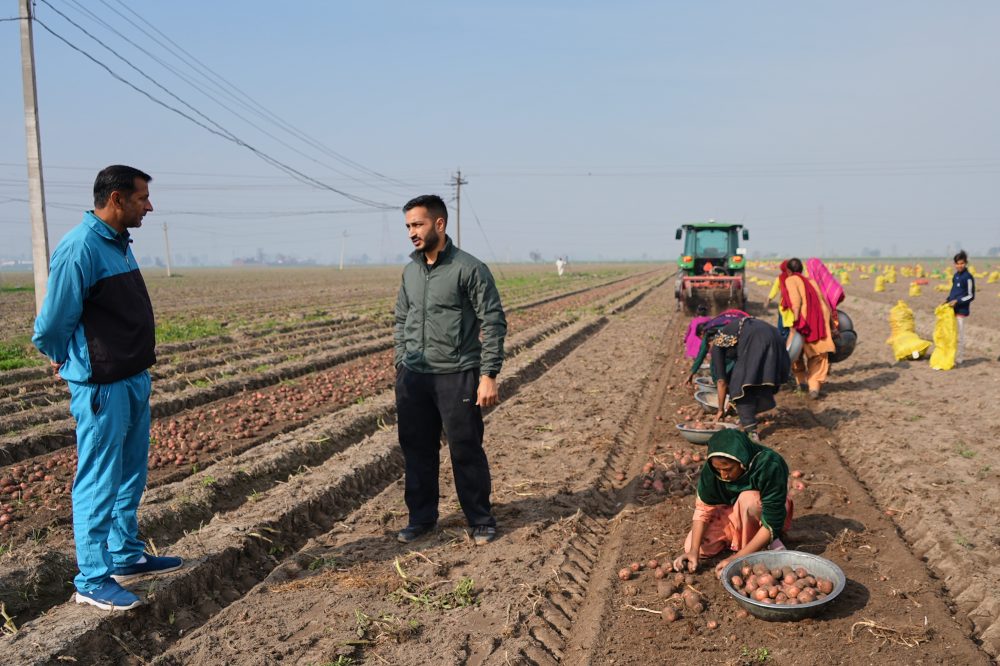

KARNAL, India (AP) — Using his finger to touch the tablet screen next to his tractor’s driver seat, farmer Bir Virk activated the autonomous driving feature. The agricultural machine began moving independently through his potato fields in Karnal, located in India’s northern region.
Meanwhile, approximately 90 miles south in New Delhi, education specialist Swetank Pandey was implementing comparable technological advances at his test preparation facility. He utilized computer algorithms to analyze and score handwritten examination responses from students preparing for India’s highly competitive government employment tests.
Both scenarios demonstrate the growing influence of artificial intelligence across various sectors.
Across India’s agricultural and educational landscapes, AI technology is rapidly becoming an essential resource for enhancing operational effectiveness while reducing time investment, expenses, and workforce demands. Pioneer users like Virk and Pandey report that these innovations are significantly improving their output as they explore AI’s capacity to address workplace challenges.
“I am able to farm very efficiently and I feel very happy that I do the work what my grandfather and father used to do. Now I am carrying the tradition forward with the right technology,” said Virk.
While artificial intelligence adoption accelerates worldwide, India is experiencing steady technological advancement as companies, emerging businesses, and individual users explore innovative methods to enhance productivity.
India’s federal administration is implementing nationwide programs to finance AI research and provide workforce training in these technologies. This commitment is evident during this week’s five-day artificial intelligence conference in New Delhi, drawing participation from world leaders and prominent technology executives.
Home to almost one billion internet subscribers, India has emerged as a crucial market for international technology corporations seeking to expand their AI operations in one of the planet’s most rapidly developing digital economies.
In December, Microsoft revealed plans for a $17.5 billion four-year investment to enhance cloud computing and AI infrastructure throughout India. This announcement followed Google’s commitment of $15 billion over five years, which includes establishing the company’s inaugural AI research center in the nation.
“There’s some good use cases that have started. There are these scaling platforms that are now embedding AI into them,” said Sangeeta Gupta, senior vice president at NASSCOM, a prominent body representing India’s technology industry.
However, India’s AI implementation faces several limitations.
The nation continues to trail behind in creating its own comprehensive AI systems comparable to America’s OpenAI or China’s DeepSeek, revealing obstacles including restricted access to cutting-edge computer processors, data storage facilities, and the challenge of incorporating hundreds of regional languages into learning systems.
Although technology firms have increased investments in AI education and worker retraining, employees who cannot adapt face job displacement. Tata Consultancy Services, India’s biggest private sector employer, eliminated over 12,000 positions last year due to the accelerating transition toward artificial intelligence.
Nevertheless, individuals like Virk and Pandey emphasize that AI applications are already accelerating their work processes and improving efficiency.
The farmer first discovered AI-powered agricultural technology five years ago during his studies and employment in America. After returning to India in 2021, he purchased the system from a Swedish manufacturer and has operated it on his property for several years.
Virk’s autonomous tractor performs seed planting, fertilizer application, and crop collection. The technology package costs approximately $3,864 and includes a steering mechanism, satellite navigation for precise movement, and AI software that translates information into machine actions.
The system also records operational problems and transmits them to an online platform, where the software provider examines the information and delivers relevant improvements back to the equipment.
“Technology and intelligence play a big role in this. The tractor works in a straight line. It maintains an accuracy of 0.01 centimeter (0.004 inch),” Virk said.
According to Virk, his AI-powered tractor has cut his working hours in half.
“Its most special feature is that it is self-learning,” he said.
Instructor Pandey works at a government job preparation institute, an industry characterized by intense competition. Each year, millions of young Indians vie for civil service positions, requiring coaching facilities to handle enormous volumes of examinations, assessments, and study materials.
According to Pandey, AI has simplified managing this workload.
Employing advanced language processing systems including ChatGPT, Gemini, and Claude, alongside additional automated tools, Pandey and his colleagues review and assess examination papers, develop customized educational content, and organize curricula for test candidates.
Pandey explained that the technology assists with routine tasks, enabling evaluation of tens of thousands of answer sheets within 20 to 25 minutes.
“If you have a better machine, bigger system, you can do it in two minutes,” he said.
Currently, his educational institution employs a combined approach where AI assists with grading while instructors review the results, enhancing both efficiency and accuracy.
Pandey noted that AI frequently generates educational materials that students connect with more effectively than content created by human instructors.
“AI is able to give us in advance a basic idea what the student is doing right now and what next he or she should do to be able to achieve their goals,” he said.