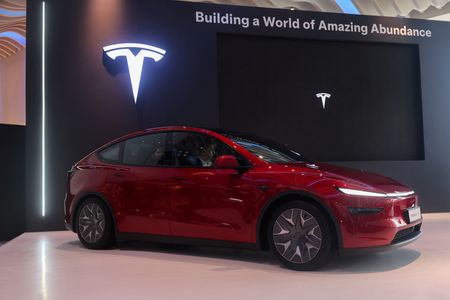

Federal highway safety regulators announced Thursday that Tesla’s 2026 Model Y has become the first automobile to successfully complete newly implemented driver-assistance technology evaluations.
The National Highway Traffic Safety Administration revealed that Model Y vehicles built starting November 12, 2025, have met the requirements of these recently introduced assessments, which are now part of the agency’s New Car Assessment Program. The evaluations examine four key safety technologies: automatic emergency braking for pedestrians, lane-keeping assistance, blind spot alerts, and blind spot intervention capabilities.
These pass-or-fail evaluations received approval from NHTSA in November 2024 and took effect for 2026 model year vehicles following a congressional mandate.
Car manufacturers highly value the coveted five-star safety ratings because many consumers consider them when purchasing new vehicles. These ratings operate independently from NHTSA’s required safety standards.
The timing of these enhanced safety measures comes as traffic fatalities experienced a significant increase following the COVID-19 pandemic, with pedestrian deaths reaching their highest point since 1981 in 2022. However, NHTSA reported last month that U.S. traffic fatalities dropped to their lowest level since 2019.
The five-star New Car Assessment Program, which has operated since 1978, serves as a resource for potential car buyers to evaluate vehicle safety features.
The Trump administration postponed these program modifications by one year in September after automotive manufacturers requested additional preparation time.
NHTSA has previously incorporated other driver-assistance technologies into the assessment program, including electronic stability control, forward collision alerts, and lane departure warnings in 2011; backup camera systems in 2013; and automatic emergency braking in 2015 for 2018 model year vehicles.
Meanwhile, NHTSA continues conducting separate investigations into Tesla, including an examination of the company’s Full Self-Driving system amid concerns it may not adequately detect hazards or alert drivers during poor visibility conditions.