
Before the 2026 World Cup kicked off, plenty of international soccer fans had serious reservations about the United States serving as a co-host for the sport’s biggest event. Concerns ranged from visa complications and steep costs to gun violence and a perceived lack of enthusiasm for the game among Americans.
Those concerns haven’t completely faded — but as matches get underway, a wave of upbeat posts has taken over social media. Fans visiting the country for the very first time are sharing their surprise at finding a culture full of round-the-clock shopping, unlimited soda refills, chicken wings with ranch dressing, and genuinely warm locals eager to make them feel at home.
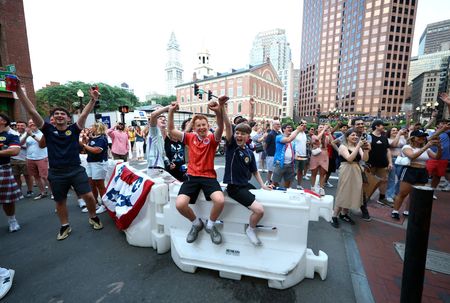
Scottish fan Gail Nicholl, who follows her national team as part of the “Tartan Army” supporter group, described a memorable encounter at a Boston pub before Scotland’s opening match against Haiti. “I met these two gorgeous girls from Boston. It was her birthday, she was having cocktails. I bought her another one and they kept saying ‘welcome to Boston, Massachusetts!’” she said. “They loved us, we loved them … Everyone is so friendly, so nice.”
A Swiss fan from Zurich echoed that sentiment on a Reddit thread filled with glowing reviews from visiting tourists. “Something new for me is how friendly and outgoing everyone is,” the fan wrote.
Whether this goodwill can help repair America’s global image — strained by years of an “America First” approach that has put it at odds with allies including Canada, Britain, and Germany — is still an open question. But sports analytics professionals say these experiences carry real weight.
“The front porch of your house is the first thing a visitor experiences before they ever step inside,” said Darin White, founder of Samford University’s Sports Industry Program in Alabama and a former soccer coach. “Sports serves that same function for cities, states, and countries. It is often the first meaningful, emotionally charged encounter someone has with a place they might otherwise never have thought much about.”
White added that research consistently shows hosting a major sporting event can genuinely change deeply held stereotypes about a place.
One of the more notable aspects of this World Cup is that it’s drawing international visitors to cities well beyond the usual tourist destinations. While New York, Los Angeles, and Orlando are familiar stops, this tournament is also bringing fans to Kansas City, Atlanta, and Houston.
In Kansas City, Argentine fans — for whom grilling “asado” barbecue is nearly as culturally significant as soccer itself — gathered to sample the local “dry rub” style of smoked meat. “The Argentinean barbecue is my favourite. But this one is really good,” said Argentina supporter Cristian Gastes.
Over in Dallas, Germany fan Maximilian Kirch, who hails from Duesseldorf, also gave barbecue a try and topped off the experience by showing off a newly acquired Texan cowboy hat. “Of course I’m wanting to experience more of it,” he said.
“There is something distinct about the warmth you encounter when you get off the beaten path,” White said. “The fan from Morocco who got help finding their gate in Dallas, or the family from Germany who got directions from a stranger in Seattle, those moments do not make headlines. But they are doing real work on Brand USA.”
Still, some of the pre-tournament worries remain. Extreme heat — especially in cities like Miami — is taking a toll on both players and fans, and the final is still a month away, pushing deeper into summer. Soccer’s global governing body FIFA reports strong attendance at matches, but high ticket and travel prices have kept many would-be visitors at home.
Visa restrictions have also played a significant role. Citizens from four of the participating nations — Iran, Haiti, Ivory Coast, and Senegal — have faced partial or complete bans on entering the United States. Iran and Haiti both have sizable American diaspora communities to root for their teams, though some within those communities have expressed mixed feelings. Ivory Coast and Senegal, however, have only small U.S.-based fan bases.
That’s where American fans have stepped in. Brooklyn resident Jessica Ambres attended the France versus Senegal match this week in New Jersey, seated high in the upper deck and wearing a Senegal jersey. “I’m in the bloodiest of the nosebleeds but I hope they can hear me down there on the pitch,” she said. As a Black American, she said she felt a personal connection to the African diaspora.
Across stadiums throughout the country, American fans have been showing up not only to back the U.S. team or their own ancestral homelands, but also to rally behind underdogs and teams with thin fan representation.
Politicians and business owners are hopeful that this spirit of welcome will leave a lasting impression long after the tournament ends. Boston Mayor Michelle Wu expressed her hopes for the Scottish supporters who visited her city. “I hope that the Tartan Army will keep coming back to Boston,” she said. “Of course, have a wonderful time during the games now, but we’d love to see you any season, any year. This is your home.”