
Utah is marking a troubling one-year anniversary — a full year of fighting measles outbreaks, with no clear finish line in sight. The milestone could have consequences not just for the state, but for the entire country’s measles-free designation.
Since the first outbreak began on June 20, 2025, more than 680 residents have contracted the disease. The virus has spread across 22 of the state’s 29 counties, making it far more widespread than outbreaks seen in Texas, South Carolina, and Arizona, which were largely contained to single regions.
Measles cases turned up in hospitals and medical offices, large retail stores, restaurants, and youth athletic competitions. In February, an exposure at a statewide high school wrestling championship led to at least 46 confirmed cases among those who attended.
Measles is considered one of the most contagious illnesses in the medical world. It causes a distinctive rash, high fever, severe cough, ear infections, and diarrhea. While most patients recover fully, young infants, pregnant individuals, and people with compromised immune systems face a higher risk of serious complications — including pneumonia, brain swelling, and blindness, and in some cases, death. Even otherwise healthy individuals may develop problems years later, including a rare but always-fatal degenerative brain disease that can appear roughly a decade after the initial infection.
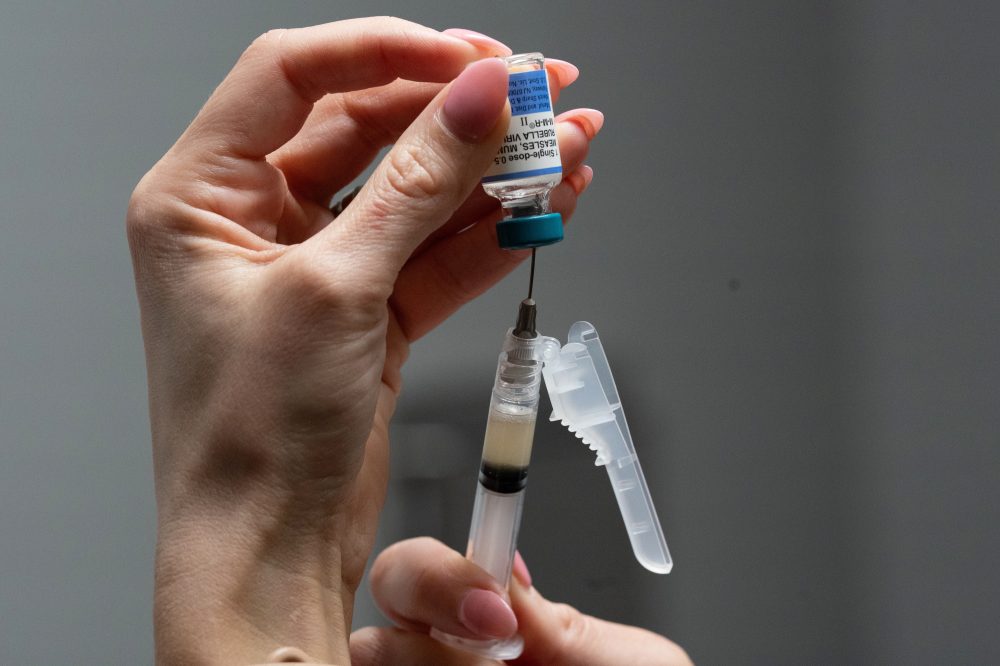
The measles vaccine is considered safe and is 97% effective following two doses.
Although the pace of new cases has slowed in recent weeks, state epidemiologist Leisha Nolen says there is little room for complacency. She fears that the upcoming school year and the arrival of colder weather this fall could trigger another wave of infections.
“It’s still here, it’s still transmitting,” she said. “We just need those few cases to hit the wrong community and it could flare up really big again.”
The hardest-hit area has been the southwestern portion of the state, where 265 people have fallen ill since last summer. Meanwhile, a rural region in the northeast — known as the “tricounty” area, made up of Daggett, Duchesne, and Uintah counties — recorded the second-largest drop in childhood vaccination rates in the state.
State data shows that more than 16% of kindergarteners in that region were not up to date on their measles vaccinations during the last school year. Statewide, 12.8% of kindergarteners were missing the vaccine — well below the 95% vaccination rate that public health experts say is needed to prevent outbreaks.
The TriCounty Health Department recorded 74 measles cases this spring after infections spread from the youth wrestling tournament into local schools and then into households. Sydnee Lyons, the health department’s public information officer, noted that vaccine hesitancy had been growing in the area for some time.
Despite the high number of cases, local and state health officials view TriCounty’s response as a relative success. Officials focused on limiting the damage by excluding unvaccinated students from in-person classes and directing sick individuals to isolate. Their approach — emphasizing community care rather than punishment — encouraged more people to seek out vaccinations, officials said.
TriCounty infectious disease specialist Cyndie Mattinson recalled one parent who told a school nurse she was reluctant to contact the health department because she feared being judged for having unvaccinated children. The nurse reassured her, and Mattinson was ultimately able to have a productive conversation with the mother.
“The perceptions were changed that we weren’t out there to police, we were there to be a help and a resource to the community,” Mattinson said.
Utah’s prolonged fight with measles could jeopardize the United States’ measles-free status. Public health authorities define measles as eliminated when a country demonstrates it has stopped continuous local transmission for at least one year. As of June 18, the national measles case count stood at 2,104 — nearly surpassing last year’s record total.
Nolen noted that it remains unclear whether Utah’s earliest clusters are connected to the larger outbreak that emerged along the Utah-Arizona border in August. What is clear, she said, is that the majority of cases since then have originated within Utah itself, rather than being imported from other parts of the country.
International health experts are scheduled to meet in November to decide whether the United States and Mexico have lost their measles elimination status. Canada lost its status last year following its own ongoing outbreaks.
In Utah, physicians continue to calm worried patients while pushing for stronger public health measures. Dr. Ellie Brownstein, president-elect of the state chapter of the American Academy of Pediatrics and a pediatrician in Salt Lake City, spent much of the outbreak fighting a legislative proposal that would have made it easier for families to obtain school vaccine exemptions. The bill ultimately failed, but Brownstein says the broader cultural response to measles’ comeback has fallen short.
“I don’t know that we get it to end,” Brownstein said. “I don’t know that we’re going to get this genie back in the box because there’s enough people out there to spread it.”