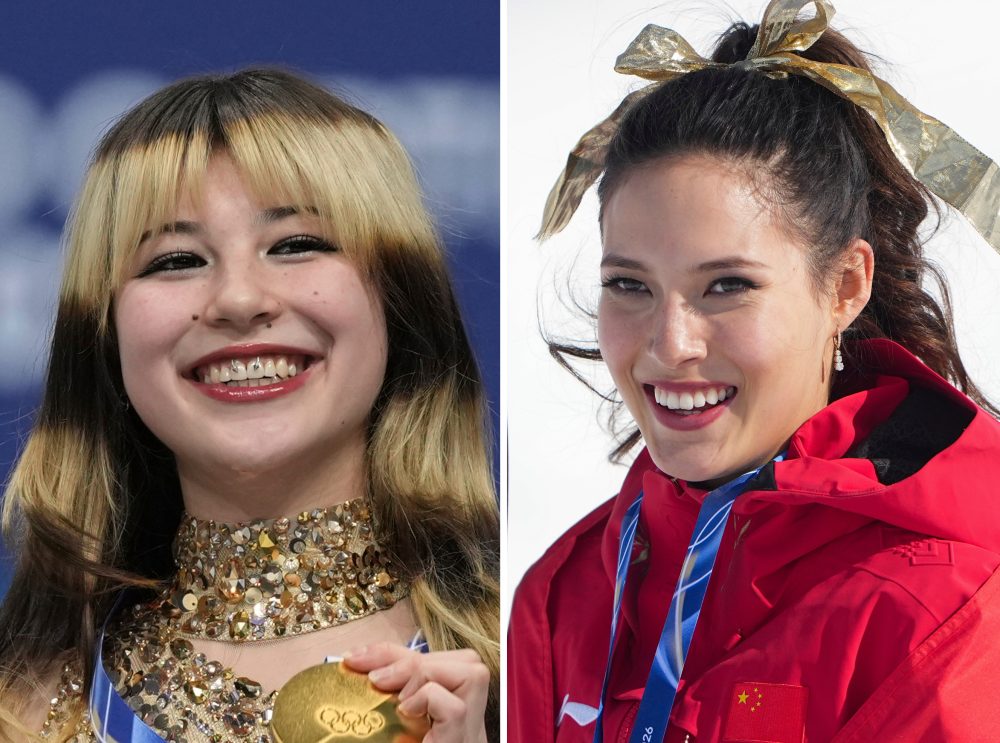

WASHINGTON — A compelling and controversial story has emerged from the 2026 Milan Cortina Winter Olympics, featuring two exceptional Chinese-American athletes whose similar backgrounds led to dramatically different choices about national representation.
Freestyle skier Eileen Gu, 22, and figure skater Alysa Liu, 20, share remarkable parallels in their personal histories. Both were born in California to Chinese immigrant families and raised by single parents. Each athlete delivered outstanding performances at last month’s Winter Games, earning gold medals for their respective countries.
However, their decisions about which nation to represent have sparked intense public discourse about patriotism, financial motivations, and political values across both America and China.
Gu made the choice to compete under China’s flag, while Liu proudly represents the United States. These contrasting decisions have ignited passionate discussions about allegiance that extend far beyond sports.
Chinese audiences largely celebrate Gu for embracing her Chinese heritage and bringing honor to what many consider the motherland. However, Liu has also gained admirers in China for what they perceive as her authentic personality and independent spirit — recognition that subtly acknowledges her father’s participation in the 1989 Tiananmen Square democracy movement that ultimately brought him to America.
American reactions to Gu’s choice have been more critical, with political figures including Vice President JD Vance expressing disapproval. The controversy has even prompted legislative action, with one congressional proposal suggesting a 100% tax on athletes like Gu who compete for nations such as China and Russia.
“Any American who works with a foreign adversary has not only betrayed our country but must be stripped of all benefits from doing so,” declared Rep. Andy Ogles, a Tennessee Republican.
Gu’s journey largely reflects China’s remarkable economic transformation, as the nation’s impressive growth has created attractive opportunities for individuals with Chinese ancestry to return for enhanced financial prospects.
Born in San Francisco to a Chinese mother employed in the financial sector, Gu’s father remains unidentified publicly. She represented China in both the 2022 and 2026 Winter Olympics, securing lucrative endorsement contracts worth millions from major Chinese corporations and international companies targeting the Chinese marketplace.
During the 2022 Beijing Games, where she captured two gold medals and one silver, Gu achieved celebrity status in China, affectionately nicknamed “Frog Princess.” Social media users eagerly shared videos of her enjoying traditional Chinese snacks, and her recent performances in Italy received widespread attention and praise throughout China.
Gu has consistently maintained that her decision to represent China stems primarily from her desire to encourage female participation in freestyle skiing — believing China offers greater growth potential for the sport than the United States — rather than purely financial considerations.
Nevertheless, questions surrounding Gu’s citizenship status have created controversy and affected her public image. Citizens on both sides question her loyalty and speculate whether she surrendered her American passport to comply with Chinese regulations prohibiting dual citizenship. Gu has avoided addressing these inquiries directly, leaving her citizenship status unclear.
Hu Xijin, formerly an editor at a Chinese Communist Party newspaper, contended that China’s priority should be attracting talented individuals like Gu, viewing this as a victory over the United States.
“Today’s China is stronger, and it can provide Gu with interests that cannot be realized if she represented Team U.S.A.,” Hu posted on social media. “She has the sharp judgment to pick Team China, and this is the magnetic effect resulted from China’s growth.”
For Liu, representing China was never a consideration.
Liu was born to Arthur Liu via surrogacy. Unlike Gu’s mother, Liu’s father escaped China while being pursued by authorities for his role in the 1989 student demonstrations that concluded with violent suppression in central Beijing, forcing numerous student protesters into exile. Military forces killed hundreds, possibly thousands, while ending the protests on June 3-4, 1989.
“Chinese people still have no freedom of speech, no freedom of religion, and there are still political prisoners in China,” Arthur Liu recently stated to Nikkei Asia. “Clearly, I wouldn’t allow my daughter to compete for such a government.”
While Chinese officials welcomed Gu with favorable media coverage and millions in government training support, Liu said he permitted his daughter to compete in Beijing during 2022 only after receiving safety guarantees from the State Department and U.S. Olympic Committee. The FBI had informed him that both he and his daughter were targets of a Chinese government surveillance operation. Alysa Liu finished sixth in women’s singles skating that year.
This time, she made history by becoming the first American woman to claim Olympic figure skating gold in 24 years. News of her achievement spread rapidly across Chinese social media, earning praise such as “free spirit” and “more genuine.” However, some users remained loyal to Gu and argued that Liu’s victory held no significance for Chinese people.
As Liu’s prominence grew, her father’s background surfaced on Chinese social media platforms, though references were typically brief and indirect since the 1989 Tiananmen Movement — commonly referred to as “6-4” for the crackdown date — remains an extremely sensitive political subject in China 37 years later. While some praised the elder Liu as a freedom advocate, others condemned him.
The frequent comparisons between his daughter and Gu prompted Arthur Liu to address the topic directly.
“Everyone is entitled to her own ambition,” the father explained during a YouTube conversation with Zhang Boli, another former student activist. “The two have chosen different paths, and people immediately see the contrast. The contrast is so sharp that people cannot help but comment.”
When asked about these comparisons recently, Alysa Liu told Newsweek: “Oh, my God, I think this discourse is really silly because we’re both half Chinese.”
American criticism of Gu during this Olympic cycle appeared to intensify following comments from Vance, who told Fox News during the Games that “I certainly think that somebody who grew up in the United States of America, who benefited from our education system, from the freedoms and liberties that make this country a great place, I would hope that they want to compete with the United States of America.”
Gu responded to these remarks by saying, “I’m flattered. Thanks, JD! That’s sweet,” according to USA Today.
Beyond Ogles’ proposed legislation, Rep. Lisa McClain, a Michigan Republican, criticized Gu for lacking “the respect for the country which has given them so much to represent that country.”
Nationality changes are common in competitive athletics, and other Chinese Americans or Chinese Canadians have competed for Team China. However, none have generated the public controversy that Gu has, observed Susan Brownell, a University of Missouri-St. Louis professor who specializes in Chinese sports and Olympic competition. “It does really appear,” she noted, “that part of the issue here is if you’re good enough to beat the U.S.”
Badiucao, a Chinese-Australian artist, captured this comparison through two illustrations: one depicting Alysa Liu skating triumphantly alongside the Statue of Liberty, the other showing Gu wrapped in an oversized, blood-stained Chinese banknote with Mao Zedong’s image watching over her shoulder.
“In a world of Eileen Gu,” the artist wrote, “be Alysa Liu.”