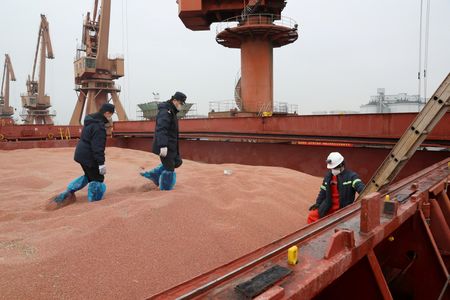

An anticipated meeting between President Trump and Chinese President Xi Jinping this week could result in expanded agricultural trade agreements covering grains and meat products, though industry experts don’t foresee substantial new soybean commitments beyond China’s October agreement.
While farming remains one of the less controversial aspects of U.S.-China relations, the specific outcomes from the presidential summit remain unclear with just days remaining, according to government officials, commodity traders, and industry analysts.
The Trump administration is pushing for increased commitments from China regarding soybean and other farm product purchases, according to someone with knowledge of the negotiations.
“They know it’s something that they need. They know it’s something we want to sell. So, whether it’s at the trip or shortly thereafter is to be seen,” a senior U.S. official told reporters during a briefing about the visit, though no specific products were mentioned.
The presidential delegation will include over a dozen corporate leaders and senior executives, including Cargill chairman Brian Sikes, a White House official confirmed.
Nevertheless, commodity traders and market analysts believe any agreement will likely face constraints due to China’s apparent reluctance to purchase additional soybeans—the highest-value crop—beyond their October pledge, citing weak domestic demand and lower-priced Brazilian alternatives.
Market observers are instead anticipating potential agreements for corn, sorghum, and milling wheat, along with beef and poultry products, some of which were discussed during March’s high-level negotiations.
“There’s still some space to strike purchase deals for other major U.S. exports. That could take the form of volume purchase deals for key products like corn and sorghum,” explained Even Rogers Pay, who serves as director at Trivium China, a Beijing consulting firm.
During 2024, prior to Trump’s return to the presidency, China purchased approximately $4.5 billion worth of these alternative products, significantly less than the $12 billion in soybean purchases.
Neither China’s Ministry of Commerce nor its Ministry of Agriculture and Rural Affairs provided immediate responses to comment requests.
China has substantially reduced its dependence on American farm products since Trump’s initial presidency, obtaining about 20% of its soybeans from the U.S. in 2024—the year before his return to office—compared to 41% in 2016.
Last year saw China purchasing only 15% of its soybeans from American producers.
Industry watchers are seeking clarification on how China plans to meet last year’s promise to purchase 25 million metric tons of soybeans annually through 2028, which would represent the largest volume since 2022.
“China hasn’t ever officially confirmed the details of the agreement. It’s also not clear whether the targets apply to calendar years or crop years,” Pay noted.
Any confirmation of renewed Chinese interest in American soybeans would likely boost Chicago soybean futures, which have already reached two-month peaks partly due to expectations of increased Chinese buying.
“When President Trump and Xi meet, we’d be thrilled to see additional purchases from China that would put us closer to the typical amount of exports in a typical year,” said Virginia Houston, government affairs director for the American Soybean Association, though she declined to specify exact volume targets.