Launch Window: Between 10 p.m. tonight and 3 a.m. tomorrow Mission: TOMEX+ (Turbulent Oxygen Mixing Experiment Plus)
What to Expect
NASA is launching a series of three sounding rockets from Wallops Island tonight as part of the TOMEX+ mission. Its goal? To explore the mesopause, one of the most turbulent atmospheric zones located around 56 miles above Earth, where a layer of atomic sodium resides—created by tiny meteors burning up in the sky
First Two Rockets: They’ll release vibrant vapor tracers—colorful clouds that you can photograph from the ground. These tracers help scientists visualize and map wind patterns in the upper atmosphere.
Third Rocket (Launching ~5 Minutes Later): Equipped with a lidar instrument, it will emit short pulses of light to precisely measure atmospheric density and movement over time
Together, this trio offers scientists a uniquely detailed 3D view of turbulence at the edge of space, shedding light on high-altitude cloud formation, satellite drag, and even atmospheric behavior on other planets
Viewing Tips for Region Residents
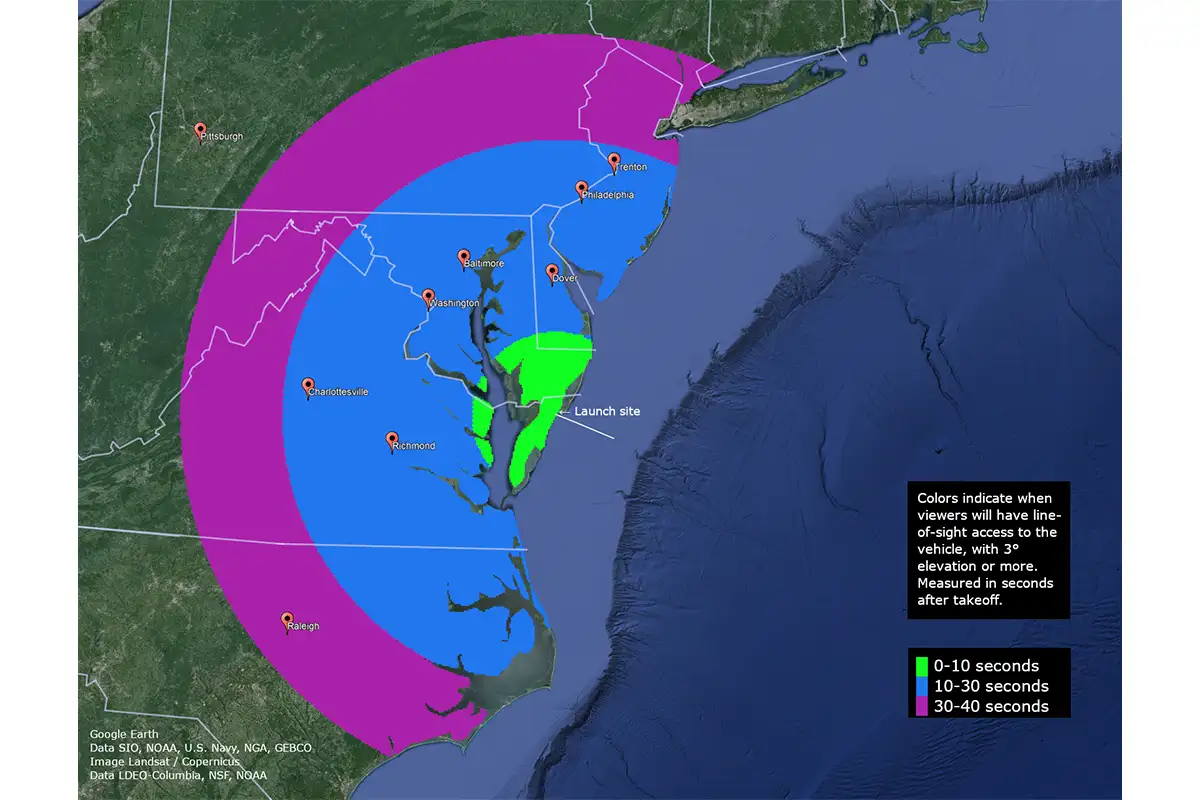
If the skies are clear, residents of Northern Virginia and nearby metro areas like Washington, D.C., Baltimore, and Philadelphia may catch the spectacle:
Within 10 seconds of launch: expect visibility closest to Wallops Island.
In Northern Virginia and similar zones, visibility may occur 10–30 seconds after liftoff.
Western Virginia and parts of Pennsylvania may see it 30–40 seconds post-launch
A livestream and live mission updates will begin approximately five minutes before each rocket’s launch on NASA’s social media channels
The “Stronger Together” mission will be Rocket Lab’s second Electron mission from its dedicated launch pad at Rocket Lab Launch Complex 2 (LC-2) on Wallops Island, Virginia.
The launch is a dedicated mission for Capella Space, a leading U.S. satellite manufacturer and Earth observation company. “Stronger Together” will deliver to orbit two more Synthetic Aperture Radar (SAR) satellites that enable Capella Space to deliver the highest quality, highest resolution SAR imagery commercially available with the fastest order-to delivery time, empowering organizations across the public and private sector to make informed, accurate decisions.
“Stronger Together” will be Capella Space’s second launch with Rocket Lab on Electron and its first from Rocket Lab Launch Complex 2 in Virginia. Supporting Rocket Lab’s vertical integration strategy, Rocket Lab will also supply Capella Space with two of Rocket Lab’s own Motorized Lightbands; separation systems designed to separate the Capella satellites from Electron once in orbit.
Rocket Lab will not attempt to recover Electron for this mission.
Community college and university teams from across the United States will descend on NASA’s Wallops Flight Facility in Virginia on Aug. 9 to launch experiments that they designed and built into space.
.
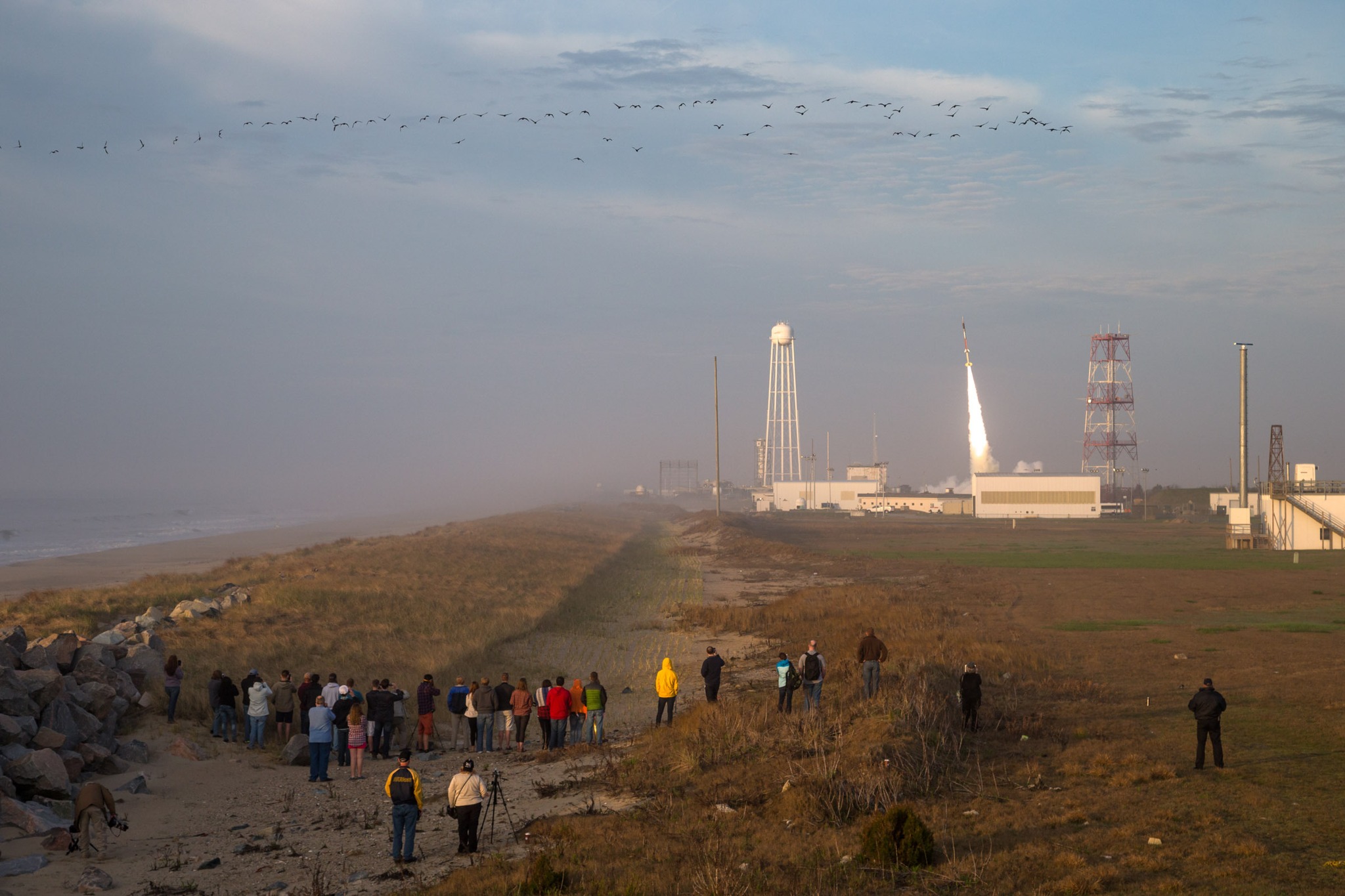
The student experiments will launch on a 44-foot-tall Terrier-Improved Malemute sounding rocket. Launch is scheduled between 5:30 and 9 p.m. EDT, with live coverage scheduled to begin at 5:10 p.m. on the Wallops YouTube site. The NASA Wallops Visitor Center will be open to the public for viewing the flight, which is expected to be visible from the Eastern Shore of Virginia and Maryland and southern Delaware. The backup launch dates are Aug. 10 and 11.
.
After flying to around 91 miles altitude, the payload carrying the experiments will descend by parachute and is expected to land in the Atlantic Ocean, about 64 miles off the Virginia coast, 15 minutes after launch. The students will receive their flown experiments and any stored data after the payload is recovered from the ocean.
.
The student projects focus on technology development for sounding rockets and spacecraft. The onboard payload includes a device to help payloads descend autonomously after an electrical failure; a sublimation-fueled motor for spacecraft; machine-learning applications for space robotics; a deployable boom for capturing high-definition, 360-degree video of a rocket’s experiments; a probe for measuring electrical currents in the ionosphere; and an ejection system for returning small spacecraft to Earth.
.
The experiments are being flown through the RockSat-X program in conjunction with the Colorado Space Grant Consortium. RockSat-X gives students at secondary institutions the experience of building experiments for space flight.
.
“RockSat-X provides students an opportunity to improve their skills through experiment development and then analyzing their data following the launch,” said Giovanni Rosanova, chief of the Sounding Rockets Program Office at Wallops. “Programs like these are vital in preparing students for careers after graduation.”
.
Approximately 75 of the 120 students participating in this year’s RockSat-X program will be at Wallops to support the final integration their experiments into the rocket and view the launch.
.
RockSat-X is part of NASA’s three-phase sounding rocket program for students. RockOn launches are at the entry level, RockSat-C projects are at the intermediate level, and RockSat-X is the most advanced. RockSat-X experiments are flown approximately 20 miles higher in altitude than those in the RockOn and RockSat-C programs, providing more flight time in space. The whole experience requires students to expand their skills to develop and build more complex projects as they progress through the programs.
“This will be the 13th flight of a RockSat-X payload,” said Chris Koehler, director of the Colorado Space Grant Consortium. “Hundreds of students have participated in the RockSat-X program prior to careers with government, education, or commercial organizations.”
.
Participating institutions in the 2022 RockSat-X flight are the Arapahoe Community College in Littleton, Colorado; Red Rocks Community College in Lakewood, Colorado; College of the Canyons in Santa Clarita, California; Virginia Tech in Blacksburg; Northwest Nazarene University in Nampa, Idaho; Kauai Community College in Līhuʻe, Hawaii; and the University of Kentucky in Lexington.
The team is developing an autonomous autorotational device that will provide a reusable descent method for a payload vehicle in the event of an electrical systems failure. Utilizing aerodynamic design and telemetry data collection, the team will investigate how a payload’s velocity involved in assisted pitched blade design will maximize autorotation upon re-entry into an atmosphere.
.
University of Hawaii Community Colleges
The team is conducting research on the feasibility of using a sublimation–fueled motor for providing low-power vernier thrust. The specific impulse of the sublimate camphor will be determined by a static ground test and by deploying the rocket from the sounding rocket at apogee. On board cameras will record the sublimation rocket’s flight parameters. This data will be supplemented by an inertial measurement unit and a multi-axis accelerometer that will provide a baseline for the payload’s flight trajectory.
.
Northwest Nazarene University
The team will investigate that Deep Meta Reinforcement Learning is a viable method for adaptive astro-robotics and demonstrate a viable soft robotic fluid for future space applications.
.
Community Colleges of Colorado
The team seeks to improve on a legacy deployable boom arm by changing the mechanism used to generate torque with interlocking gears, use a 360-degree camera to shoot high-definition video with a clear view of the rocket and experiments, and create an experiment that will test bit flips caused from high energy radiation.
.
Virginia Tech
The team is developing a Langmuir probe system capable of recording and recovering current-voltage curve characteristics while in flight between the E and F layers of the ionosphere.
.
University of Kentucky The team seeks to demonstrate the successful ejection of a capsule from an altitude of 93 miles and to gather and transmit data from an instrumented capsule throughout its flight. The method of ejecting the capsule is planned to be used for a future International Space Station mission.