Tag: sun

  • NOAA’s SWFO-L1 Space Weather Observatory Nears Final Orbital Position, Systems Reported Healthy

    NOAA’s SWFO-L1 Space Weather Observatory Nears Final Orbital Position, Systems Reported Healthy

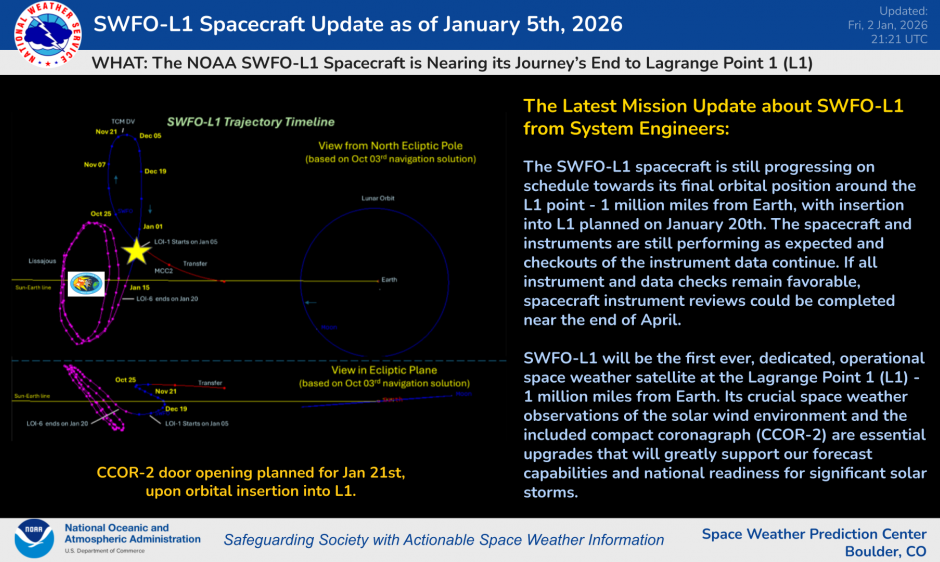
    January 6, 2026 — NOAA’s Space Weather Follow On-L1 (SWFO-L1) spacecraft is nearing the final stages of its journey to Lagrange Point 1 (L1), with orbital insertion scheduled for January 20, 2026. According to a NOAA Space Weather Prediction Center update, the mission’s instrumentation is performing as expected, and engineers report that the spacecraft continues to meet operational milestones as it approaches its final orbit.

    SWFO-L1 was launched on September 24, 2025 aboard a SpaceX Falcon 9 rocket and is designed to provide continuous, real-time monitoring of the solar environment upstream of Earth. Upon reaching the gravitationally stable L1 point—approximately 1 million miles from Earth—it will be renamed SOLAR-1 (Space weather Observations at L1 to Advance Readiness-1).

    Mission engineers are preparing to open the compact coronagraph (CCOR-2) door on January 21, the day after insertion, which will allow NOAA to begin evaluating imagery performance from this key instrument. Early tests of other sensor suites have already shown promising results.

    SWFO-L1 carries several advanced instruments, including a magnetometer, solar wind plasma sensor (SWiPS), and a supra-thermal ion sensor (STIS). These instruments will provide vital measurements of solar wind speed, density, and magnetic field characteristics that drive space weather disturbances. Previous early data from these sensors have already contributed to improved monitoring of solar wind and geomagnetic conditions during space weather events.

    Once commissioned in spring 2026, SOLAR-1’s data is expected to significantly enhance NOAA’s ability to forecast and issue warnings for geomagnetic storms, solar flares, and interplanetary shocks that can impact critical infrastructure such as power grids, communications, navigation systems, and satellites.

    With more accurate and timely space weather data, NOAA officials say the mission will help protect both space-based and ground-based technological systems that are increasingly vulnerable to solar activity—ensuring better preparedness for potentially disruptive solar events.

  • Rare G4 Geomagnetic Storm May Bring Northern Lights to Delmarva Sunday Night

    Rare G4 Geomagnetic Storm May Bring Northern Lights to Delmarva Sunday Night

    Delmarva Peninsula — A rare and powerful G4 (Severe) Geomagnetic Storm Watch has been issued by the NOAA Space Weather Prediction Center (SWPC) for Sunday, June 1st, bringing the potential for Northern Lights (aurora borealis) to be visible as far south as parts of the Delmarva Peninsula, pending favorable sky conditions.

    The alert, issued Saturday, cites a series of strong solar eruptions from the Sun’s surface that are sending coronal mass ejections (CMEs) toward Earth. These charged solar particles are forecast to arrive late Sunday (UTC time), with impacts possible through early Monday.

    NOAA’s G-scale for geomagnetic storms ranges from G1 (Minor) to G5 (Extreme). A G4 storm is a rare event, with only a few occurring each solar cycle, and can trigger vibrant auroras that stretch well south of their typical range near the Arctic Circle.

    If skies remain clear Sunday night, residents across Maryland’s Eastern Shore, Delaware, and even coastal Virginia could have a chance to spot the shimmering auroras towards the northern skies—especially from darker rural areas away from city lights.

    In addition to auroras, G4-level geomagnetic storms can cause intermittent issues with GPS accuracy, radio communications, and satellite operations, though infrastructure is generally equipped to handle such events.

    The storm is associated with recent activity from sunspot region 4100 launching a long duration M8 solar flare. SWPC forecasters say the exact timing and intensity of auroral displays will depend on how directly the CME hits Earth’s magnetic field and how the Interplanetary Magnetic Field (IMF) aligns.

    For the best chance at viewing the aurora:

    • Look north after dark Sunday night.
    • Get away from light pollution.
    • Bring a camera—auroras are often more easily detected in long-exposure photos than by eye at lower latitudes.

    This could be one of the most significant aurora viewing opportunities for the Mid-Atlantic region in for 2025 thus far. Stay tuned to local forecasts for cloud cover updates and check the NOAA SWPC or aurora tracking sites for real-time alerts.