Tag: stars

  • Lyrid Meteor Shower 2025: When, Where, and How to See This Spring’s Fiery Display

    Lyrid Meteor Shower 2025: When, Where, and How to See This Spring’s Fiery Display

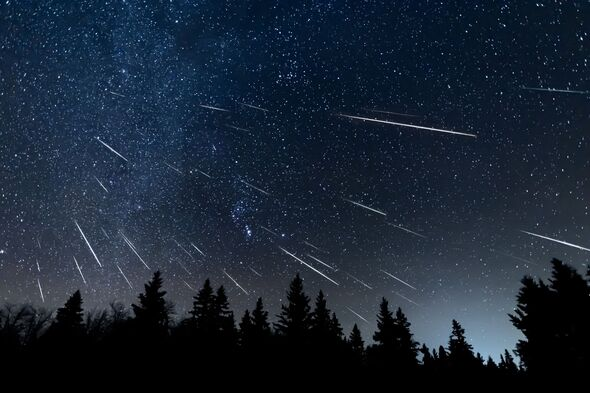
    Get ready for a springtime sky show! The Lyrid meteor shower is set to peak this week, offering skywatchers across the Northern Hemisphere a chance to witness one of the oldest and most reliable annual meteor showers.

    The 2025 Lyrids will reach their peak overnight Tuesday, April 22 into the early morning hours of Wednesday, April 23. Under dark, clear skies, observers can expect to see 15 to 20 meteors per hour, with some leaving glowing, persistent trails that hang in the sky for seconds at a time.

    When and Where to Watch

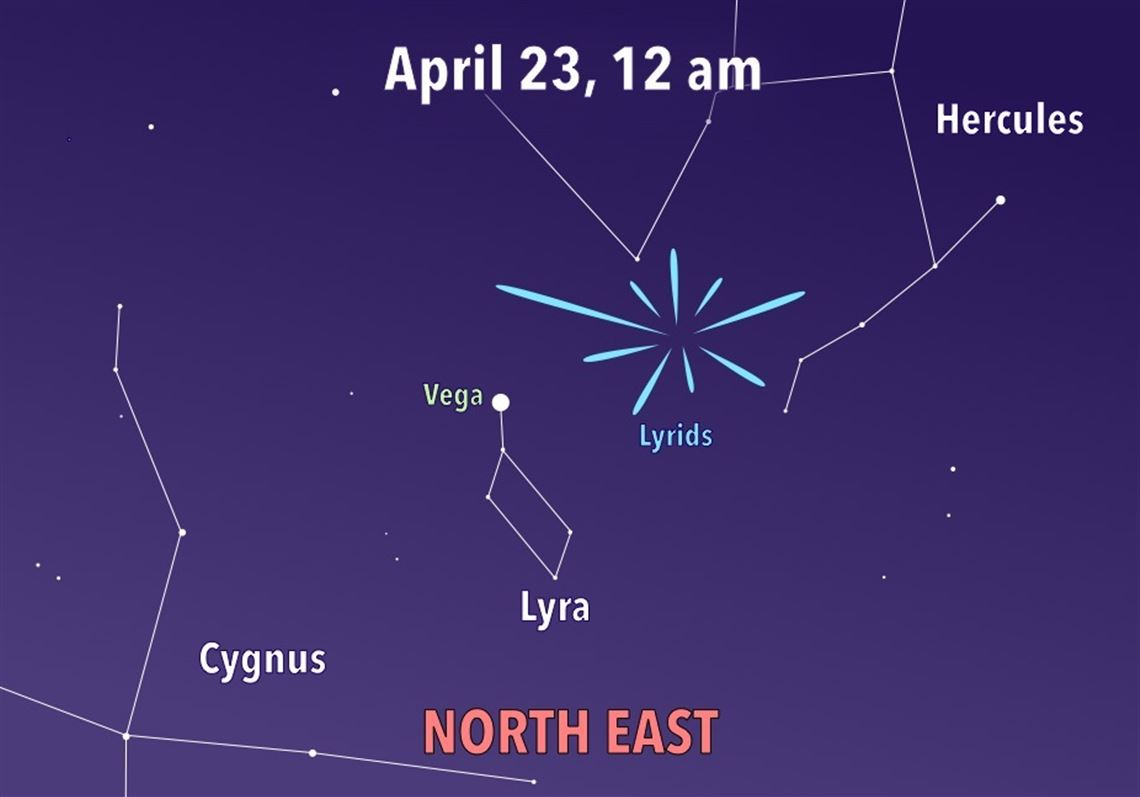
    The best time to look for Lyrids is after midnight local time, when the radiant point—located near the bright star Vega in the constellation Lyra—climbs higher into the sky. The higher Vega rises, the better your chances of spotting meteors streaking across the heavens.

    For the best view, head to a dark-sky location away from city lights. Lie back, give your eyes 20 to 30 minutes to adjust, and look up—you don’t need a telescope or binoculars.

    Will the Moon Interfere?

    The first quarter Moon sets before the peak viewing window opens, which means conditions will be much darker in the early morning hours of April 23—perfect for spotting fainter meteors that might otherwise be washed out by moonlight.

    A Shower with Deep Roots

    The Lyrids are caused by debris from Comet C/1861 G1 Thatcher, which last passed through the inner solar system over 160 years ago. First recorded by Chinese astronomers in 687 BCE, the Lyrids have been lighting up Earth’s skies for over 2,700 years, earning a reputation for occasional bursts of intense activity.

    While this year’s shower isn’t expected to produce an outburst, unexpected surges can’t be ruled out—making every meteor you catch feel just a little more magical.

    Weather Outlook

    As always, the weather plays a key role in visibility. Clear skies will offer the best opportunity to catch the show, so check your local forecast in advance. For those under clouds, several astronomy organizations will host livestreams of the event.

    Tips for the Best Experience

    • Go dark: Find a spot away from artificial light for the best contrast.
    • Get comfy: A reclining chair or blanket will help you look straight up without neck strain.
    • Dress warmly: Even in April, nighttime temperatures can dip, especially in open areas.
    • Be patient: It can take time for your eyes to adjust and for the meteors to start putting on a show.

    The Lyrid meteor shower may not be the year’s flashiest, but its long history and crisp spring timing make it a fan favorite. Make a wish—or a dozen—and enjoy one of nature’s best nighttime displays.

  • Astronomers discover rapid radio bursts from distant ‘dead’ galaxy

    Astronomers discover rapid radio bursts from distant ‘dead’ galaxy

    Astronomers have detected fast-repeating radio bursts from a distant “dead” galaxy, challenging existing theories about such phenomena. The discovery was reported on January 24, 2025.

    Fast radio bursts (FRBs) are intense, millisecond-long pulses of radio waves originating from distant galaxies. While some FRBs have been traced to galaxies with active star formation, the recent detection from a quiescent, or “dead,” galaxy—where star formation has ceased—raises questions about the mechanisms producing these bursts.

    The identification of repeating FRBs from a galaxy previously thought incapable of generating such high-energy phenomena suggests that our understanding of the environments and conditions necessary for FRB production is incomplete. Further research is needed to determine the exact sources and processes responsible for these enigmatic signals.

    The latest bursts were traced to a massive elliptical galaxy located billions of light-years away. This galaxy is classified as “quiescent,” meaning it has not formed new stars for billions of years. Such galaxies are typically considered inhospitable to the high-energy processes thought to produce FRBs, making the discovery especially surprising.

    The Case for Magnetars
    Magnetars, formed from the collapse of massive stars, are leading candidates for the origin of repeating FRBs. Their intense magnetic fields can produce bursts of radio waves during periods of instability. In active galaxies, magnetars can arise from recent supernova explosions, but their presence in a quiescent galaxy indicates they might also be formed by less conventional means, such as mergers of old stellar remnants.

    This finding underscores the importance of continued observation and study of FRBs across diverse galactic environments to unravel the mysteries surrounding their origins.

  • A Rare Celestial Spectacle: The Lunar Occultation of Mars on January 13, 2025

    A Rare Celestial Spectacle: The Lunar Occultation of Mars on January 13, 2025

    Prepare your stargazing binoculars and telescopes for a truly remarkable event, as Mars will temporarily vanish behind the moon in an astronomical phenomenon known as a lunar occultation. This captivating event will occur on January 13, 2025, offering skywatchers across large portions of the world a rare opportunity to witness the Red Planet disappearing and re-emerging from behind Earth’s natural satellite.

    What is a Lunar Occultation?

    A lunar occultation happens when the moon passes directly between Earth and another celestial object, temporarily obscuring that object from view. In this case, Mars will be hidden behind the moon’s bright disk for several minutes, creating a unique and fleeting moment in the night sky. Lunar occultations of planets are relatively rare occurrences because they require precise alignment between Earth, the moon, and the planet in question. When they do happen, they offer an extraordinary sight for observers and an excellent opportunity for astrophotographers to capture a spectacular cosmic event.

    Coinciding with Mars’ Opposition

    The timing of this occultation makes it even more special. On January 13, Mars will be in opposition, meaning it will be directly opposite the sun from Earth’s perspective. During opposition, Mars appears at its largest and brightest in the night sky, as it reaches its closest approach to Earth. This combination of a lunar occultation and Mars being at opposition is a rare cosmic coincidence that amplifies the visual spectacle.

    Mars will shine brilliantly in a deep reddish hue, and its brightness will contrast sharply with the glowing, full moon. As a result, viewers will have the chance to observe Mars in its most stunning form just before it slips behind the lunar surface.

    Where and When to Watch

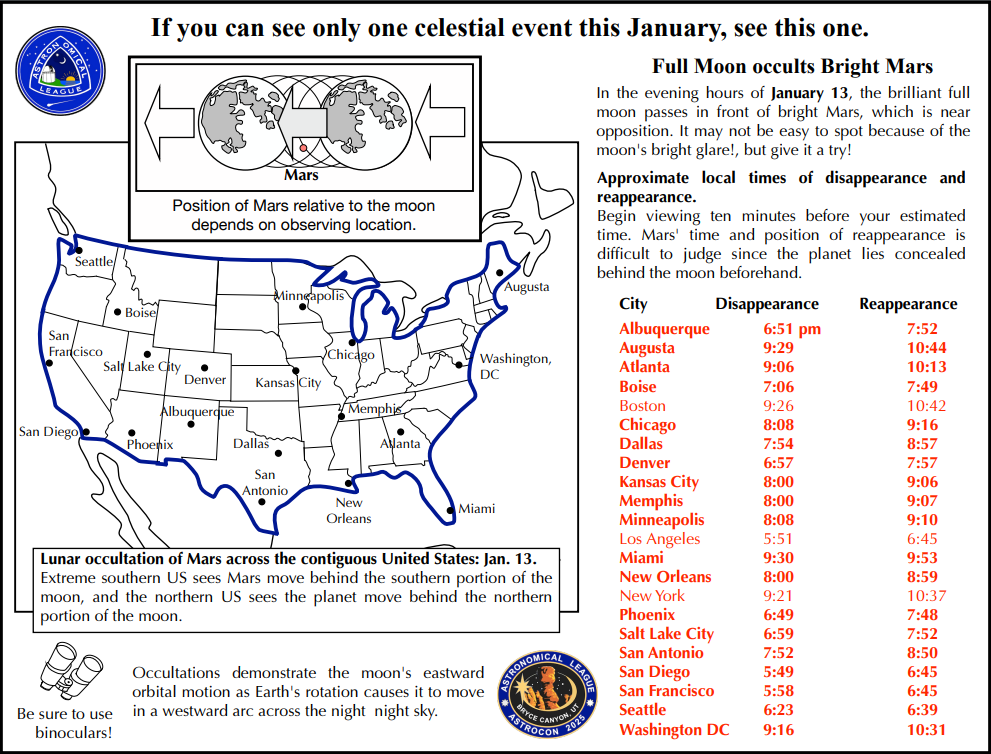
    This event will be visible across the contiguous United States, parts of Canada and Mexico, and portions of Western Africa. The exact timing of the occultation will vary slightly depending on your geographic location. Generally, Mars and the moon will rise together around 5 p.m. EST on January 13 and will remain close throughout the night until they set around 8 a.m. EST on January 14.

    In many regions, the occultation will begin in the early evening hours, shortly after sunset. Observers will first see Mars approach the bright limb of the moon before it disappears behind it. Depending on your location, the disappearance will last for several minutes to over an hour before Mars re-emerges on the opposite side of the moon.

    How to Maximize Your Viewing Experience

    For the best possible view of this celestial event, it’s crucial to find a location away from urban light pollution. A rural area or a dark-sky park will provide optimal conditions. Give your eyes at least 20 minutes to adjust to the darkness for enhanced visibility. While the lunar occultation will be visible to the naked eye, using a pair of binoculars or a small telescope will dramatically improve your experience, allowing you to see finer details of both Mars and the lunar surface.

    Astrophotographers should prepare in advance to capture this rare event. A telescope equipped with a camera or a DSLR attached to a high-quality telephoto lens will yield the best results. Since the moon will be full and bright, adjusting exposure settings to balance the moon’s brightness against Mars’ dimmer glow will be key to producing well-detailed images.

    Scientific and Cultural Significance

    Events like the lunar occultation of Mars have fascinated both amateur astronomers and professionals for centuries. Historically, occultations have been used to refine our understanding of the moon’s orbit and to measure the positions of stars and planets with great precision. In the modern era, they serve as a reminder of the dynamic nature of the night sky and offer an excellent opportunity to engage the public in the wonders of astronomy.

    Moreover, such events can inspire a sense of awe and curiosity about the universe. Whether you’re a seasoned stargazer or a casual observer, witnessing Mars disappear behind the moon can be a humbling experience, reminding us of our place in the vast cosmic dance.

    Final Thoughts

    The lunar occultation of Mars on January 13, 2025, is shaping up to be one of the most anticipated astronomical events of the year. With Mars at opposition, the full moon illuminating the sky, and clear winter nights typical for much of the viewing region, conditions are ideal for a memorable stargazing experience.

    Mark your calendar, gather your stargazing gear, and prepare to be dazzled by this celestial spectacle. Whether you watch with the naked eye, through binoculars, or a telescope, the sight of Mars vanishing and reappearing behind the moon is sure to be an unforgettable highlight of your stargazing adventures.

  • The Orionid Meteor Shower: A Guide for 2024

    The Orionid Meteor Shower: A Guide for 2024

    The Orionid meteor shower is an exciting annual event, and in 2024, the peak is expected on October 20 at 18:14 UTC. If you’re planning to watch, the best times are the early mornings of October 20 and 21, from after midnight until just before dawn.

    Key Dates and Times

    • Peak Viewing: October 20 and 21, just after midnight until dawn.
    • Duration: September 26 to November 22.
    • Moon Interference: Unfortunately, the moon will be a waning gibbous during the peak, which may make the meteors harder to see. Try positioning yourself so the moon is blocked from view.

    What to Expect

    On a good night, under dark skies with no moon interference, you might see between 10 to 20 meteors per hour. These meteors are known to be fast, and some may leave glowing trails that last a few seconds. Occasionally, a bright fireball might light up the sky.

    Where Do They Come From?

    The Orionids come from debris left behind by Halley’s Comet, one of the most famous comets in history. This comet orbits the sun about every 76 years, and as it passes, it leaves behind dust and small particles. These particles hit Earth’s atmosphere in October, creating the Orionid meteor shower. We also encounter its debris in May, which causes the Eta Aquariid meteor shower.

    What Makes the Orionids Special?

    • Speed: Orionid meteors travel at about 41 miles per second (66 km/s), making them some of the fastest meteors.
    • Trails: Many leave behind glowing ionized gas trails, known as persistent trains, which can last a few seconds after the meteor has disappeared.
    • Bright Meteors: Occasionally, a meteor will be exceptionally bright and may even break up into fragments.

    Where to Look in the Sky

    The Orionid meteors appear to come from the constellation Orion, which rises in the east after midnight. You don’t need to focus on Orion to see the meteors—they can appear in any part of the sky. But if you trace the path of a meteor backward, you might find it originated near Orion’s famous star, Betelgeuse.

    Tips for Viewing

    • Find a wide-open area with minimal light pollution.
    • You don’t need to look in a specific direction, as the meteors can appear anywhere in the sky.
    • If you’re watching with friends, spread out and face different directions for the best chance of spotting meteors.

    The 2024 Orionid meteor shower will peak on the mornings of October 20 and 21, though a bright moon may make it harder to see. Even so, this annual event is a great opportunity to witness fragments of Halley’s Comet streak across the sky. Happy meteor watching!

  • New Brilliant Comet On The Way? Comet C/2024 S1

    New Brilliant Comet On The Way? Comet C/2024 S1

    Comet C/2024 S1 (ATLAS): What to Expect

    Comet C/2024 S1 (ATLAS) is an exciting new discovery in the sky. Found on September 27, 2024, by the ATLAS system, this comet belongs to a special group called Kreutz sungrazers. These comets come incredibly close to the Sun, sometimes within 1.5 million kilometers (900,000 miles)—about the size of the Sun itself.

    While sungrazers have given us spectacular shows in the past, like the Great Comet of 1882 and Ikeya-Seki in 1965, C/2024 S1’s fate remains uncertain. Though originally anticipated to brighten as it nears the Sun, recent data suggest it might be disintegrating.

    Why Is This Comet Special?

    Kreutz sungrazers are particularly intriguing because their close encounters with the Sun make them unpredictable. Sometimes, they light up the sky as they heat up, but other times they disintegrate before they get the chance. C/2024 S1 is set to reach its closest point (perihelion) to the Sun on October 28, 2024. If it survives, there’s potential for it to become bright, possibly visible near sunrise. However, the latest observations show it’s starting to fade, suggesting it may break apart.

    What Does This Mean for Observers?

    If the comet brightens, it will only be for a short time around October 28, but it might be visible near sunrise in the Southern Hemisphere. On October 30 and 31, a thin waning crescent Moon will be in the sky, close to where the comet is expected to appear. While there’s still a chance for a brief show, the disintegration could mean we see very little.

    Warning: Never look directly at the Sun, especially with binoculars or telescopes, as it can cause severe and permanent eye damage.

    Monitoring Efforts

    The Comet Chasers project, involving schoolchildren and research telescopes, has been helping to observe the comet. Scientists are gathering more data to confirm whether C/2024 S1 will survive or disintegrate. Although the early signs are discouraging, comets can change rapidly, and astronomers are keeping a close watch.

    Stay tuned as we learn more in the days leading up to its closest approach!

  • Spectacular Comet C/2023 A3 (Tsuchinshan-ATLAS) Set to Dazzle Northern Hemisphere Skies

    Spectacular Comet C/2023 A3 (Tsuchinshan-ATLAS) Set to Dazzle Northern Hemisphere Skies

    Astronomy enthusiasts and casual stargazers alike are gearing up for a celestial treat as Comet C/2023 A3 (Tsuchinshan-ATLAS) makes its grand appearance in the evening skies of the Northern Hemisphere following the 12th of October.

    Brightening steadily, C/2023 A3 is already captivating viewers in the Southern Hemisphere, and predictions suggest that it could become one of the most remarkable comets seen in recent years. Experts believe that with a projected brightness potentially exceeding magnitude -5.0, this comet may even outshine the celebrated Comet NEOWISE, which dazzled audiences in the summer of 2020.

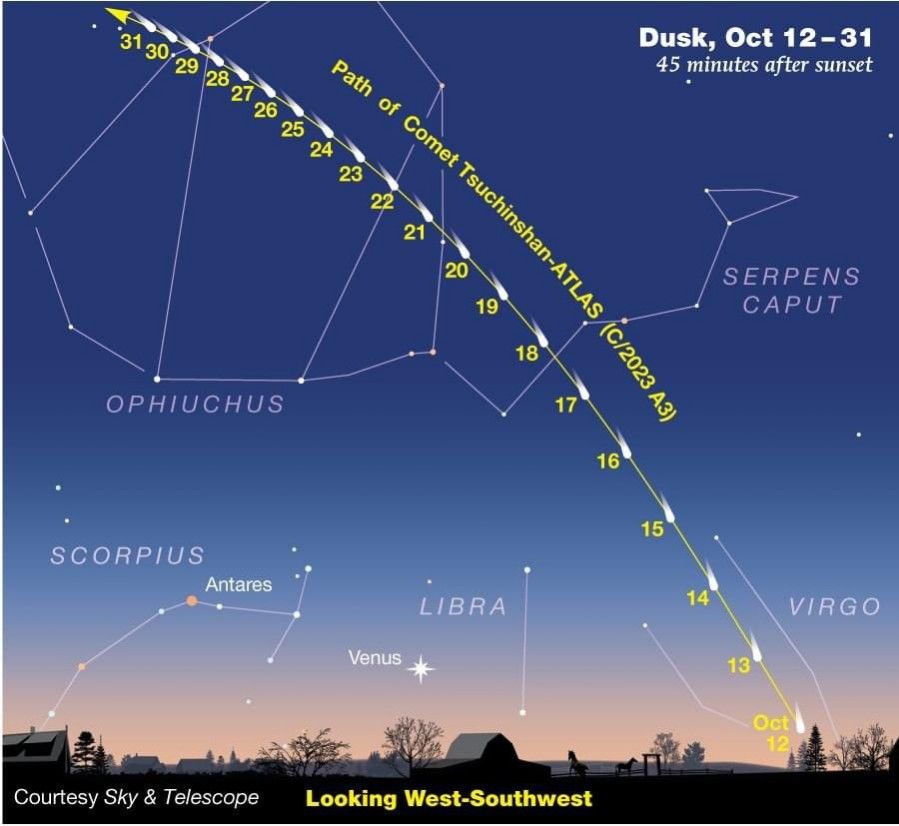
    As the comet approaches its closest pass to the Earth on October 12, observers can anticipate a stunning visual display. Initially appearing in the constellation Virgo shortly after sunset, C/2023 A3 promises to be visible to the naked eye, offering a thrilling opportunity for those in dark sky areas.

    • October 10-12: from -3.0 to -1.0 mag, appears in the evening in the Northern Hemisphere shortly after sunset, very low in the western sky in the constellation of Virgo. Short observation window, but visible with the naked eye! Best time to see the comet. Makes its closest approach to Earth on October 12.
    • October 13-14: from -1.0 to 1.0 mag, quickly losing brightness, but moving farther from the Sun and therefore easier to see. Visible with the naked eye in the evening about an hour after sunset. On October 14, C/2023 A3 will pass close to another comet, 13P/Olbers (mag 10).
    • October 15-19: 1.0 to 4.5 mag, moving toward Serpens Caput. May produce an anti-tail, a bright streak that appears to be pointing toward the Sun, opposite the other tails. On October 15, it will pass 1.4° from the M5 globular cluster, providing a good photo opportunity
    • October 20-31: 4.5 to 7.0 mag, moving across the constellation Ophiuchus relatively high in the southwestern sky in the evening. Visible with binoculars and telescopes. During these days, the tail of the comet will begin to grow rapidly, possibly reaching up to 20° long (about 40 times the size of the Full Moon) under dark skies.
    • November: from 7 to 8 mag, visible in the evening. Rises higher in the Northern Hemisphere after sunset.
    • December: from 8 to 10 mag, gradually moves closer to the Sun in our sky, rising lower above the horizon. Not visible from the Southern Hemisphere.

    As the comet moves further from the Sun after its perihelion on September 27, observers can also expect to see a dramatic tail grow, formed by the melting ice and dust particles released as it experiences the Sun’s heat.

    With the comet gaining visibility, schools, observatories, and astronomy clubs are arranging viewing events and educational sessions to celebrate this magnificent astronomical event.

    Stay tuned and prepare your telescopes or cameras! This is a once-in-a-lifetime chance to witness the beauty of Comet C/2023 A3 (Tsuchinshan-ATLAS) as it lights up our night skies.