Astronomers have detected fast-repeating radio bursts from a distant “dead” galaxy, challenging existing theories about such phenomena. The discovery was reported on January 24, 2025.
Fast radio bursts (FRBs) are intense, millisecond-long pulses of radio waves originating from distant galaxies. While some FRBs have been traced to galaxies with active star formation, the recent detection from a quiescent, or “dead,” galaxy—where star formation has ceased—raises questions about the mechanisms producing these bursts.
The identification of repeating FRBs from a galaxy previously thought incapable of generating such high-energy phenomena suggests that our understanding of the environments and conditions necessary for FRB production is incomplete. Further research is needed to determine the exact sources and processes responsible for these enigmatic signals.
The latest bursts were traced to a massive elliptical galaxy located billions of light-years away. This galaxy is classified as “quiescent,” meaning it has not formed new stars for billions of years. Such galaxies are typically considered inhospitable to the high-energy processes thought to produce FRBs, making the discovery especially surprising.
The Case for Magnetars Magnetars, formed from the collapse of massive stars, are leading candidates for the origin of repeating FRBs. Their intense magnetic fields can produce bursts of radio waves during periods of instability. In active galaxies, magnetars can arise from recent supernova explosions, but their presence in a quiescent galaxy indicates they might also be formed by less conventional means, such as mergers of old stellar remnants.
This finding underscores the importance of continued observation and study of FRBs across diverse galactic environments to unravel the mysteries surrounding their origins.
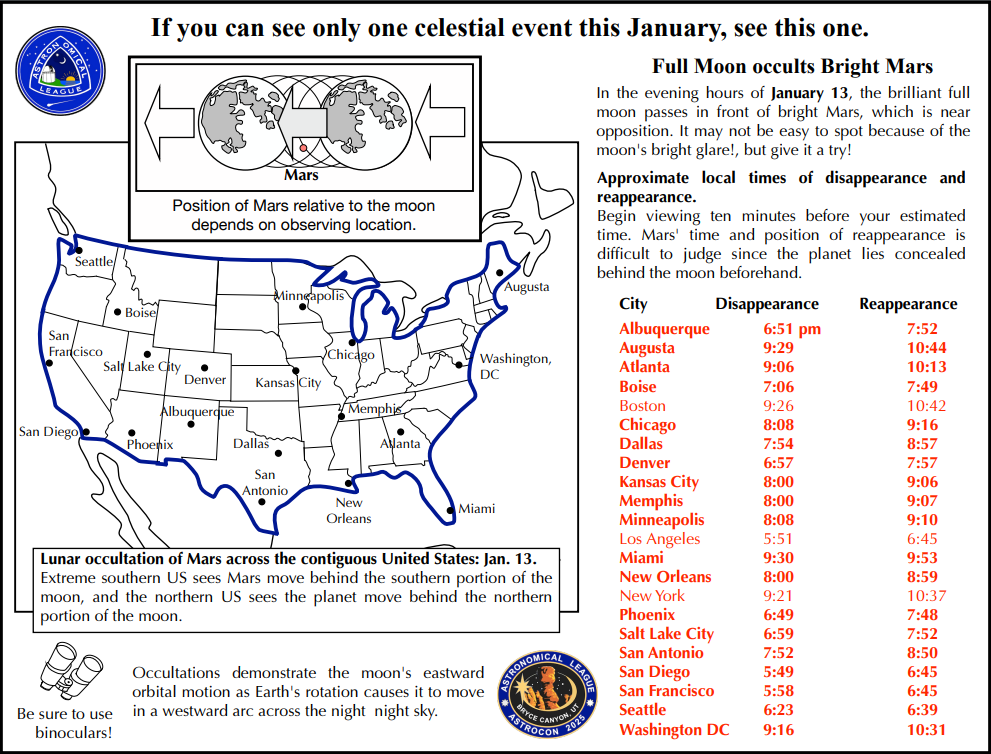
Prepare your stargazing binoculars and telescopes for a truly remarkable event, as Mars will temporarily vanish behind the moon in an astronomical phenomenon known as a lunar occultation. This captivating event will occur on January 13, 2025, offering skywatchers across large portions of the world a rare opportunity to witness the Red Planet disappearing and re-emerging from behind Earth’s natural satellite.
What is a Lunar Occultation?
A lunar occultation happens when the moon passes directly between Earth and another celestial object, temporarily obscuring that object from view. In this case, Mars will be hidden behind the moon’s bright disk for several minutes, creating a unique and fleeting moment in the night sky. Lunar occultations of planets are relatively rare occurrences because they require precise alignment between Earth, the moon, and the planet in question. When they do happen, they offer an extraordinary sight for observers and an excellent opportunity for astrophotographers to capture a spectacular cosmic event.
Coinciding with Mars’ Opposition
The timing of this occultation makes it even more special. On January 13, Mars will be in opposition, meaning it will be directly opposite the sun from Earth’s perspective. During opposition, Mars appears at its largest and brightest in the night sky, as it reaches its closest approach to Earth. This combination of a lunar occultation and Mars being at opposition is a rare cosmic coincidence that amplifies the visual spectacle.
Mars will shine brilliantly in a deep reddish hue, and its brightness will contrast sharply with the glowing, full moon. As a result, viewers will have the chance to observe Mars in its most stunning form just before it slips behind the lunar surface.
Where and When to Watch
This event will be visible across the contiguous United States, parts of Canada and Mexico, and portions of Western Africa. The exact timing of the occultation will vary slightly depending on your geographic location. Generally, Mars and the moon will rise together around 5 p.m. EST on January 13 and will remain close throughout the night until they set around 8 a.m. EST on January 14.
In many regions, the occultation will begin in the early evening hours, shortly after sunset. Observers will first see Mars approach the bright limb of the moon before it disappears behind it. Depending on your location, the disappearance will last for several minutes to over an hour before Mars re-emerges on the opposite side of the moon.
How to Maximize Your Viewing Experience
For the best possible view of this celestial event, it’s crucial to find a location away from urban light pollution. A rural area or a dark-sky park will provide optimal conditions. Give your eyes at least 20 minutes to adjust to the darkness for enhanced visibility. While the lunar occultation will be visible to the naked eye, using a pair of binoculars or a small telescope will dramatically improve your experience, allowing you to see finer details of both Mars and the lunar surface.
Astrophotographers should prepare in advance to capture this rare event. A telescope equipped with a camera or a DSLR attached to a high-quality telephoto lens will yield the best results. Since the moon will be full and bright, adjusting exposure settings to balance the moon’s brightness against Mars’ dimmer glow will be key to producing well-detailed images.
Scientific and Cultural Significance
Events like the lunar occultation of Mars have fascinated both amateur astronomers and professionals for centuries. Historically, occultations have been used to refine our understanding of the moon’s orbit and to measure the positions of stars and planets with great precision. In the modern era, they serve as a reminder of the dynamic nature of the night sky and offer an excellent opportunity to engage the public in the wonders of astronomy.
Moreover, such events can inspire a sense of awe and curiosity about the universe. Whether you’re a seasoned stargazer or a casual observer, witnessing Mars disappear behind the moon can be a humbling experience, reminding us of our place in the vast cosmic dance.
Final Thoughts
The lunar occultation of Mars on January 13, 2025, is shaping up to be one of the most anticipated astronomical events of the year. With Mars at opposition, the full moon illuminating the sky, and clear winter nights typical for much of the viewing region, conditions are ideal for a memorable stargazing experience.
Mark your calendar, gather your stargazing gear, and prepare to be dazzled by this celestial spectacle. Whether you watch with the naked eye, through binoculars, or a telescope, the sight of Mars vanishing and reappearing behind the moon is sure to be an unforgettable highlight of your stargazing adventures.