Tag: solar flare

  • Rare G4 Geomagnetic Storm May Bring Northern Lights to Delmarva Sunday Night

    Rare G4 Geomagnetic Storm May Bring Northern Lights to Delmarva Sunday Night

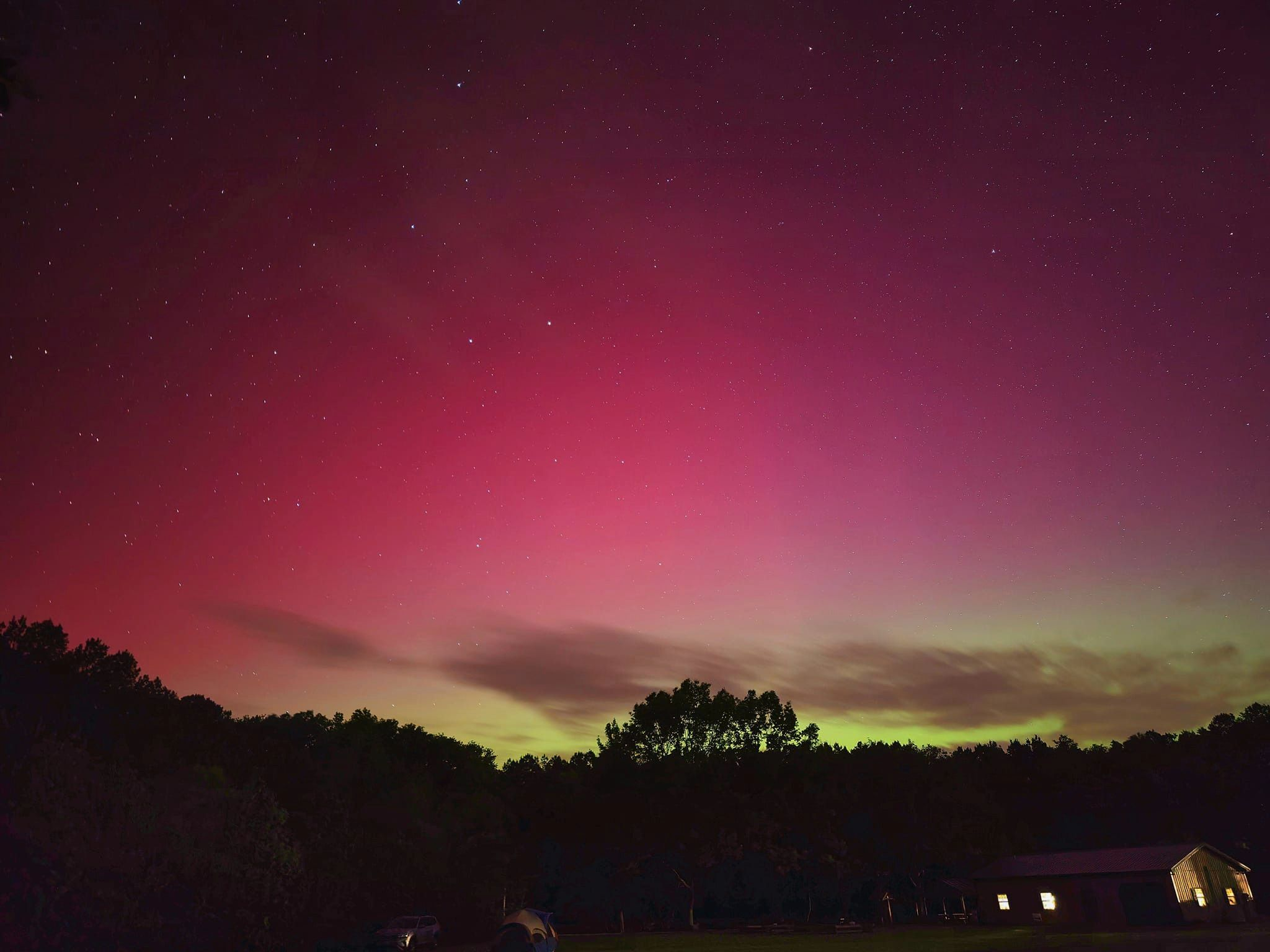
    Delmarva Peninsula — A rare and powerful G4 (Severe) Geomagnetic Storm Watch has been issued by the NOAA Space Weather Prediction Center (SWPC) for Sunday, June 1st, bringing the potential for Northern Lights (aurora borealis) to be visible as far south as parts of the Delmarva Peninsula, pending favorable sky conditions.

    The alert, issued Saturday, cites a series of strong solar eruptions from the Sun’s surface that are sending coronal mass ejections (CMEs) toward Earth. These charged solar particles are forecast to arrive late Sunday (UTC time), with impacts possible through early Monday.

    NOAA’s G-scale for geomagnetic storms ranges from G1 (Minor) to G5 (Extreme). A G4 storm is a rare event, with only a few occurring each solar cycle, and can trigger vibrant auroras that stretch well south of their typical range near the Arctic Circle.

    If skies remain clear Sunday night, residents across Maryland’s Eastern Shore, Delaware, and even coastal Virginia could have a chance to spot the shimmering auroras towards the northern skies—especially from darker rural areas away from city lights.

    In addition to auroras, G4-level geomagnetic storms can cause intermittent issues with GPS accuracy, radio communications, and satellite operations, though infrastructure is generally equipped to handle such events.

    The storm is associated with recent activity from sunspot region 4100 launching a long duration M8 solar flare. SWPC forecasters say the exact timing and intensity of auroral displays will depend on how directly the CME hits Earth’s magnetic field and how the Interplanetary Magnetic Field (IMF) aligns.

    For the best chance at viewing the aurora:

    • Look north after dark Sunday night.
    • Get away from light pollution.
    • Bring a camera—auroras are often more easily detected in long-exposure photos than by eye at lower latitudes.

    This could be one of the most significant aurora viewing opportunities for the Mid-Atlantic region in for 2025 thus far. Stay tuned to local forecasts for cloud cover updates and check the NOAA SWPC or aurora tracking sites for real-time alerts.
  • Severe Geomagnetic Storm Expected: CME Set to Impact Earth on October 10-11, 2024

    Severe Geomagnetic Storm Expected: CME Set to Impact Earth on October 10-11, 2024

    A fast-moving coronal mass ejection (CME) erupted from the Sun on the evening of October 8, 2024, and is projected to reach Earth by October 10. This CME, associated with a long-duration X1.8 solar flare, is moving at an estimated speed of 1200 to 1300 km/s. With this velocity, the CME could arrive as early as the morning or midday of October 10 (EDT). Experts are warning of a possible G4 (Severe) geomagnetic storm upon its arrival and throughout its passage.

    What Makes This Storm Significant?

    The CME, triggered by an X-class solar flare, is moving at a particularly high speed. These types of solar flares and subsequent CMEs can cause significant disturbances in Earth’s magnetic field upon impact. If the storm reaches G4 (Severe) on the NOAA Space Weather Prediction Center’s geomagnetic storm scale, the consequences could be far-reaching.

    G4 storms can cause voltage control problems in power grids, affect spacecraft operations, and lead to widespread HF radio blackouts on the daylight side of Earth. In addition, auroras could be visible much farther from the poles than usual, potentially gracing the skies of lower latitudes with a stunning display of the Northern and Southern Lights.

    Arrival and Impact Timing

    Current forecasts suggest that the CME could reach Earth as early as the morning to midday of October 10. However, the precise timing and intensity of the geomagnetic storm won’t be known until the CME is approximately 1 million miles from Earth. At this point, the DSCOVR and ACE satellites will measure its speed, density, and magnetic field characteristics. These factors will determine whether the storm will hit with severe intensity or something less.

    What Does a G4 Storm Mean?

    A G4 storm is classified as “severe” and has the potential to cause significant disruptions across multiple sectors:

    • Power Systems: Voltage irregularities may occur, especially in high-latitude regions. Some transformers could experience damage, though modern grid systems are better equipped to handle these situations.
    • Satellite Operations: Satellites in low-Earth orbit could experience increased drag, forcing operators to make corrections. Communications and GPS signals could also be temporarily disrupted, potentially impacting air traffic control, maritime navigation, and other services.
    • Radio Communications: High-frequency (HF) radio communications, critical for aviation and emergency services, may face widespread blackouts, particularly on the daylight side of the planet.
    • Auroras: One of the more enjoyable effects of geomagnetic storms is the appearance of auroras. During a G4 event, auroras can extend much farther from the poles, potentially being visible across parts of Europe, the northern United States, and even farther south in some cases.

    Preparing for the Storm

    Governments, businesses, and individuals should prepare for the potential effects of this geomagnetic storm. Power grid operators are monitoring the situation closely, and satellite operators may place their spacecraft in safe modes to mitigate damage from solar particles. For the public, it’s a good idea to charge essential devices ahead of time in case of brief power outages and monitor space weather updates.

    Those who live in areas where auroras might be visible should keep an eye on real-time space weather updates and consider venturing outside for what could be an unforgettable display.

    Stay Updated

    We won’t know the full characteristics of this CME until its proximity to Earth allows for satellite measurements. To stay informed on the latest updates and space weather predictions, please visit our webpage. Regular updates will be provided as more data becomes available from DSCOVR, ACE, and other space weather monitoring satellites.

    Prepare for potential disruptions and, if you’re lucky, be ready to witness a breathtaking natural phenomenon in the night sky.

  • Northern Lights May Grace Mid-Atlantic Skies This Weekend Following Powerful Solar Flare

    Northern Lights May Grace Mid-Atlantic Skies This Weekend Following Powerful Solar Flare

    Residents of the Mid-Atlantic region may have the rare opportunity to witness the Northern Lights this weekend, thanks to a powerful solar flare that erupted on Thursday. The flare, classified as an X9, the most intense of this current solar cycle, hurled a coronal mass ejection (CME) toward Earth. This CME is expected to arrive by Saturday afternoon, October 5, with the potential to create dazzling auroral displays across the sky that night.

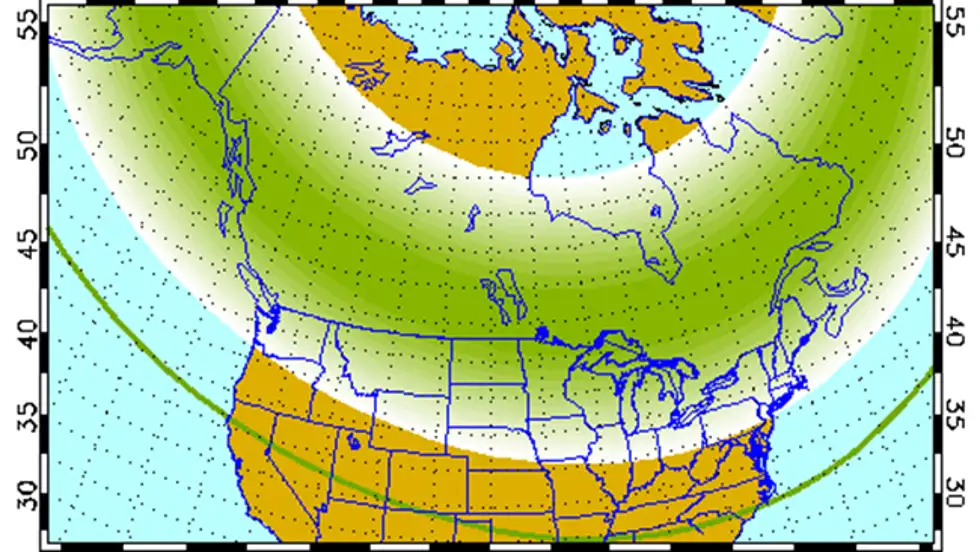
    Forecasters are predicting a G3 (strong) geomagnetic storm, which could push the auroras farther south than usual, potentially making them visible as far as the Mid-Atlantic states, including regions like Pennsylvania, Maryland, and Virginia. This would be a special treat for skywatchers, as the Northern Lights are typically confined to polar regions and are rarely visible this far south.

    The solar flare responsible for this event is the largest we’ve seen during this 11-year solar cycle. These X-class flares are the most intense type of solar flares and have the power to impact Earth’s magnetic field, disrupting satellite communications and causing geomagnetic storms. The impending G3 storm falls in the “strong” category, which could result in heightened auroral activity and visible Northern Lights.

    For those hoping to catch a glimpse, the best time to look up will be after nightfall on Saturday. Clear skies and areas away from city lights will offer the best viewing conditions. While there is no guarantee that the Northern Lights will be visible this far south, the combination of a strong CME and a G3 storm significantly increases the chances.

    Skywatchers should also keep an eye on real-time aurora forecasts for updates on the storm’s strength and timing as it approaches. Even though geomagnetic activity is highly unpredictable, this event offers an exciting possibility for stargazers in the Mid-Atlantic.

    Be sure to look north toward the horizon and keep your cameras ready, you might just witness a rare cosmic display.