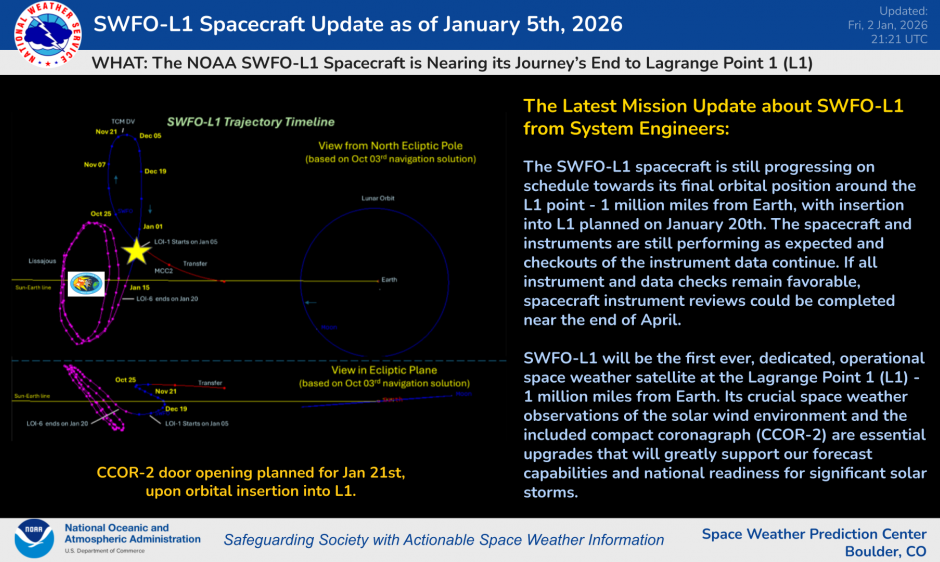
January 6, 2026 — NOAA’s Space Weather Follow On-L1 (SWFO-L1) spacecraft is nearing the final stages of its journey to Lagrange Point 1 (L1), with orbital insertion scheduled for January 20, 2026. According to a NOAA Space Weather Prediction Center update, the mission’s instrumentation is performing as expected, and engineers report that the spacecraft continues to meet operational milestones as it approaches its final orbit.
SWFO-L1 was launched on September 24, 2025 aboard a SpaceX Falcon 9 rocket and is designed to provide continuous, real-time monitoring of the solar environment upstream of Earth. Upon reaching the gravitationally stable L1 point—approximately 1 million miles from Earth—it will be renamed SOLAR-1 (Space weather Observations at L1 to Advance Readiness-1).
Mission engineers are preparing to open the compact coronagraph (CCOR-2) door on January 21, the day after insertion, which will allow NOAA to begin evaluating imagery performance from this key instrument. Early tests of other sensor suites have already shown promising results.
SWFO-L1 carries several advanced instruments, including a magnetometer, solar wind plasma sensor (SWiPS), and a supra-thermal ion sensor (STIS). These instruments will provide vital measurements of solar wind speed, density, and magnetic field characteristics that drive space weather disturbances. Previous early data from these sensors have already contributed to improved monitoring of solar wind and geomagnetic conditions during space weather events.
Once commissioned in spring 2026, SOLAR-1’s data is expected to significantly enhance NOAA’s ability to forecast and issue warnings for geomagnetic storms, solar flares, and interplanetary shocks that can impact critical infrastructure such as power grids, communications, navigation systems, and satellites.
With more accurate and timely space weather data, NOAA officials say the mission will help protect both space-based and ground-based technological systems that are increasingly vulnerable to solar activity—ensuring better preparedness for potentially disruptive solar events.
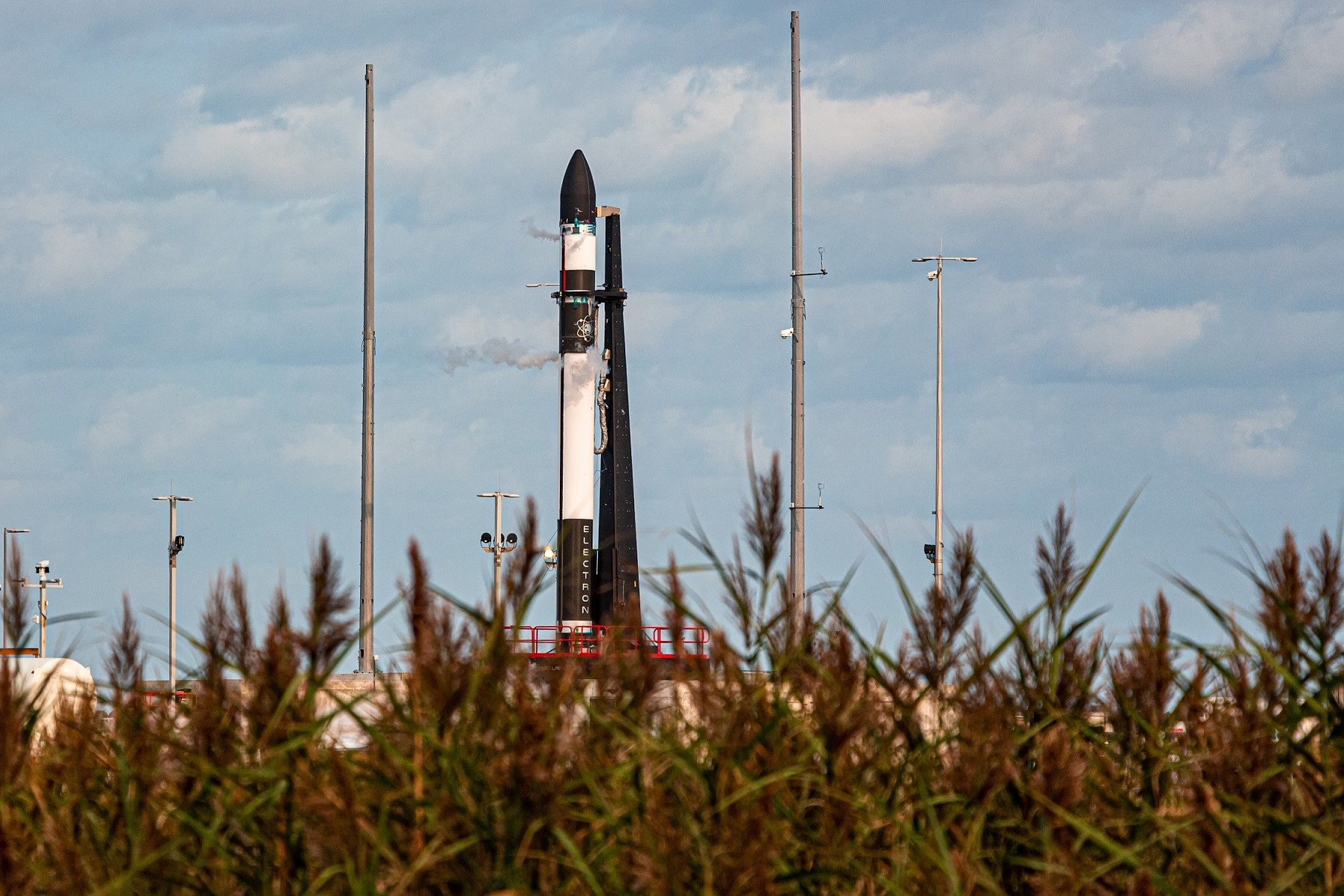
NASA’s Wallops Flight Facility will support the launch of Rocket Lab USA’s first Electron rocket from Virginia at 6 p.m. EST, Monday, Jan. 23.
The 59-foot-tall Electron rocket will lift off from Launch Complex 2 at Virginia Space’s Mid-Atlantic Regional Spaceport on Wallops Island. The mission, named “Virginia is for Launch Lovers,” will deploy radio frequency monitoring satellites for HawkEye 360.
The launch window for the mission is 6-8 p.m. with subsequent back-up launch days.
With this mission, NASA is helping foster a growing low-Earth space economy and continues Wallops’ 35-year history of support to the commercial launch industry.
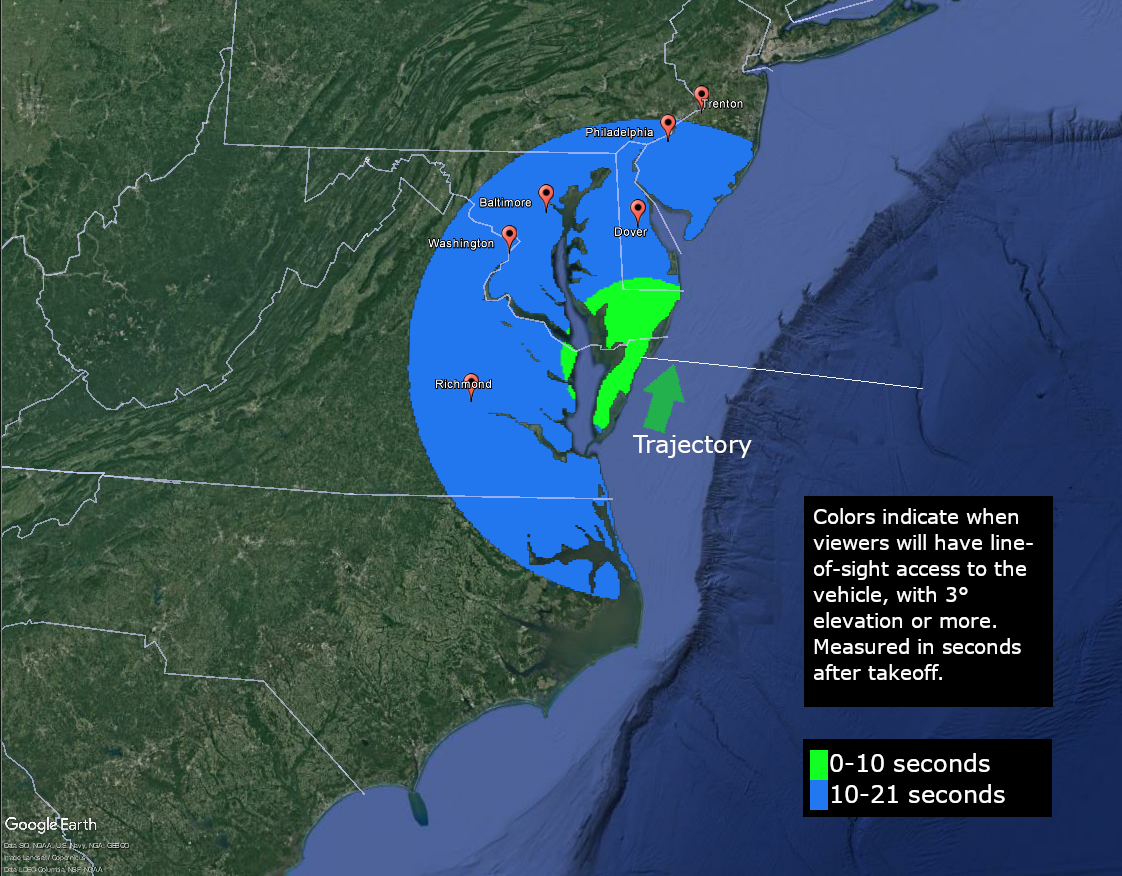
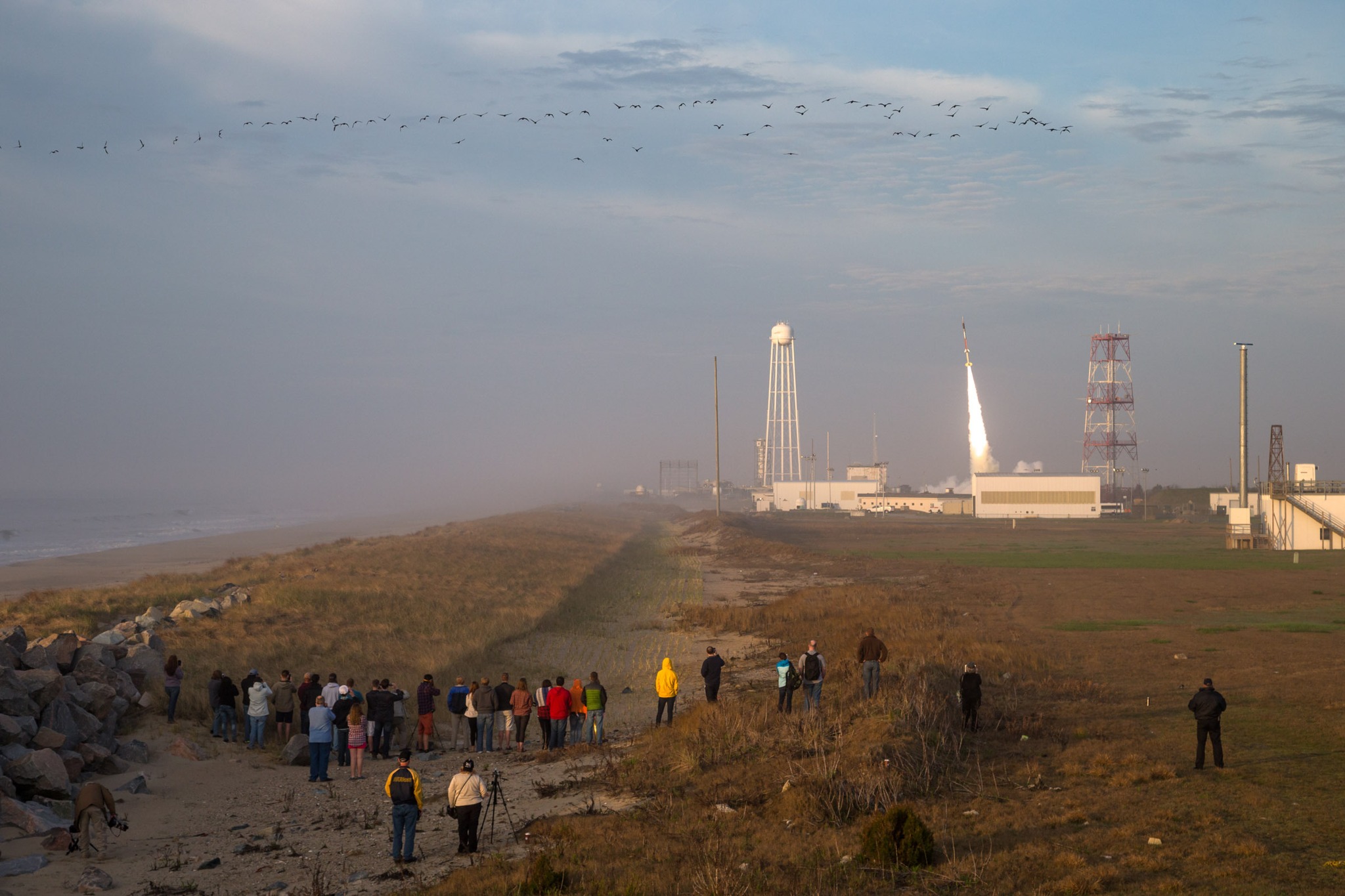
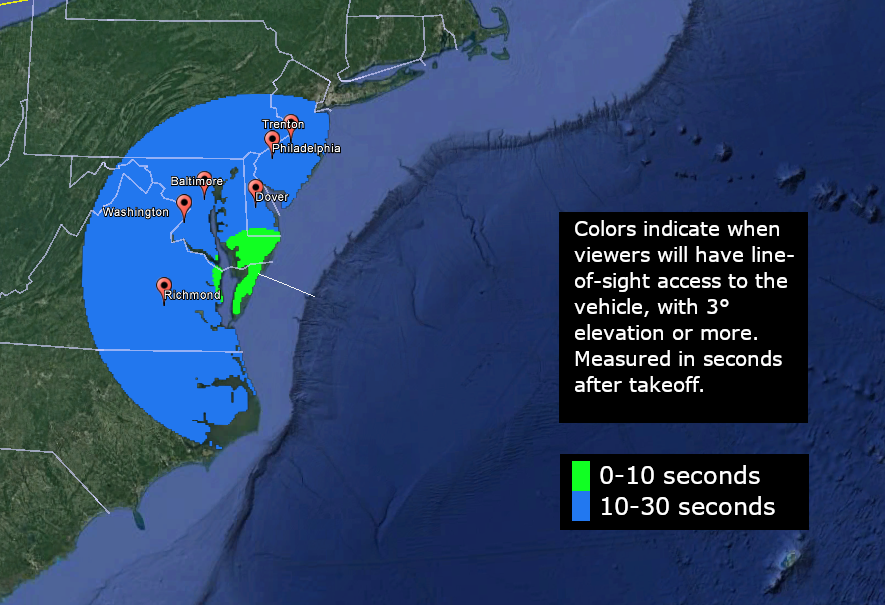
The launch may be visible, weather permitting, to residents throughout much of the east coast of the United States.
Viewing locations on Chincoteague Island include Robert Reed Park on Main Street or Beach Road spanning the area between Chincoteague and Assateague Islands. The Virginia, Maryland and Delaware Atlantic beaches also provide good viewing locations. The NASA Visitor Center at Wallops will be open for this launch, and will open at 4 p.m. on Monday, Jan. 23.
Rise and shine early to catch the next launch of Northrop Grumman’s Antares rocket from NASA’s Wallops Flight Facility on the Eastern Shore of Virginia.
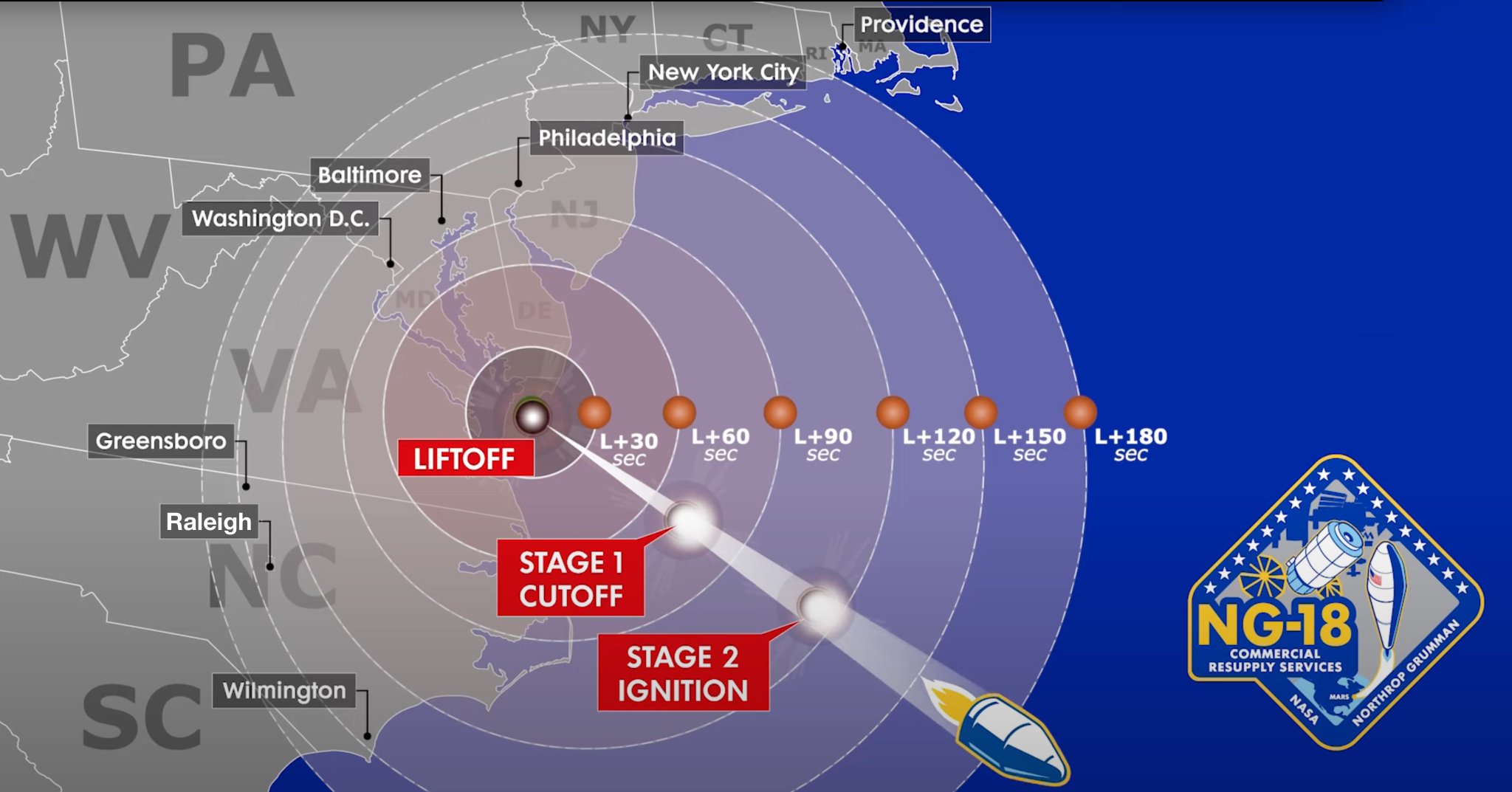
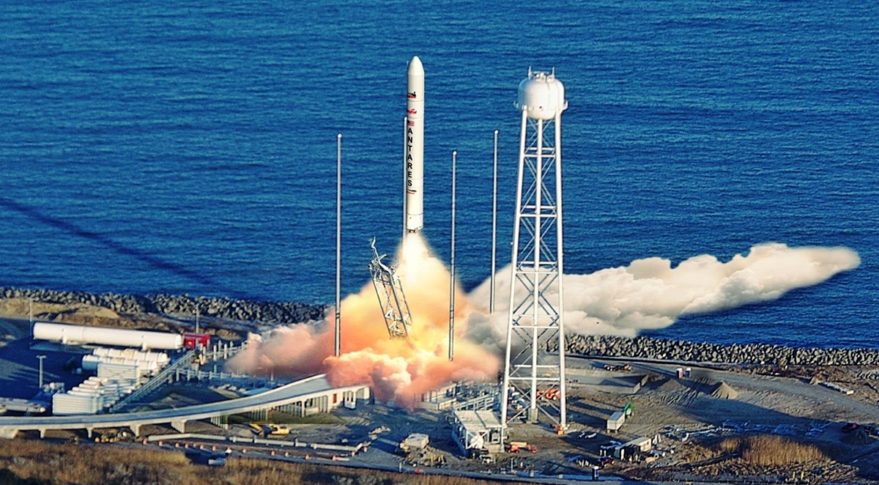
The next Antares launch is scheduled for 5:50 a.m. EST, Sunday, Nov. 6, from the Mid-Atlantic Regional Spaceport’s Pad 0A on Wallops Island.
The launch just before sunrise may be visible, weather permitting, to residents throughout the mid-Atlantic region and possibly the East Coast of the United States.
This will be Northrop Grumman’s 18th commercial resupply services mission for NASA, delivering science investigations, supplies and equipment to the International Space Station.
The time changes from Eastern Daylight Time (EDT) to Eastern Standard Time (EST) at 2 a.m., Nov. 6. Take the change into account when making your plans and remember to turn your clock back one-hour when going to bed the night of Nov. 5.
Viewing locations on Chincoteague Island include Robert Reed Park on Main Street or Beach Road spanning the area between Chincoteague and Assateague Islands. The Virginia, Maryland and Delaware Atlantic beaches also provide good viewing locations.
The NASA Visitor Center at Wallops will be open for this launch. Gates open at 3:30 a.m. EST.
Live coverage of the mission countdown is scheduled to begin at approximately 1:50 a.m. EDT on the Wallops IBM video site.
Launch coverage and mission commentary will air live on NASA TV at 5:30 a.m. EST. For NASA TV streaming video, downlink and scheduling information, visit:
NASA will test new science equipment for future missions with a sounding rocket launch August 22 from its Wallops Flight Facility in Virginia.
.
The Sporadic-E ElectroDynamics Demonstration mission, or SpEED Demon, will fly new instrumentation along with heritage instruments that have flown on other sounding rocket missions, but not together. The SpEED Demon instruments will be further improved based on results from this launch and will subsequently fly on a science mission targeted for summer 2024 from the Kwajalein Atoll in the Marshall Islands and possibly many other sounding rocket opportunities.
Credits: NASA’s Wallops Flight Facility
SpEED Demon will launch on a 40-foot tall Terrier-Improved Malemute sounding rocket between 9 p.m. EDT Aug. 22 and 1 a.m. Aug. 23. The backup launch dates are Aug. 23 through Aug. 27.
.
The NASA Wallops Visitor Center will open to the public at 8 p.m. on launch day for viewing the flight. The rocket launch is expected to be visible from the mid-Atlantic/Chesapeake Bay region. Live coverage of the mission is scheduled to begin at 8:40 p.m. on the Wallops YouTube site.
NASA’s MAVEN (Mars Atmosphere and Volatile EvolutioN) spacecraft discovered “layers” and “rifts” in the electrically charged part of the upper atmosphere (the ionosphere) of Mars. The phenomenon is similar to commonly occurring sporadic-E layers on Earth, which SpEED Demon is studying, that can cause unpredictable disruptions to radio communications. This unexpected discovery by MAVEN shows that Mars is a unique laboratory to explore and better understand this highly disruptive phenomenon that can occur on presumably any planet. Credits: NASA’s Goddard Space Flight Center
Community college and university teams from across the United States will descend on NASA’s Wallops Flight Facility in Virginia on Aug. 9 to launch experiments that they designed and built into space.
.
The student experiments will launch on a 44-foot-tall Terrier-Improved Malemute sounding rocket. Launch is scheduled between 5:30 and 9 p.m. EDT, with live coverage scheduled to begin at 5:10 p.m. on the Wallops YouTube site. The NASA Wallops Visitor Center will be open to the public for viewing the flight, which is expected to be visible from the Eastern Shore of Virginia and Maryland and southern Delaware. The backup launch dates are Aug. 10 and 11.
.
After flying to around 91 miles altitude, the payload carrying the experiments will descend by parachute and is expected to land in the Atlantic Ocean, about 64 miles off the Virginia coast, 15 minutes after launch. The students will receive their flown experiments and any stored data after the payload is recovered from the ocean.
.
The student projects focus on technology development for sounding rockets and spacecraft. The onboard payload includes a device to help payloads descend autonomously after an electrical failure; a sublimation-fueled motor for spacecraft; machine-learning applications for space robotics; a deployable boom for capturing high-definition, 360-degree video of a rocket’s experiments; a probe for measuring electrical currents in the ionosphere; and an ejection system for returning small spacecraft to Earth.
.
The experiments are being flown through the RockSat-X program in conjunction with the Colorado Space Grant Consortium. RockSat-X gives students at secondary institutions the experience of building experiments for space flight.
.
“RockSat-X provides students an opportunity to improve their skills through experiment development and then analyzing their data following the launch,” said Giovanni Rosanova, chief of the Sounding Rockets Program Office at Wallops. “Programs like these are vital in preparing students for careers after graduation.”
.
Approximately 75 of the 120 students participating in this year’s RockSat-X program will be at Wallops to support the final integration their experiments into the rocket and view the launch.
.
RockSat-X is part of NASA’s three-phase sounding rocket program for students. RockOn launches are at the entry level, RockSat-C projects are at the intermediate level, and RockSat-X is the most advanced. RockSat-X experiments are flown approximately 20 miles higher in altitude than those in the RockOn and RockSat-C programs, providing more flight time in space. The whole experience requires students to expand their skills to develop and build more complex projects as they progress through the programs.
“This will be the 13th flight of a RockSat-X payload,” said Chris Koehler, director of the Colorado Space Grant Consortium. “Hundreds of students have participated in the RockSat-X program prior to careers with government, education, or commercial organizations.”
.
Participating institutions in the 2022 RockSat-X flight are the Arapahoe Community College in Littleton, Colorado; Red Rocks Community College in Lakewood, Colorado; College of the Canyons in Santa Clarita, California; Virginia Tech in Blacksburg; Northwest Nazarene University in Nampa, Idaho; Kauai Community College in Līhuʻe, Hawaii; and the University of Kentucky in Lexington.
The team is developing an autonomous autorotational device that will provide a reusable descent method for a payload vehicle in the event of an electrical systems failure. Utilizing aerodynamic design and telemetry data collection, the team will investigate how a payload’s velocity involved in assisted pitched blade design will maximize autorotation upon re-entry into an atmosphere.
.
University of Hawaii Community Colleges
The team is conducting research on the feasibility of using a sublimation–fueled motor for providing low-power vernier thrust. The specific impulse of the sublimate camphor will be determined by a static ground test and by deploying the rocket from the sounding rocket at apogee. On board cameras will record the sublimation rocket’s flight parameters. This data will be supplemented by an inertial measurement unit and a multi-axis accelerometer that will provide a baseline for the payload’s flight trajectory.
.
Northwest Nazarene University
The team will investigate that Deep Meta Reinforcement Learning is a viable method for adaptive astro-robotics and demonstrate a viable soft robotic fluid for future space applications.
.
Community Colleges of Colorado
The team seeks to improve on a legacy deployable boom arm by changing the mechanism used to generate torque with interlocking gears, use a 360-degree camera to shoot high-definition video with a clear view of the rocket and experiments, and create an experiment that will test bit flips caused from high energy radiation.
.
Virginia Tech
The team is developing a Langmuir probe system capable of recording and recovering current-voltage curve characteristics while in flight between the E and F layers of the ionosphere.
.
University of Kentucky The team seeks to demonstrate the successful ejection of a capsule from an altitude of 93 miles and to gather and transmit data from an instrumented capsule throughout its flight. The method of ejecting the capsule is planned to be used for a future International Space Station mission.
A two-stage suborbital sounding rocket is scheduled for launch March 21, 2022, for a mission managed by the Air Force Research Laboratory/Air Force Office of Scientific Research, from NASA’s launch range at the Wallops Flight Facility in Virginia.
The launch of the Terrier-Improved Malemute rocket is scheduled between 7-10 p.m. EDT, March 21. The backup launch dates are March 22 through April 1.
The purpose of the mission, called Boundary Layer Turbulence 2, or BOLT-2, is to increase the understanding of boundary layer transition, turbulent heating, and drag on vehicles flying at hypersonic conditions. Boundary layer transition to turbulence is the process where smooth, laminar flow becomes unstable after which turbulence dominates and significantly increases heating and drag on high-speed vehicles.
Live coverage of the mission is scheduled to begin at 6:40 p.m. EDT on the Wallops YouTube site. Launch updates will be available on the Wallops Facebook and Twitter pages.
The rocket launch is expected to be visible from the Chesapeake Bay region. The NASA Visitor Center at Wallops will not be open for viewing the launch.
NASA and commercial cargo provider Northrop Grumman are targeting 12:40 p.m. EST Saturday, Feb. 19, for the launch of the company’s 17th resupply mission to the International Space Station from NASA’s Wallops Flight Facility on Wallops Island, Virginia.
TV Delmarva will be in Wallops Island to bring you live coverage from ground level with this mission
Loaded with more than 8,200 pounds of research, crew supplies, and hardware, Northrop Grumman’s Cygnus cargo spacecraft will launch on the company’s Antares rocket from Virginia Space’s Mid-Atlantic Regional Spaceport.
The Cygnus spacecraft, named the S.S. Piers Sellers in honor of the late NASA astronaut who spent nearly 35 days across three missions helping to construct the space station, will arrive at the orbiting outpost Monday, Feb. 21. At about 4:35 a.m., NASA astronaut Raja Chari will capture Cygnus, with NASA astronaut Kayla Barron acting as backup. After Cygnus capture, mission control in Houston will send ground commands for the station’s arm to rotate and install it on the station’s Unity module Earth-facing port.
an investigation from Colgate-Palmolive that will leverage the acceleration of skin aging in microgravity to help create and validate an engineered tissue model to serve as a platform for testing potential products to protect aging skin
a demonstration of a lithium-ion secondary battery capable of safe, stable operation under extreme temperatures and in a vacuum environment
new hydrogen sensors that will be tested for the space station’s oxygen generation system
a system that will test hydroponic and aeroponic techniques for plant growth and will allow scientists to observe root growth through video and still images
The Cygnus spacecraft is scheduled to remain at the space station until May, when it will depart the station, disposing of several tons of trash during a fiery reentry into Earth’s atmosphere.