Tag: launch

  • Rocket Launch Scheduled Tonight from NASA’s Wallops Flight Facility

    Rocket Launch Scheduled Tonight from NASA’s Wallops Flight Facility

    A two-stage suborbital sounding rocket is scheduled for launch March 21, 2022, for a mission managed by the Air Force Research Laboratory/Air Force Office of Scientific Research, from NASA’s launch range at the Wallops Flight Facility in Virginia.

    The launch of the Terrier-Improved Malemute rocket is scheduled between 7-10 p.m. EDT, March 21. The backup launch dates are March 22 through April 1.

    The purpose of the mission, called Boundary Layer Turbulence 2, or BOLT-2, is to increase the understanding of boundary layer transition, turbulent heating, and drag on vehicles flying at hypersonic conditions. Boundary layer transition to turbulence is the process where smooth, laminar flow becomes unstable after which turbulence dominates and significantly increases heating and drag on high-speed vehicles.

    Live coverage of the mission is scheduled to begin at 6:40 p.m. EDT on the Wallops YouTube site. Launch updates will be available on the Wallops Facebook and Twitter pages.

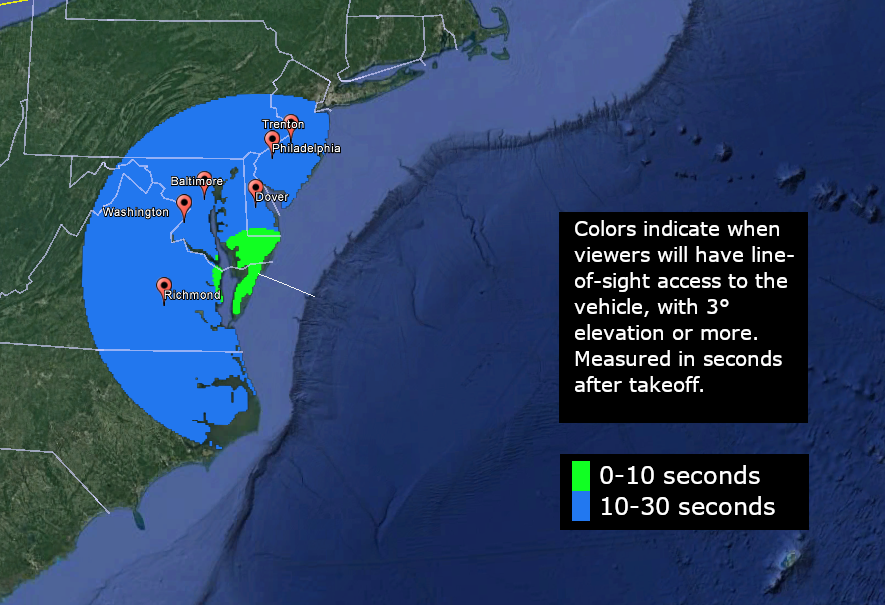
    The rocket launch is expected to be visible from the Chesapeake Bay region. The NASA Visitor Center at Wallops will not be open for viewing the launch.

  • Rocket Lab Coming To Delmarva! | Opens 250 Jobs To The Wallops Island Region.

    Rocket Lab Coming To Delmarva! | Opens 250 Jobs To The Wallops Island Region.

    NASA’s Wallops Flight Facility in Virginia was selected by Rocket Lab as the home for its new Neutron rocket’s first launch pad and production facility, further supporting the growth of commercial space capabilities in Virginia.

    The Neutron Production Complex will include a rocket production, assembly, and integration facility just outside the NASA gate to Wallops Island.  The dedicated launch pad will be located on the south end of Wallops Island.

    “NASA’s only owned and operated launch range at Wallops Flight Facility supports small- and medium-class orbital rocket launches, which are key contributors to a growing space economy,” said Wallops Director David Pierce. “The high-tech jobs created by this move are vital for the Wallops region, and I’m excited we’re bringing more of the agency’s expertise to Rocket Lab, Virginia Space, and all our partners on the Eastern Shore.”

    Rocket Lab has targeted the first Neutron medium class orbital rocket launch for no earlier than 2024.

    “We congratulate the Commonwealth of Virginia, Virginia Space and Accomack County working with Rocket Lab to bring this next chapter of commercial space operations to Wallops,” said Pierce. “We welcome Rocket Lab’s expansion on the Shore and look forward to working with them in bringing this new launch capability to reality.”

    Wallops is a multi-user/multi-tenant facility in a geographic location ideal for supporting satellite tracking and commanding, military operations and training, scientific investigations, technology development and testing, as well as commercial aerospace. The facility’s diverse mission sets and on-site partners, including the U.S. Navy, National Oceanic and Atmospheric Administration, the United States Coast Guard, and Virginia Space’s Mid-Atlantic Regional Spaceport, are a model for leveraging and optimizing multi-organizational capabilities and support services.

    A robust and competitive low-Earth orbit economy is vital to continued progress in space. The United States is committed to encouraging and facilitating the growth of the U.S. commercial space sector that supports America’s needs, is globally competitive, and advances U.S. leadership in the next generation of new markets and innovation-driven entrepreneurship. NASA has developed a long-term vision to achieve this goal where, one day, NASA will become one of many customers in low-Earth orbit. This plan builds on, uses the capabilities of, and applies the lessons learned from decades of work and experience with commercial companies.

    Written By: Keith Koehler
    NASA’s Wallops Flight Facility, Virginia

  • NASA Wallops Island Gearing Up For The CRS-17 Launch To The ISS Next Weekend

    NASA Wallops Island Gearing Up For The CRS-17 Launch To The ISS Next Weekend

    NASA and commercial cargo provider Northrop Grumman are targeting 12:40 p.m. EST Saturday, Feb. 19, for the launch of the company’s 17th resupply mission to the International Space Station from NASA’s Wallops Flight Facility on Wallops Island, Virginia.

    Live launch coverage will air on NASA Television and the agency’s website, as well as YouTubeTwitterFacebook, and NASA’s App, beginning at 12:15 p.m.

    TV Delmarva will be in Wallops Island to bring you live coverage from ground level with this mission

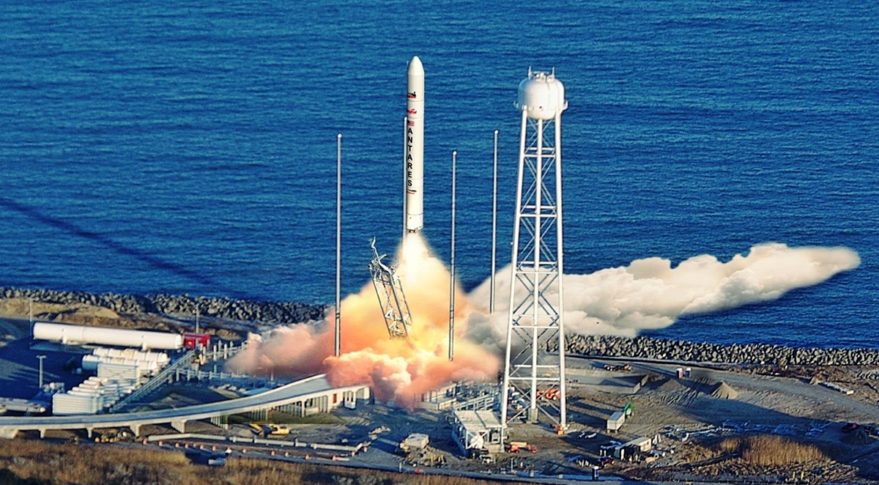
    Loaded with more than 8,200 pounds of research, crew supplies, and hardware, Northrop Grumman’s Cygnus cargo spacecraft will launch on the company’s Antares rocket from Virginia Space’s Mid-Atlantic Regional Spaceport.

    The Cygnus spacecraft, named the S.S. Piers Sellers in honor of the late NASA astronaut who spent nearly 35 days across three missions helping to construct the space station, will arrive at the orbiting outpost Monday, Feb. 21. At about 4:35 a.m., NASA astronaut Raja Chari will capture Cygnus, with NASA astronaut Kayla Barron acting as backup. After Cygnus capture, mission control in Houston will send ground commands for the station’s arm to rotate and install it on the station’s Unity module Earth-facing port.

    Highlights of space station research facilitated by this mission include:

    • a study that examines the effects of a drug on breast and prostate cancer cells;
    • a new combustion facility
    • an investigation from Colgate-Palmolive that will leverage the acceleration of skin aging in microgravity to help create and validate an engineered tissue model to serve as a platform for testing potential products to protect aging skin
    • a demonstration of a lithium-ion secondary battery capable of safe, stable operation under extreme temperatures and in a vacuum environment
    • new hydrogen sensors that will be tested for the space station’s oxygen generation system
    • a system that will test hydroponic and aeroponic techniques for plant growth and will allow scientists to observe root growth through video and still images

    The Cygnus spacecraft is scheduled to remain at the space station until May, when it will depart the station, disposing of several tons of trash during a fiery reentry into Earth’s atmosphere.