Tag: hail

  • Strong Thunderstorms Possible Across the Mid Atlantic This Afternoon

    Strong Thunderstorms Possible Across the Mid Atlantic This Afternoon

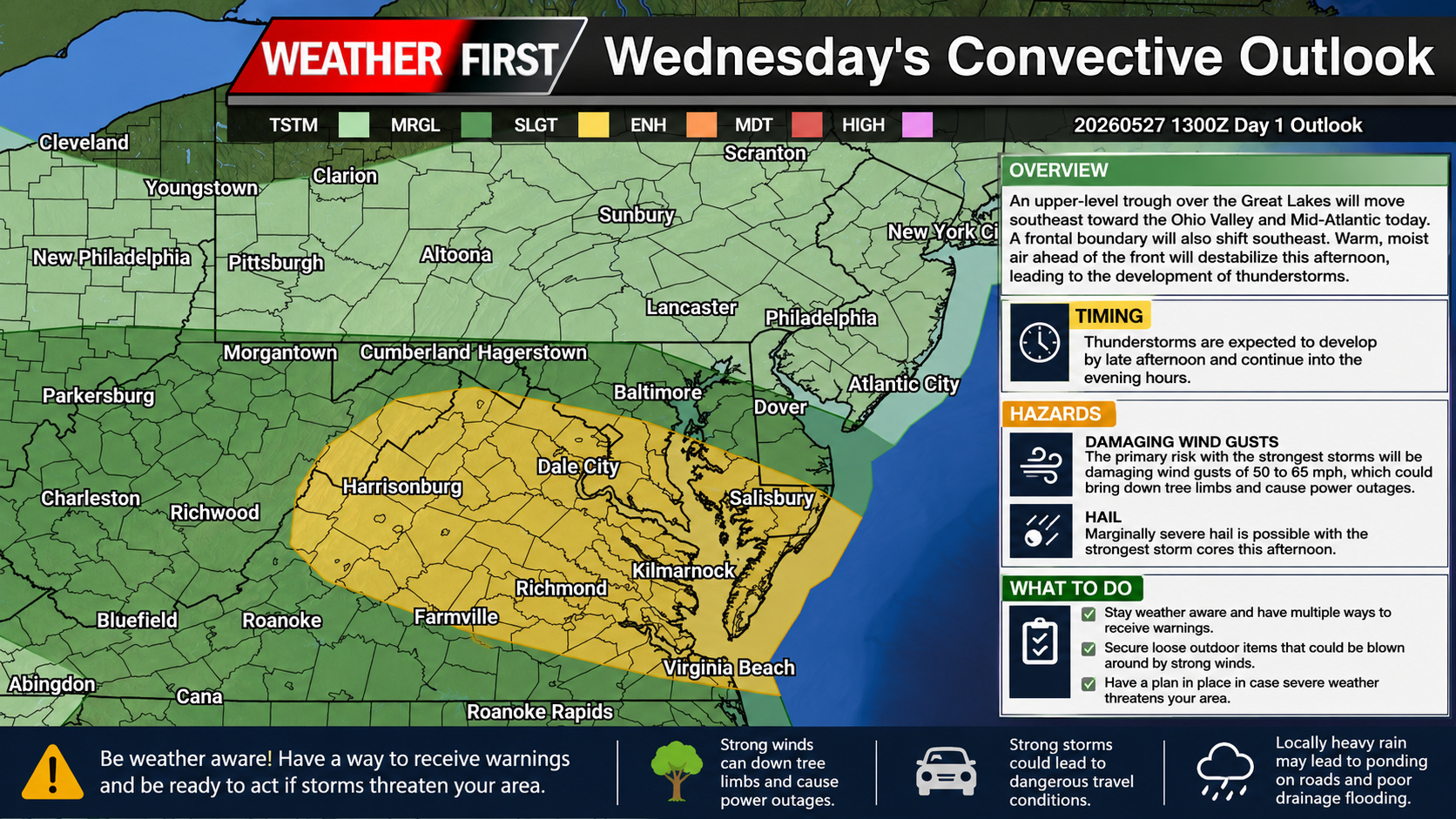
    A more active weather pattern is expected to unfold across the Mid Atlantic today as a disturbance moving out of the Great Lakes pushes toward the Ohio Valley and East Coast. Forecasters are monitoring the potential for scattered strong to severe thunderstorms this afternoon and evening, especially across portions of Maryland, Delaware, Virginia, and southern Pennsylvania.

    An upper level trough currently swinging southeast through the Great Lakes will help provide the energy needed for thunderstorm development later today. Early morning satellite and water vapor imagery already showed a lead disturbance tracking across southern Ohio into the central Appalachians, helping to spark areas of showers and thunderstorms ahead of the main system.

    At the surface, a frontal boundary draped across the region has been reshaped by ongoing morning rainfall and thunderstorms. As this boundary gradually slides southeast through the day, warm and humid air ahead of it will continue building instability across the Mid Atlantic. Dewpoints climbing into the upper 60s and lower 70s will create a very moisture rich atmosphere capable of supporting stronger storms by this afternoon.

    Clusters of thunderstorms to develop and move east southeastward later today. The primary threat with the strongest storms will be damaging wind gusts ranging from 50 to 65 mph, capable of bringing down tree limbs and causing isolated power outages. Some of the more intense storm cores may also produce small to marginally severe hail.

    While widespread severe weather is not expected, scattered strong storms could become locally intense during the peak heating hours this afternoon into early evening. Residents across the region should stay alert for rapidly changing weather conditions and be prepared for possible severe thunderstorm warnings later today.

    In addition to the wind threat, locally heavy rainfall may also accompany stronger storms given the humid environment already in place across the region.
  • Severe Weather On Tap For Monday Evening Across Delmarva

    Severe Weather On Tap For Monday Evening Across Delmarva

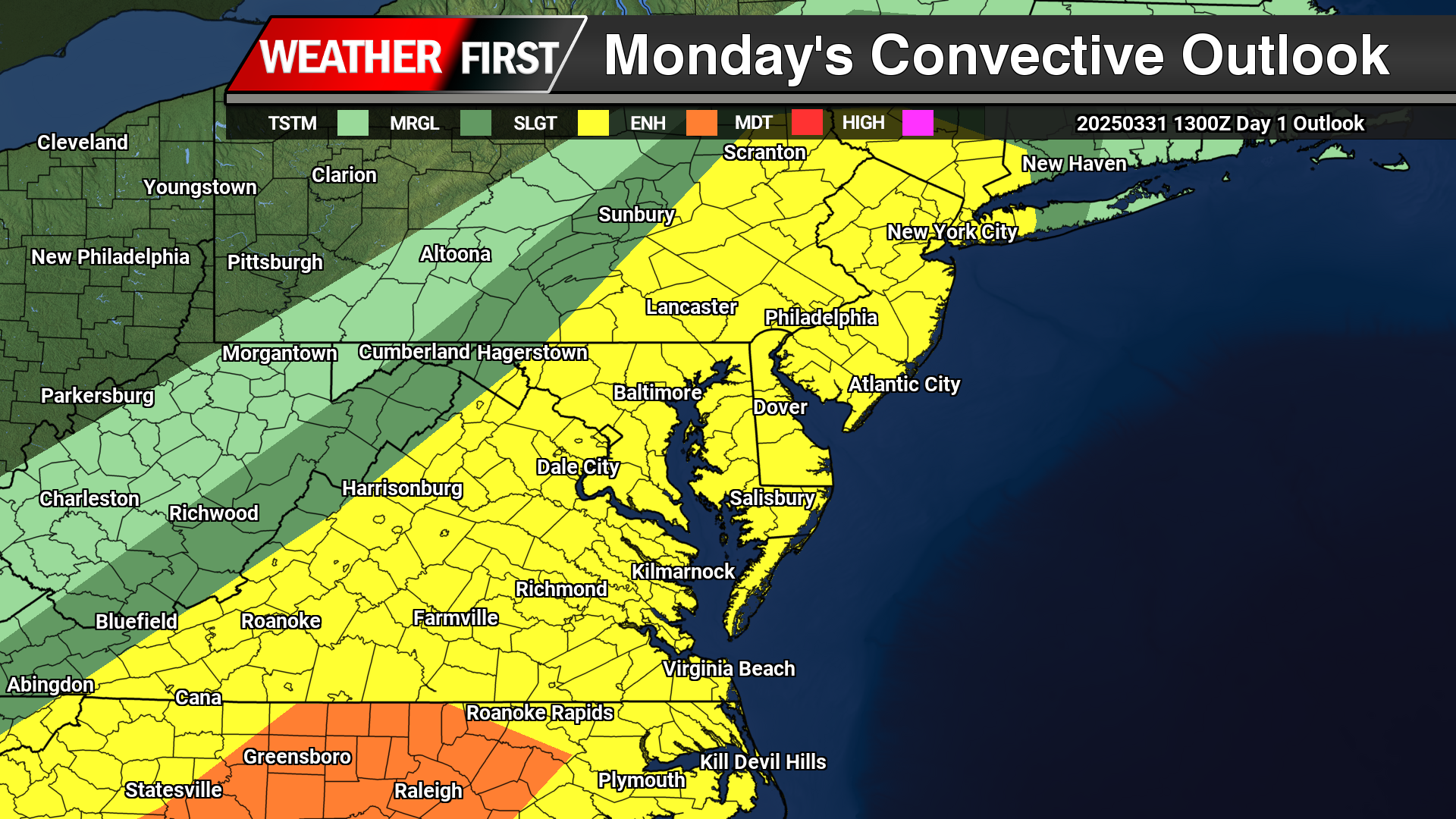
    Strong to severe thunderstorms remain on tap as we venture into the afternoon and evening hours today as a strong cold front advances from the west. A “Slight Risk” of severe weather from the Storm Prediction Center laid across all of the Mid-Atlantic today.

    Looking at satellite this morning over towards our west a nice blanket of sunshine moving into the region to help destabilize the atmosphere with surface heating as temperatures are expected to be well into the 70s as dew points surge into the 60s to have plenty of moisture in place. Well suited for thunderstorm develop later today.

    The first round of storms will begin to develop across the Maryland Western shore around the mid-afternoon hours (4-5PM) which will have the highest chances of larger hail or even an isolated tornado being discrete in nature. Later in the evening hours as the cold front arrives, a squall line likely to develop with the primary threat of damaging straight line winds. Although a quick spin up in the line is always a possibility but those probabilities remain on the low side of things.

    As mentioned before, the primary threat for the storms this afternoon will be indeed damaging straight line winds from the main squall line that moves through towards the evening hours from 7-10PM. Winds gusting as high as 70 mph are possible with the strongest portions of the line. Heavy rainfall from the squall line of 1-3″/hr could lead to some localized flooding in spots. During the mid afternoon hours when a few discrete cells form will have the best shot of large hail to 1″ or locally larger. Tornado threat remains low but not impossible for the first cells to develop in the afternoon hours and then again in the line itself.

  • Severe Weather Awareness Week: Day 3 “Severe Thunderstorms & Hail”

    Severe Weather Awareness Week: Day 3 “Severe Thunderstorms & Hail”

    Severe thunderstorms are officially defined as storms that are capable of producing hail that is an inch or larger or wind gusts over 58 mph. Hail this size can damage property such as plants, roofs and vehicles. Wind this strong is able to break off large branches, knock over trees or cause structural damage to trees. Some severe thunderstorms can produce hail larger than softballs or winds over 100 mph, so please pay attention to the weather so you know when severe storms are possible. Thunderstorms also produce tornadoes and dangerous lightning; heavy rain can cause flash flooding.

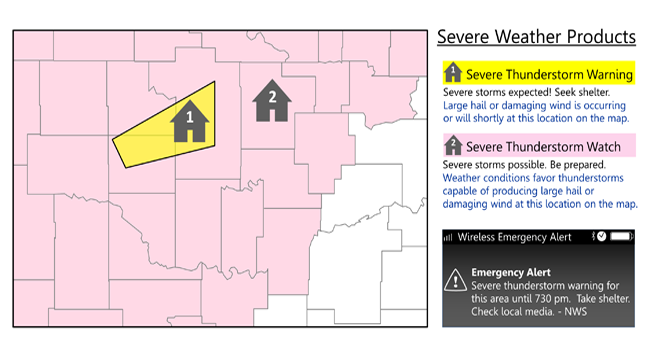
    Do you know the difference between a National Weather Service Severe Thunderstorm Watch and a Severe Thunderstorm Warning? Check your knowledge below.

    Severe Thunderstorm Watch: Be Prepared! Severe thunderstorms are possible in and near the watch area. Stay informed and be ready to act if a severe thunderstorm warning is issued. The watch area is typically large, covering numerous counties or even states.

    Severe Thunderstorm Warning: Take Action! Severe weather has been reported by spotters or indicated by radar. Warnings indicate imminent danger to life and property. Take shelter in a substantial building. Get out of mobile homes that can blow over in high winds. Warnings typically encompass a much smaller area (around the size of a city or small county) that may be impacted by a large hail or damaging wind identified by an NWS forecaster on radar or by a trained spotter/law enforcement who is watching the storm.

    Find out what you can do before severe weather strikes. Preparation is key to staying safe and minimizing impacts.

    • Be Weather-Ready: Check the forecast regularly to see if you’re at risk for severe weather. Listen to local news or a NOAA Weather Radio to stay informed about severe thunderstorm watches and warnings. Check the Weather-Ready Nation for tips.
    • Sign Up for Notifications: Know how your community sends warning. Some communities have outdoor sirens. Others depend on media and smart phones to alert residents to severe storms.
    • Create a Communications Plan: Have a family plan that includes an emergency meeting place and related information. Pick a safe room in your home such as a basement, storm cellar or an interior room on the lowest floor with no windows. Get more ideas for a plan at: https://www.ready.gov/make-a-plan
    • Practice Your Plan: Conduct a family severe thunderstorm drill regularly so everyone knows what to do if a damaging wind or large hail is approaching. Make sure all members of your family know to go there when severe thunderstorm warnings are issued. Don’t forget pets if time allows.
    • Prepare Your Home : Keep trees and branches trimmed near your house. If you have time before severe weather hits, secure loose objects, close windows and doors, and move any valuable objects inside or under a sturdy structure.
    • Help Your Neighbor: Encourage your loved ones to prepare for severe thunderstorms. Take CPR training so you can help if someone is hurt during severe weather.

    Find out what you can do when severe weather strikes. Acting quickly is key to staying safe and minimizing impacts.

    • Stay Weather Ready: Continue to listen to local news or a NOAA Weather Radio to stay updated about severe thunderstorm watches and warnings.
    • At Your House: Go to your secure location if you hear a severe thunderstorm warning. Damaging wind or large hail may be approaching. Take your pets with you if time allows.
    • At Your Workplace or School: Stay away from windows if you are in a severe thunderstorm warning and damaging wind or large hail is approaching. Do not go to large open rooms such as cafeterias, gymnasiums or auditoriums.
    • Outside: Go inside a sturdy building immediately if severe thunderstorms are approaching. Sheds and storage facilities are not safe. Taking shelter under a tree can be deadly. The tree may fall on you. Standing under a tree also put you at a greater risk of getting struck by lightning.
    • In a Vehicle: Being in a vehicle during severe thunderstorms is safer than being outside; however, drive to closest secure shelter if there is sufficient time.

    What should you do when the lightning and thunder stops and it looks likes the severe thunderstorm is over?

    • Stay Informed: Continue listening to local news or a NOAA Weather Radio to stay updated about severe thunderstorm watches and warnings. More severe thunderstorms could be headed your way.
    • Contact Your Family and Loved Ones: Let your family and close friends know that you’re okay so they can help spread the word. Text messages or social media are more reliable forms of communication than phone calls.
    • Assess the Damage: After you are sure the severe weather threat has ended, check your property for damages. When walking through storm damage, wear long pants, a long-sleeved shirt and sturdy shoes. Contact local authorities if you see power lines down. Stay out of damaged buildings. Be aware of insurance scammers if your property has been damaged.
    • Help Your Neighbor: If you come across people that are injured and you are properly trained, if needed, provide first aid to victims until emergency response team members arrive.
  • Case Story | Dorchester/Sussex County Hailstorm

    Case Story | Dorchester/Sussex County Hailstorm

    I will start off to say we for sure had a unicorn of hail storm here across areas of Delmarva. I’ve been studying a lot of storms over the years across Delmarva and this one was in the top tier of hail storms for the sure because of the damage it caused just from the hail alone.

    Let’s start off with the elephant in the room that this was a long tracked supercell thunderstorm as discrete as you could possibility get. Didn’t have to share resources with other storms in the environment. And I’m going to be real with you, the environment this storm was in for what it produced is actually astonishing. Storms of this magnitude producing widespread 2in diameter hail or greater for this long duration is something you would normally see out in the central plains. With the very cold air aloft and the very unstable atmosphere. Our supercell yesterday was only under 1500 j/kg of MLCAPE where storms I’ve normally seen with this kind of hail has at least twice that if not more. This one lone supercell took advantage of a disturbed free environment all to itself and used the maximum instability the region had. Not to mention tapping in the the 50kt bulk shear in the region to keep supercellular characteristics

    Hail Streak Across Western Shore Of Maryland & Central Delmarva

    This storm first developed just the west of Washington D.C as a single cluster before taking off as a HP Supercell throughout Prince Georges and Calvert County. Confirmed multiple locations with > 2in diameter hail with a single report of 3in in Diameter in Chesapeake Beach in Calvert County. Before moving across the Chesapeake keeping the same intensity across Delmarva.

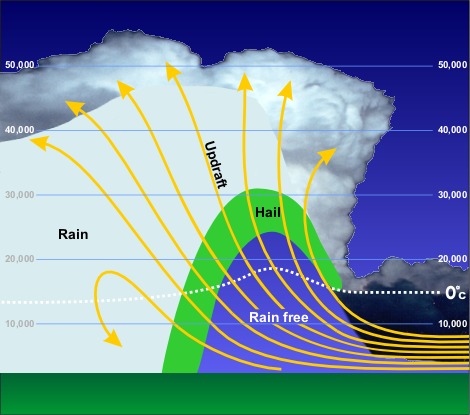
    Here’s what took me by surprise. Normally getting large hail of this size, you need a storm that is very tall in the atmosphere. On radar estimates, we had on average 40-45 kft (40-45,000 feet) cloud tops with one singular overshooting top to 45 kft. Normally seeing 2in hail you need very cold cloud tops closer to 50-55kft and cold temperatures aloft which is something we do not get here in the warmer seasons. Looking at radar from KDOX and GOES-16 Satellite we had one persistent updraft on the southern side of the storm. The hail core was astonishing. We had the updraft all the way to the very top of the storm at 40kft which is amazing for how small of an area it covered.

    Keep in mind I want to share with you the logistics of how strong of a updraft is needed to suspend >2in hail in a storm. For the reported 2 to 3 in Diameter hail you need a updraft speed of 70-85 MPH upward velocity. Looking at some the hail sizes and shapes we have a mixture of round and spikey hail meaning there has been some warmer air with some melting on the way up. Even more evidence that there was some strong upward forcing of water molecules in this small but potent updraft.

    Impressive damage across areas of Dorchester and Western Sussex County from this one storm yesterday. Severe damage to vehicles, windows blown out, siding a complete loss. Not to mention reports of a hail accumulations for areas around Cambridge. Very common for hail sizes around baseballs causing significant damage to property.

    Average of >2in Hail Events In The US. Delmarva Is At The Bottom Of The Scale

    Goes to show you, Delmarva can defy the odds of getting Central Plains type of storms. Whether it’s a tornado outbreak, a derecho or in our case this time around, a severe hail event. Always remember, it can only take one storm to make a disaster. We had a very rare event happen yesterday that unfortunately had some devastating consequences. Luckily nobody was hurt and property can be rebuilt.

  • Severe Weather Threat For Thursday

    Severe Weather Threat For Thursday

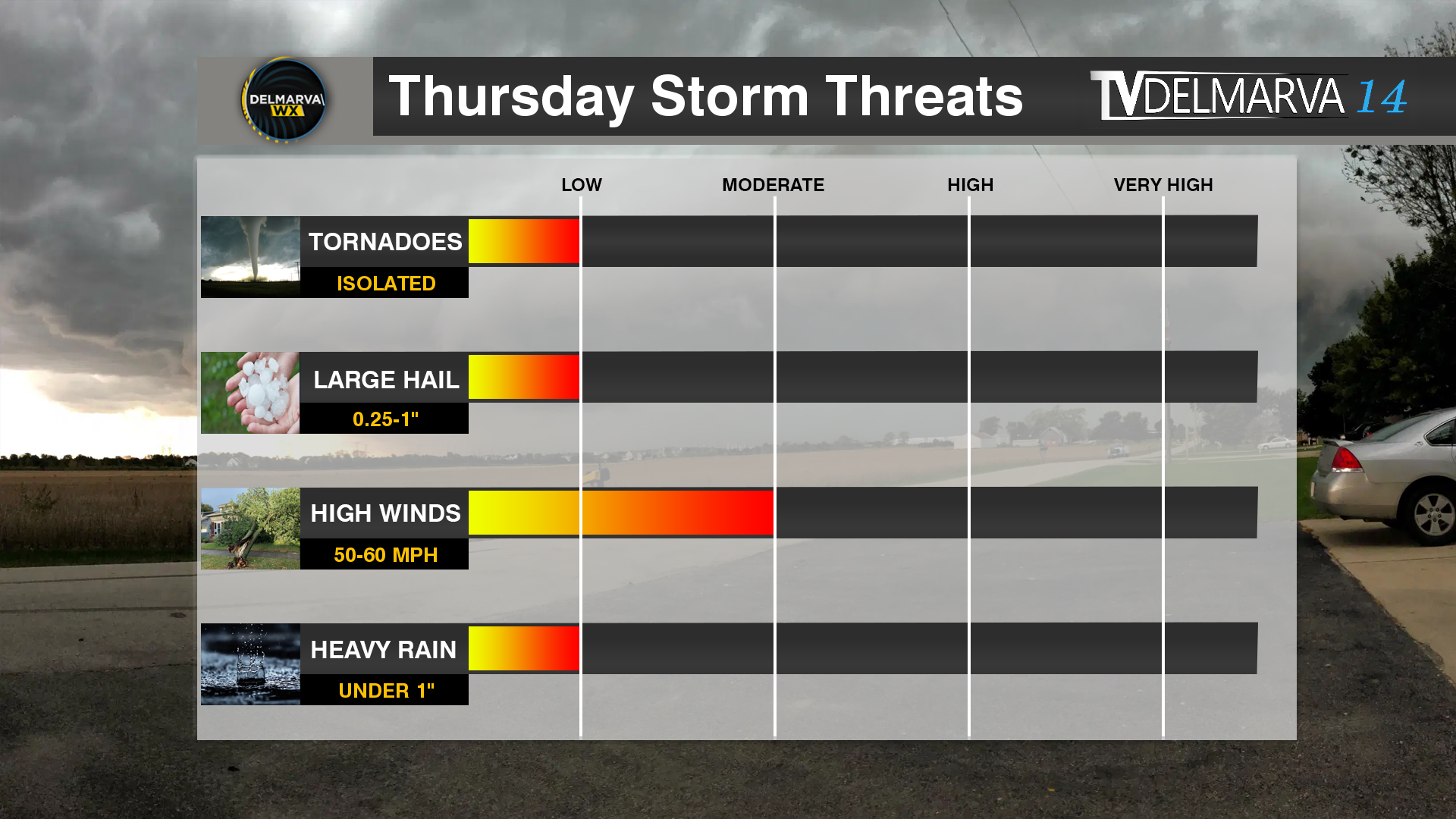
    While we are now in the short term model guidance, we had a big shift in the timing of this event. On Tuesday many of the medium range model guidance showed this event to be extremely underwhelming and much later into the night. Now into Wednesday, we have pushed the timing up about 6-8 hours into the afternoon and evening hours on Thursday. That big shift in timing boosted our chances to match with the SPC’s Slight Risk of Severe Weather they had all week.

    A good agreement between the HRRR/RAP as well as the CAMS showing ample thunderstorm development across the Mid-Atlantic States. An increase in instability as well with dew points going into the lower 60’s. Storms should be developing from west to east from 2-10pm.

    With the main threat being wind damage within these storms. No surprise with the strong winds aloft and in the lower level Jetstream. Strong winds at 5000 feet of 60-70 kts giving ample speed shear for storms to produce some gusty downbursts. Using TEHI for the tornadic threat and the good news is once more, fairly low probabilities. TEHI values under 2 (20%) chance of these storms producing a tornado in this environment. Also when we take a look at the Updraft Helicity Streaks, there is very little if any which is good news for shows storms with potential rotation on the models.

  • Strong To Severe Thunderstorms Possible Saturday | Brand New Tornado Forecast Tool

    Strong To Severe Thunderstorms Possible Saturday | Brand New Tornado Forecast Tool

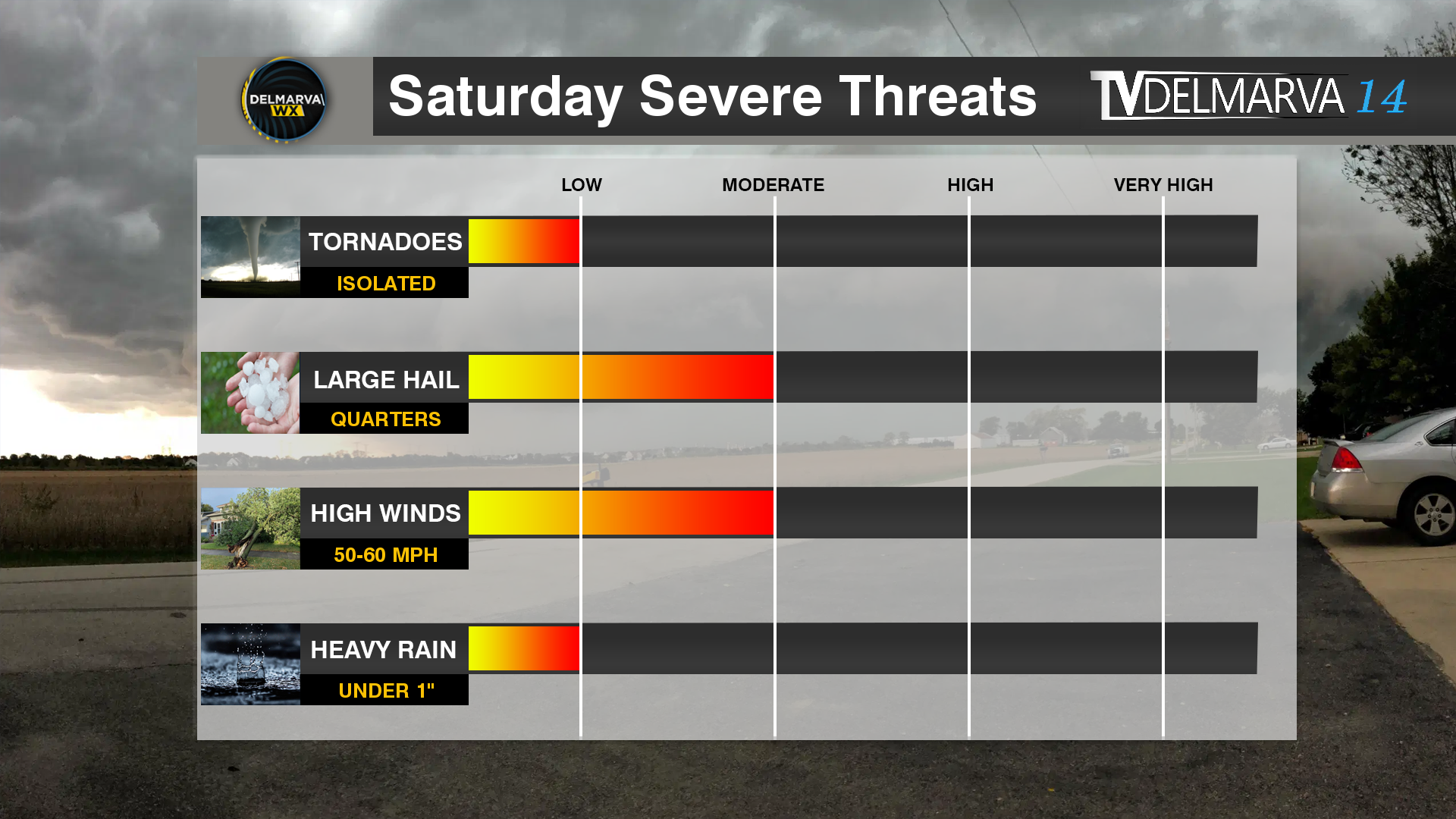
    Storm Threats For Saturday

    We are getting closer and closer to our typical Severe Weather Season here on the shore. And we get a bit of a taste for it on Saturday. Now here’s the setup we are looking at.

    First off we have a fairly strong area of low pressure moving across the Great Lakes region with a strengthening mid level Jetstream across the Mid-Atlantic States. That’s the first set of ingredients for the storm setup for tomorrow.

    Now storm formation will be isolated in nature based on the latest high resolution model guidance. One thing is for sure we got the warmer temperatures and bit of surface moistures with dew points getting into the 60’s. So it’s going to be a little bit muggy out there by the early afternoon hours.

    Now we will see ample instability and wind shear across the region before our cold front arrives during the evening hours. MLCAPE (a product used to measure instability) showing values in the moderate instability category which is very crucial for thunderstorm development. Not to mention with the decent amount of instabilty, mid level lapse rates are fairly steep as well. Anytime we get Lapse Rates in the mid levels over 7C/km, that increases our hail threat just a bit with the colder air higher into the atmosphere. This is why we have a bit of a higher threat for seeing quarter size hail in storms that may develop. Not to mention we have some decent bulk shear (wind shear in a storm environment). 50-60kts is more than plenty to get a mix of line segments or even a couple of isolated supercell thunderstorms.

    Now in production for a little while, we have been working very hard at developing to really narrow down tornado threats in a 0-10 scale (0-100%). We are testing the waters on this one since there is a little bit of a tornado threat going into tomorrow. our TEHI product showing a level 1-2 threat out of 10 for tornadoes here on the shore. meaning storms will have a 10-20% chance of producing a tornado. Low level environment showing sufficient turning in the lowest levels which is very important for tornadogenisis.

    One limiting factor for storms tomorrow is the time of year we are in. Our coastal water temperatures do play a role in our storm threats with them being in the upper 40’s. This can create some stable air near the surface and cause storms to climb upscale and scrapping any tornado threat all together.