❄️ As we brace ourselves for the frigid days ahead, the Department of Health and Social Services (DHSS) is here to support our beloved community during this harsh winter season. We understand how challenging it can be to face the biting cold, which is why we are taking proactive steps by opening warming stations. These stations are designed to provide warmth and comfort to everyone in need, ensuring that no one feels isolated or uncomfortable during this season.
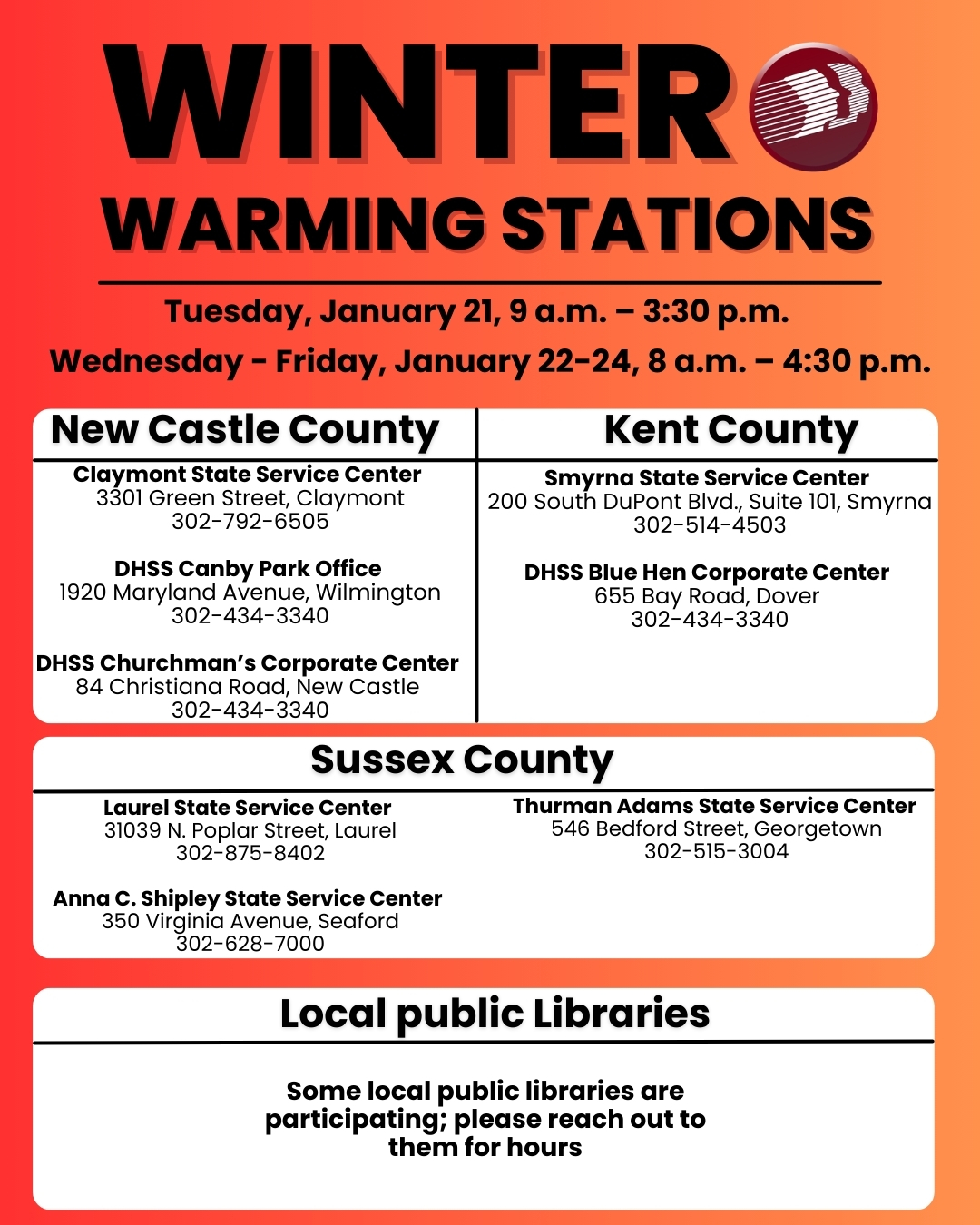
📅 We invite you to join us on Tuesday, January 21, from 9 a.m. to 3:30 p.m., and Wednesday through Friday, January 22-24, from 8 a.m. to 4:30 p.m. Our warming stations will be available at various designated locations throughout the county. These spaces have been created to ensure a secure, inviting environment where anyone can find refuge from the chilly conditions.
❗ Remember, no one should have to face this frigid weather alone. Together, let’s ensure that everyone in our community can stay safe, warm, and cared for during these cold days. Every bit of support makes a difference!
🗺️ Be sure to check the accompanying graphic for the specific locations of the warming stations available in your county. This important information will help you or someone you know find shelter from the cold.
❤️ Let’s come together to spread the word and keep an eye out for one another. If you or someone you know could benefit from a warm place to go, please don’t hesitate to visit us. Your safety and comfort are our utmost priority this winter!
Delaware public health officials announced a new monthly high total of deaths from suspected overdoses during May and said they fear the vast majority of the deaths will be connected to fentanyl, a powerful synthetic pain reliever that is 50-100 times more potent than morphine, or to the increasing use of cocaine, a powerfully addictive stimulant.
In 2021, when a record 515 people died in Delaware from overdoses, more than 80% of the deaths involved fentanyl and more than 45% involved cocaine.
In May 2022, 42 people died from suspected overdoses in Delaware, according to the Delaware Division of Forensic Science. That surpassed the previous monthly high total set in August 2018 and tied in May 2020, of 39 deaths. In May 2022, preliminary totals show that 25 of the 42 deaths involved people in New Castle County, 12 in Sussex County and five in Kent County.
Through May 31, 159 people have died from suspected overdoses in Delaware, which is about the same rate as 2021.
“We know that more families and friends have Narcan at home or with them to try to reverse opioid overdoses, but, sadly, that cannot prevent every heartbreaking overdose death,” said DHSS Secretary Molly Magarik. “We urge families to convince their loved ones to get connected to treatment resources and services. Medical providers can make that referral or family members can drop by one of our Bridge Clinics to talk with trained counselors.”
Delawareans struggling with substance use disorder also can call DHSS’ Division of Substance Abuse and Mental Health’s 24/7 Delaware Hope Line – a single point of contact where callers can connect to a variety of resources and information, including support from clinicians and peer specialists plus crisis assistance. For support, Delawareans can:
Drop by DHSS’ Bridge Clinics for in-person support, including access to naloxone (see locations and hours at the bottom of this release).
Reach the free Delaware Hope Line at 1-833-9-HOPEDE or 1-833-946-7333.
Get behavioral health tips and reminders by texting DEHOPE to 55753.
Search for treatment services and resources in Delaware or nearby states at DHSS’ one-stop website, HelpIsHereDE.com.
Joanna Champney, director of the Division of Substance Abuse and Mental Health (DSAMH), emphasized that there is no wrong door for accessing treatment. She encourages individuals who need help to call or stop by one of the Bridge Clinics, located in each county. “Our Bridge Clinics greet walk-ins with dignity and no judgment,” Champney said. “Whether someone just needs to talk about their options or they’re ready for treatment, we can help you.”
Champney also pointed to DSAMH’s expansion of clinical services to people who are justice-involved, building on the Division’s “no wrong door” approach to offering substance use disorder treatment. “Through our partnership with the Delaware State Police, we’ve put clinicians in multiple police troop locations statewide so we can help people pre-arrest who have had a brush with the law,” she said. “We know that substance use disorders often are the driver for illegal behavior, so the idea is to treat the problem. We’re seeing very high success rates of connecting people to treatment through this program.”
The increase in deaths from suspected overdoses during May 2022 follows another increase in overdose deaths for all of 2021. In its annual report for 2021, the Division of Forensic Science (DFS) reported 515 overdose deaths, an increase of more than 15% over 2020. The 515 deaths by county:
New Castle County: 334
Sussex County: 94
Kent County: 87
Of the 515 total deaths, DFS reported that 425 (82.5%) involved fentanyl, a decline of seven-tenths of a percentage point from 2020, and 221 involved cocaine, an increase of almost 9 percentage points from 2020.
Division of Public Health Director Dr. Kary Rattay urged those in active use of any illicit substances to get Narcan through DHSS’ mail-order Next Distro program, one of DSAMH’s Bridge Clinics, at a participating pharmacy – where no prescription is required – or at a Narcan training.
“This increased loss of life is heartbreaking,” Dr. Rattay said. “It is important for the public to know that fentanyl is being added to multiple types of illicit substances and is seen more commonly with amphetamines like cocaine. We know that Narcan can and does save lives, so we urge anyone who is actively using any illicit substances, as well as family and friends, to have Narcan on hand and be trained on how to use the medication. Additionally, we encourage Delawareans to download OpiRescue Delaware, a smartphone app that provides life-saving step-by-step instructions on how to respond to an overdose, including how to administer Narcan.”
In addition, under Delaware’s 911/Good Samaritan Law, people who call 9-1-1 to report an overdose and the person in medical distress cannot be arrested for low-level drug crimes.
To find Narcan training or distribution events, or a participating pharmacy, go to HelpIsHereDE.com, and click on the overdose prevention tab. The Division of Substance Abuse and Mental Health’s Bridge Clinic locations and hours:
NEW CASTLE COUNTY DSAMH Central Office 14 Central Ave. New Castle, DE 19720 24/7 302-255-1650
New Castle County Hope Center 365 Airport Road New Castle, DE 19720 Mon-Fri: 8:30 a.m.-9:30 p.m. Sat-Sun: 8:30 a.m.-6:30 p.m. 302-544-6815
KENT COUNTY James W. Williams State Service Center 805 River Road, Third Floor Dover, DE 19901 Mon-Fri: 8:30 a.m.-4 p.m. 302-857-5060
SUSSEX COUNTY Thurman Adams State Service Center 546 S. Bedford St. Georgetown, DE 19947 Mon-Fri: 8:30 a.m.-4 p.m. 302-515-3310
Delaware will hold a prescription drug take back day.
On Saturday, October 23, from 10 a.m. to 2 p.m. the Drug Enforcement Administration (DEA) has scheduled their National Take-Back Initiative (NTBI). This is a great opportunity for those who missed the previous events, or who have subsequently accumulated unwanted, unused, and expired prescription drugs, to safely dispose of those medications. This is an opportunity to prevent pill abuse and theft by ridding their homes of potentially dangerous expired, unused, and unwanted prescription drugs. The service is free and anonymous, no questions asked.
DEA will also accept vaping devices and cartridges at any of its drop off locations during Take Back Day. It is important to note that DEA cannot accept devices containing lithium ion batteries. If batteries cannot be removed prior to drop-off, DEA encourages individuals to consult with stores that recycle lithium ion batteries.
This initiative addresses a vital public safety and public health issue. Medicines that languish in home cabinets are highly susceptible to diversion, misuse, and abuse. Rates of prescription drug abuse in the U.S. are alarmingly high, as are the number of accidental poisonings and overdoses due to these drugs. Studies show that a majority of abused prescription drugs are obtained from family and friends, including from the home medicine cabinet. In addition, Americans are now advised that their usual methods for disposing of unused medicines—flushing them down the toilet or throwing them in the trash—both pose potential safety and health hazards.
Governor John Carney and the Delaware Department of Health and Social Services (DHSS) have formally issued an emergency regulation requiring educators, school staff, volunteers, and contractors working in Delaware schools to be vaccinated against COVID-19 or undergo weekly testing beginning November 1.
The requirement, which was first announced last month, applies to public and private K-12 schools.
“There’s no better way to prevent the spread of COVID-19, and keep all Delaware children in their classrooms, than to get vaccinated,” said Governor Carney. “Our top priority has been to get all Delaware students back in school this fall. This requirement will help keep them there and prevent regular disruptions to their learning. These vaccines are safe and extremely protective against COVID-19 infection and serious illness. I encourage all Delawareans to get your shot and help us finally put an end to this pandemic.”
The Delaware Division of Public Health (DPH) is strongly reminding Delawareans to use caution when around unknown wild animals, including feral cats and stray animals. The reminder comes after a skunk in Greenwood recently tested positive for rabies after attacking a stray cat. The cat escaped and was later found dead in a nearby area.
“This situation is a good reminder for everyone to not touch, feed or approach stray animals. Had that cat returned to its feral colony and been infected with rabies from the attack, it could have transmitted the infection to other cats,” said DPH Medical Director Dr. Rick Hong. “For the safety of everyone, the best thing to do to avoid risk of exposure to rabies, is to stay away from unfamiliar wild or stray animals.”
Rabies is a preventable disease. DPH recommends that individuals take the following steps to prevent rabies exposure:
All dogs, cats, and ferrets 6 months of age and older are required by Delaware law to be vaccinated against rabies by a licensed veterinarian.
Pet owners can reduce the possibility of pets being exposed to rabies by keeping them indoors and not letting them roam free. It is especially important for pet owners who do allow their cats to roam outdoors to vaccinate their pets.
Do not touch or otherwise handle wild or unfamiliar animals, including cats and dogs, even if they appear friendly.
Do not keep your pet’s food or water outdoors; bowls can attract wild and stray animals.
Do not feed feral animals, including cats, as the risk of rabies in wildlife is significant.
Spaying or neutering your pet may reduce the tendency to roam or fight and, thus, reduce the chance they will be exposed to rabies.
Keep your garbage securely covered.
Consider vaccinating livestock and horses, as well. It is recommended to consult with your private veterinarian if you have any questions regarding whether your animal(s) should be vaccinated against rabies.
Since Jan. 1, 2021, DPH has performed rabies tests on 171 animals, 17 of which were confirmed to be rabid, which includes one dog, two raccoons, two skunks (including this one), one fox, three cats, six bats, one cow and a deer. DPH only announces those rabies cases for which it is possible the animal had unknown contacts with additional humans or pets.
In 2020, DPH performed rabies tests on 121 animals, four of which were confirmed to be rabid, including one raccoon, one bat, and two cats. Two additional Delaware animals were tested out of state and confirmed positive, bringing the state total to six.
Rabies is an infectious disease affecting the nervous system of humans and other mammals. Infection can occur through the bite or scratch of an infected animal or if saliva from such an animal gets into the eyes, nose, mouth, or an opening in the skin. Rabies in humans and animals cannot be cured once symptoms appear. Therefore, if a human has been exposed, and the animal is unavailable to be quarantined or tested, DPH recommends that people receive post-exposure prophylaxis (PEP) treatment, a series of four vaccinations, as a precautionary measure.
If You Encounter an Animal Behaving Aggressively:
If you encounter a wild animal other than a feral cat or possibly dog behaving aggressively, it is recommended you contact the Delaware Department of Natural Resources and Environmental Control’s (DNREC) Wildlife Section at 302-739-9912 or 302-735-3600. Staff will determine whether it is more appropriate to refer callers to a private nuisance wildlife control operator. A listing of nuisance wildlife control operators can be found at https://wildlifehelp.org/. Calls after hours and on weekends can be made to the 24-hour dispatch number at 800-523-3336.
Do not throw items at the animal or make loud banging noises, which may startle the animal and cause it to attack. Instead, your initial response – if the animal is behaving in an aggressive manner or appears to be foaming at the mouth – should be to raise your hands above your head to make yourself appear larger to the animal while slowly backing away from it. If the animal starts coming toward you, raise your voice and yell sternly at it, “Get away!” If all that fails, use any means to protect yourself including throwing an object at the animal or trying to keep it away by using a long stick, shovel, or fishing pole.
If you encounter a stray or feral domestic animal, such as a cat or dog, behaving aggressively, contact the Office of Animal Welfare at 302-255-4646.
If You Encounter a Sick or Injured Animal:
To report a sick or hurt wild animal, Delaware residents are asked to contact the DNREC’s Wildlife Section at 302-739-9912 or 302-735-3600. Staff will determine whether it is more appropriate to refer callers to a permitted volunteer wildlife rehabilitator.
If you encounter a sick stray domestic animal, such as a cat or dog, contact the Office of Animal Welfare at 302-255-4646.