Tag: delmarvawx

  • Growing Threat of Significant Winter Storm for Delmarva This Weekend

    Growing Threat of Significant Winter Storm for Delmarva This Weekend

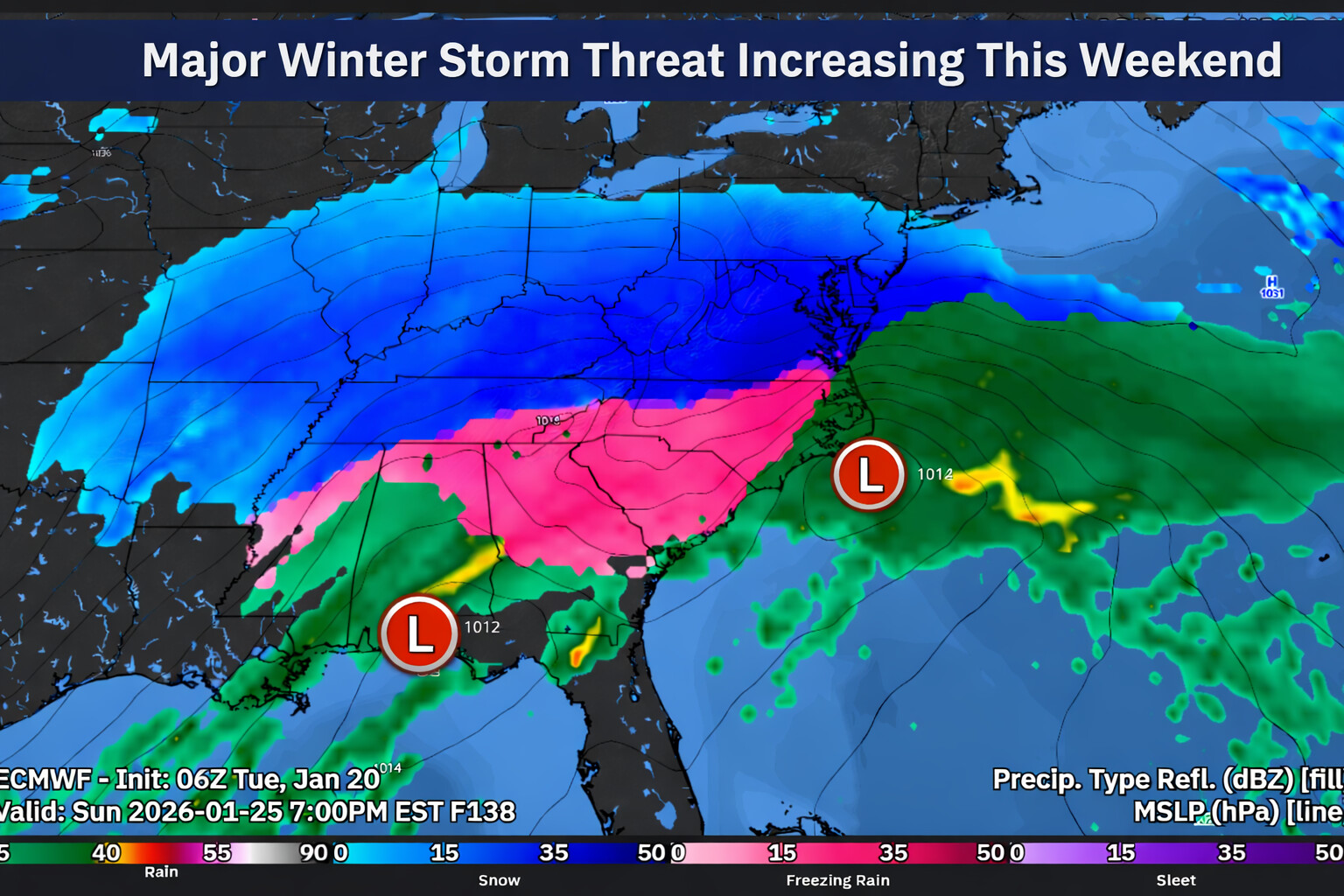
    Forecast confidence is increasing that a potentially impactful winter storm could affect the Delmarva region late Saturday through Sunday, though important details regarding track and snowfall amounts remain uncertain at this time.

    Weather patterns aloft are becoming increasingly active as we head toward the weekend, with interactions expected between northern and southern jet stream systems. The energy driving this setup is currently located over the Arctic and the Pacific Ocean, meaning it will take several more days for forecasts to fully resolve how this system evolves. Even so, most forecast guidance now consistently shows an area of low pressure developing near Texas on Friday before moving east along the Gulf Coast into Saturday.

    As the system approaches the East Coast, guidance generally favors the low tracking northeast toward the North Carolina coast before moving offshore late Sunday into early Monday. This type of track would place Delmarva on the colder, northern side of the storm, increasing the potential for winter weather impacts across the region. A key question remains how close the storm tracks to the coastline, as even small shifts could have a major influence on snowfall totals.

    A strong arctic high pressure system will be positioned to the north, supplying cold air into the Mid Atlantic. Earlier forecast guidance suggested this high might suppress the storm farther south, limiting impacts locally. However, trends over the past 12 to 24 hours show the storm track edging farther north, increasing the likelihood that precipitation spreads into Delmarva.

    Snow probabilities have responded accordingly. Current guidance now indicates a 75 to 95 percent chance of at least 2 inches of snow and a 70 to 85 percent chance of 6 inches or more for areas along and south of the Interstate 95 corridor, with probabilities decreasing farther north.

    Even more impressive with NBM blends of >12 inches of snow are between 50-60% as of this morning. These numbers are notably higher than those from previous forecast cycles and point toward a growing signal for a meaningful winter weather event.

    If this storm materializes, snowfall could begin late Saturday and continue through Sunday, with the potential for lingering impacts into Monday depending on how quickly the system moves away. While confidence in exact snowfall totals remains low, the overall signal for a winter storm affecting at least part of Delmarva is stronger than typically seen at this lead time.

    It is important to note that East Coast winter storms often produce narrow bands of heavy snow, sometimes only 50 to 100 miles wide. With the storm’s key ingredients still thousands of miles away, it is far too early to determine which specific locations will see the highest accumulations. Residents across Delmarva should continue to monitor forecast updates closely over the coming days as details become clearer.
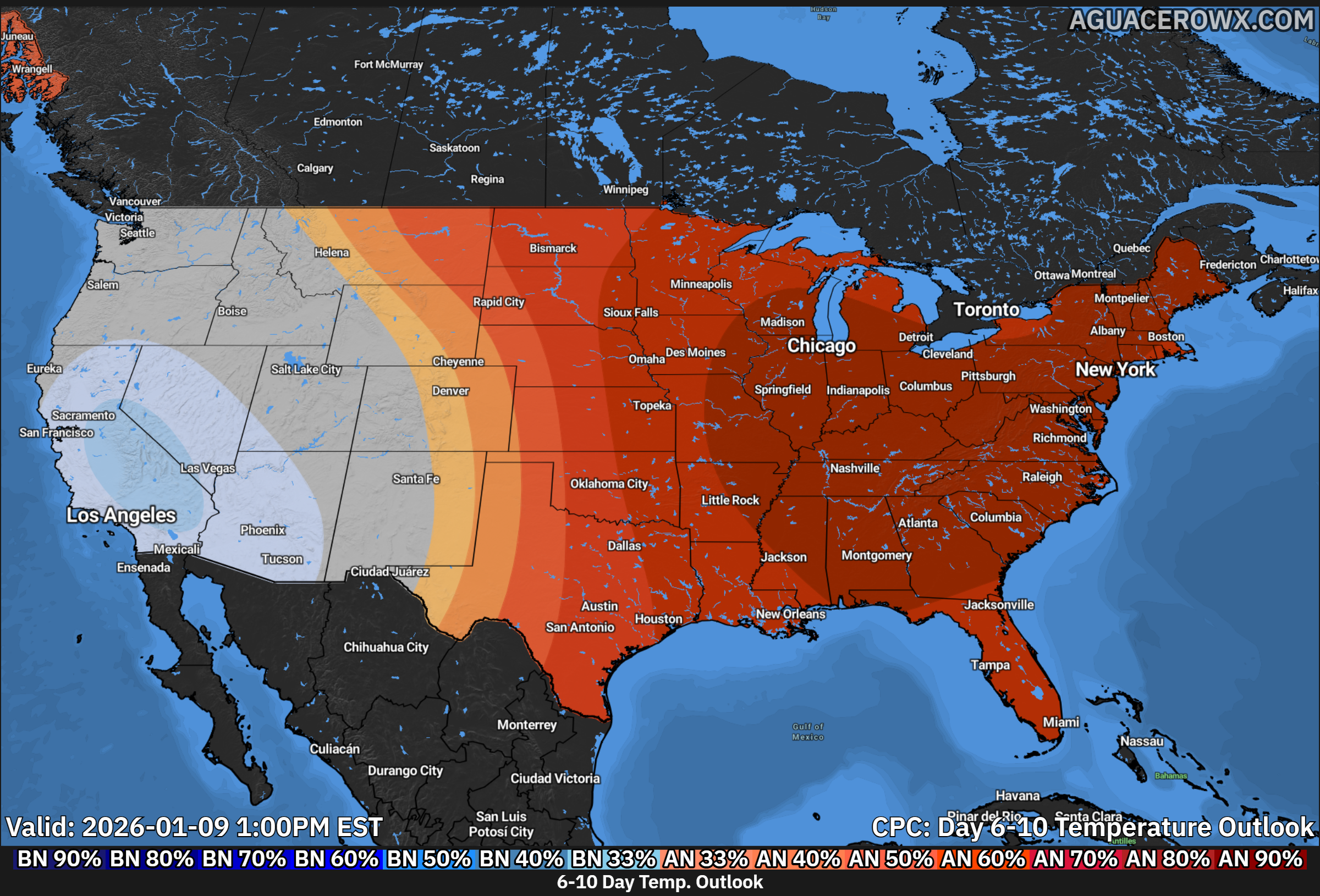
  • Widespread Warmth Expected Across Eastern U.S. in Mid-January Outlook

    Widespread Warmth Expected Across Eastern U.S. in Mid-January Outlook

    A strong signal for above-normal temperatures is shaping up across much of the eastern United States as we head into the January 8–12, 2026 timeframe, according to the latest 6–10 day temperature outlook issued by NOAA on January 2.

    The outlook shows a broad and confident area of above-average temperatures extending from the Mississippi Valley eastward to the Atlantic Coast. This includes the Midwest, Ohio Valley, Southeast, and much of the Mid-Atlantic and Northeast. In these areas, probabilities favoring above-normal temperatures range from 60% to as high as 90%, indicating a strong likelihood that temperatures will trend warmer than what is typical for early January.

    For the Mid-Atlantic region, including Delmarva, Maryland, and Pennsylvania, the signal is particularly robust. Persistent ridging in the upper atmosphere is expected to keep Arctic air bottled up well to the north, allowing milder air to dominate. This pattern would favor daytime highs running several degrees above normal, with fewer opportunities for sustained cold or wintry weather during this period.

    In contrast, below-normal temperatures are favored across portions of the western United States, especially parts of California, the Great Basin, and the Southwest. These regions show a 33–60% probability of cooler-than-average conditions, suggesting a more active Pacific pattern delivering cooler air and potentially unsettled weather.

    Areas of the northern Rockies and portions of the interior West are expected to remain near seasonal averages, lying along the transition zone between the cooler West and warmer East.

    Alaska shows a split pattern, with below-normal temperatures favored across much of the mainland, while parts of the southern coast lean above normal. Hawaii is expected to see above-average temperatures statewide.

    Overall, the pattern supports a continuation of a relatively mild January for large portions of the eastern U.S., potentially limiting snow and ice opportunities while increasing the risk of rapid snowmelt in areas that currently have snowpack.

  • Accumulating Snow On The Way For Sunday; Followed By Arctic Blast

    Accumulating Snow On The Way For Sunday; Followed By Arctic Blast

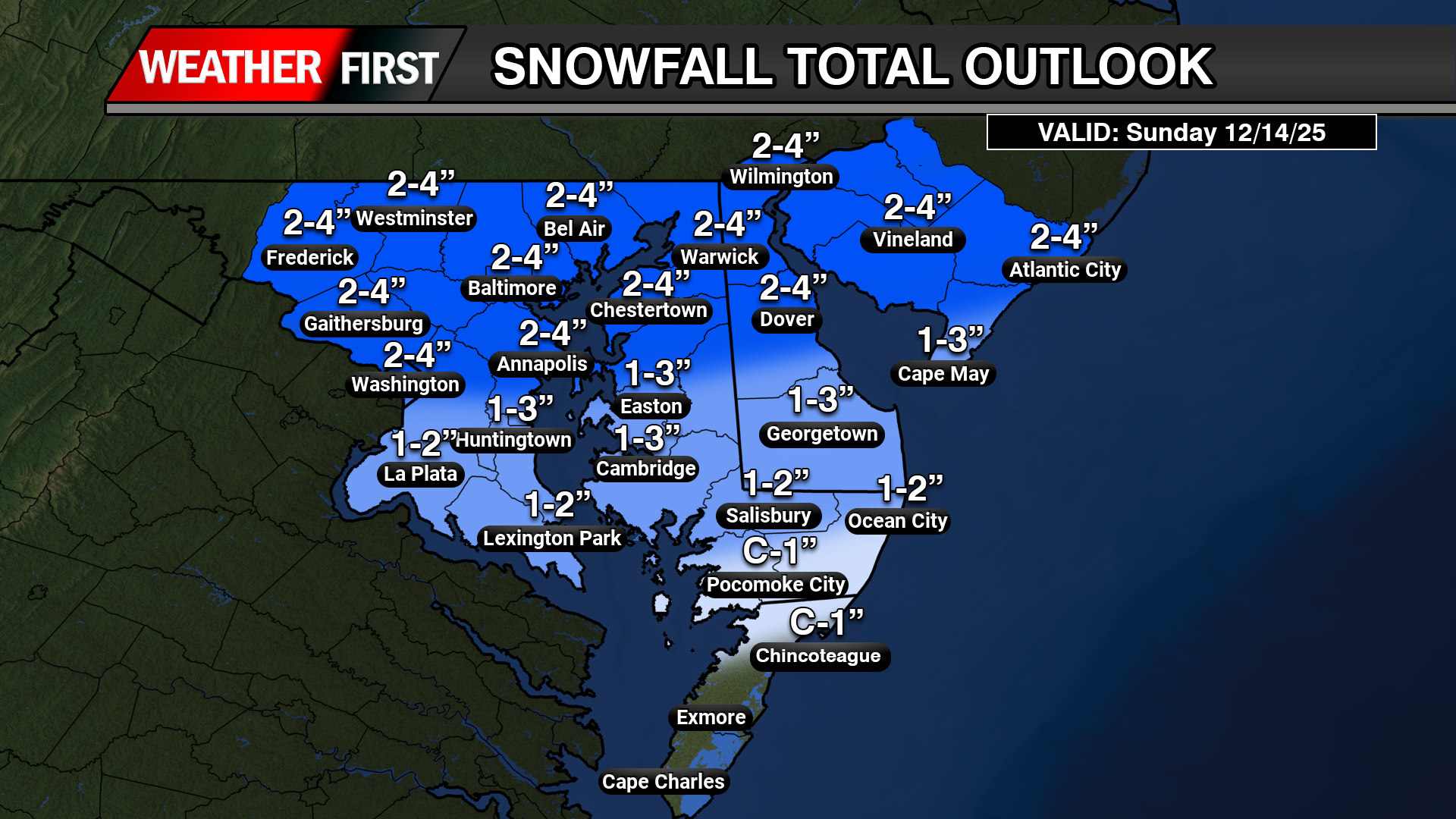
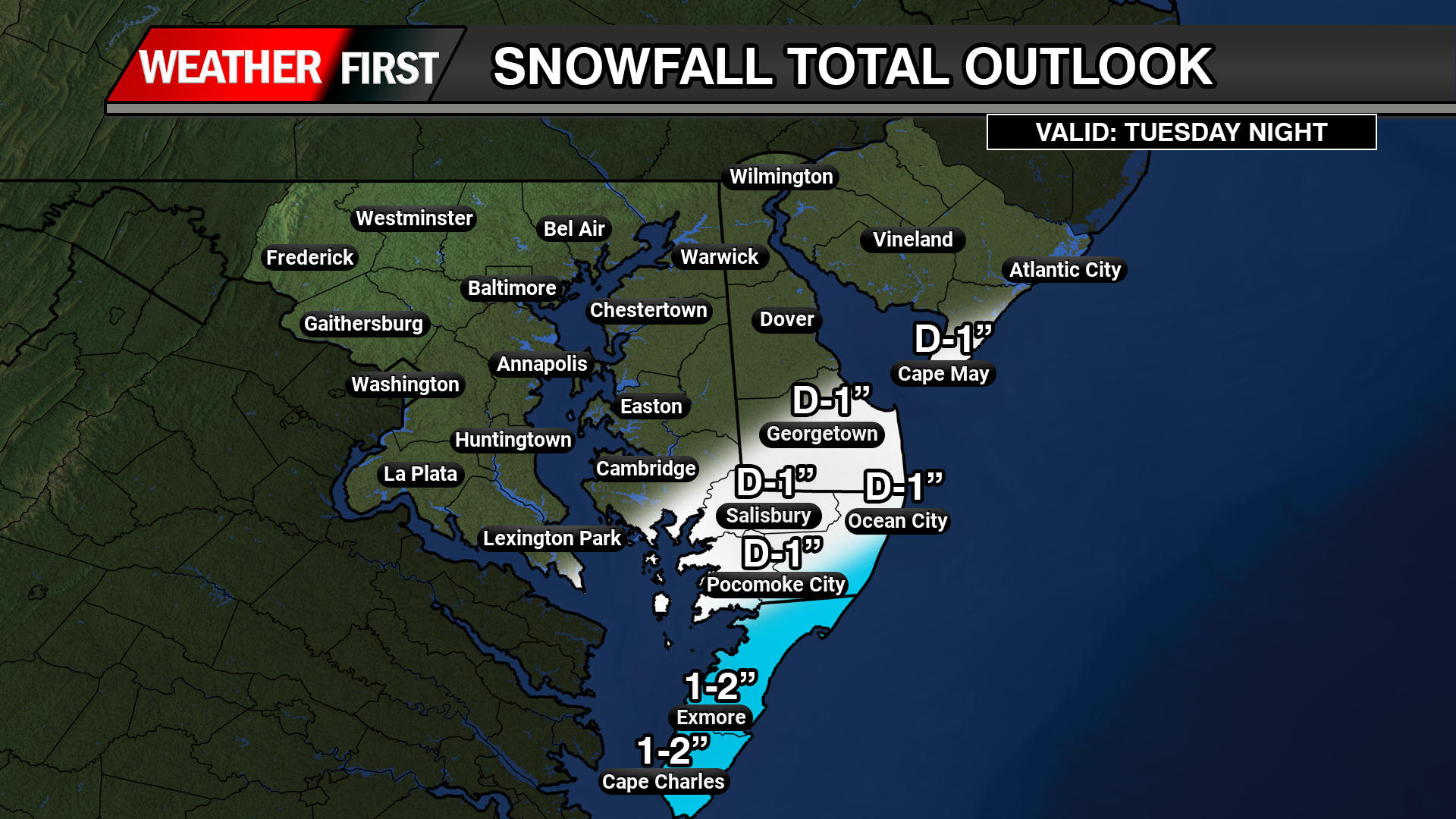
    Another round of accumulating snowfall is on tap for this weekend during the early morning hours Sunday through the late morning hours. A Clipper system approaching from the Mid-west will begin to redevelop a coastal low will bring a band of light to moderate snowfall to the region on Sunday as a arctic frontal boundary moves through bring severely cold temperatures throughout the Eastern US.

    Looks like right now areas across Northern Maryland, Northern Delmarva, and South Jersey will be in the hot seat for seeing the most accumulating snow when the coastal low begins to take over. A widespread swaft of 2-4 inches of snow seems probable with areas further south will have lighter precipitation to deal with overall. Making for Sunday morning travel a bit slick with temperatures in the upper 20s and the winds begin to pick up later in the day for some blowing and drifting.

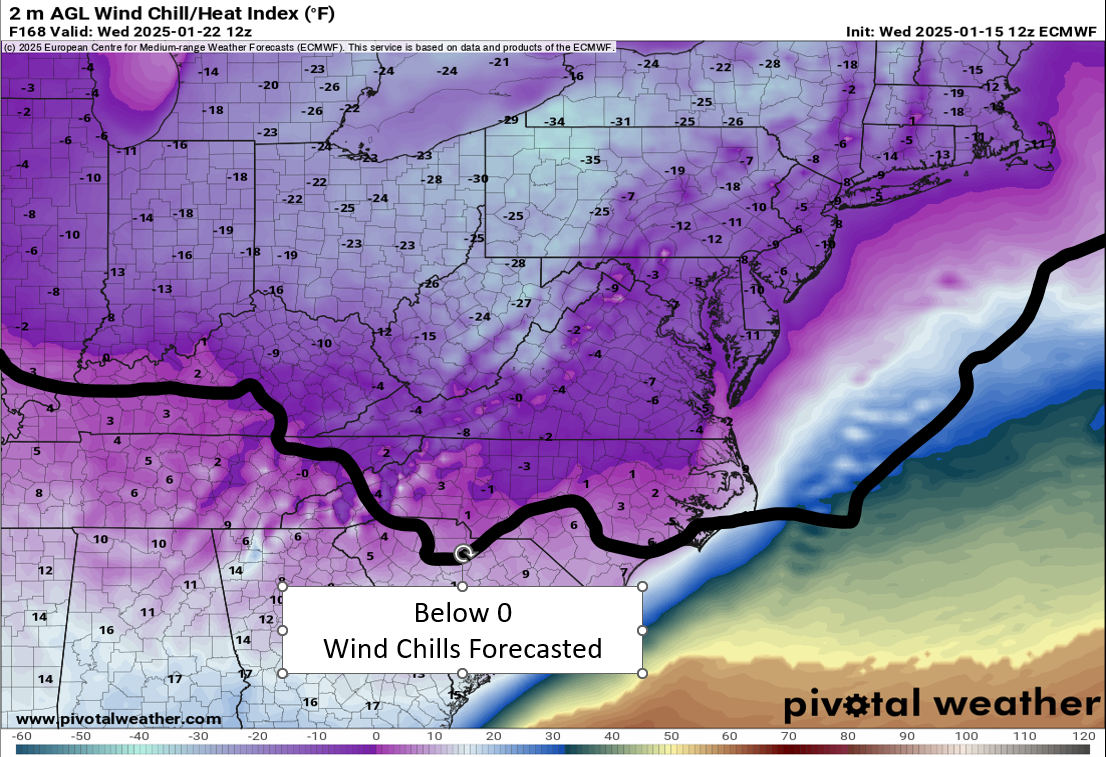
    An Arctic air mass is moving southward, bringing dangerously low temperatures and life-threatening wind chills across a broad swath of the central US, from the Northern Plains towards the Mid-Atlantic

    Temperatures are forecasted to plunge 20 to 30 degrees below normal, with wind chills dropping below -30°F in some areas. This extreme cold poses serious risks to human health, pets, and infrastructure, including the potential for frozen pipes.

    Residents in the affected regions are urged to prepare immediately by taking steps to protect themselves, their animals, and their homes. The agencies emphasize the importance of readiness to mitigate the harsh impacts of this severe weather event.

  • March 2025 Goes Down as the Windiest on Record for Parts of the U.S.

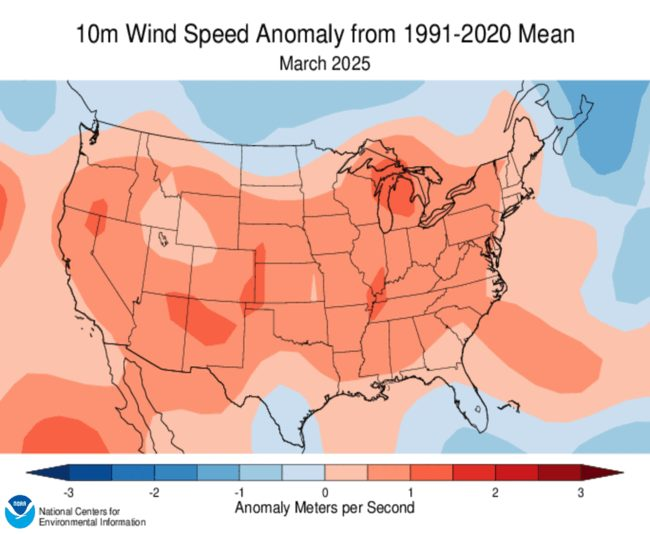
    March 2025 Goes Down as the Windiest on Record for Parts of the U.S.

    Image From WeatherMatrx

    If you thought March felt windier than usual — you were absolutely right.

    This past March wasn’t just breezy — it was officially the windiest on record for several cities across the Central and Eastern U.S., according to data from the National Weather Service.

    Why Was It So Windy?

    Spring is typically known for being a bit blustery as seasons change. But this year, things were taken to a whole new level.

    Meteorologists say an unusually active jet stream combined with frequent storm systems created a perfect recipe for non-stop wind throughout the month. The strong contrast between areas of high and low pressure kept the air constantly moving — and moving fast.

    Cities That Smashed Records

    Some of the hardest-hit areas for wind records included:

    • Chicago, IL
    • Omaha, NE
    • Kansas City, MO
    • Des Moines, IA

    These cities didn’t just have a few windy days — their average wind speeds for the entire month were 2 to 4 mph higher than normal. That may not sound like much, but for monthly records, that’s a big deal.

    What Were the Impacts?

    The gusty conditions led to plenty of problems:

    • Trees and power lines were knocked down
    • Dust storms reduced visibility across the Plains
    • Wildfire danger spiked in dry areas
    • Air travel was affected with delays and rough landings

    It was a challenging month for truck drivers, travelers, and anyone trying to enjoy the outdoors.

    Will Windy Marches Become More Common?

    It’s too early to say if this is the start of a long-term trend or just a particularly stormy spring. But meteorologists will definitely be keeping an eye on future wind patterns as the climate continues to change.

    Either way, March 2025 will go down in the books as one of the windiest we’ve ever seen — and one that residents across the Midwest and Plains won’t forget anytime soon.

  • Severe Weather On Tap For Monday Evening Across Delmarva

    Severe Weather On Tap For Monday Evening Across Delmarva

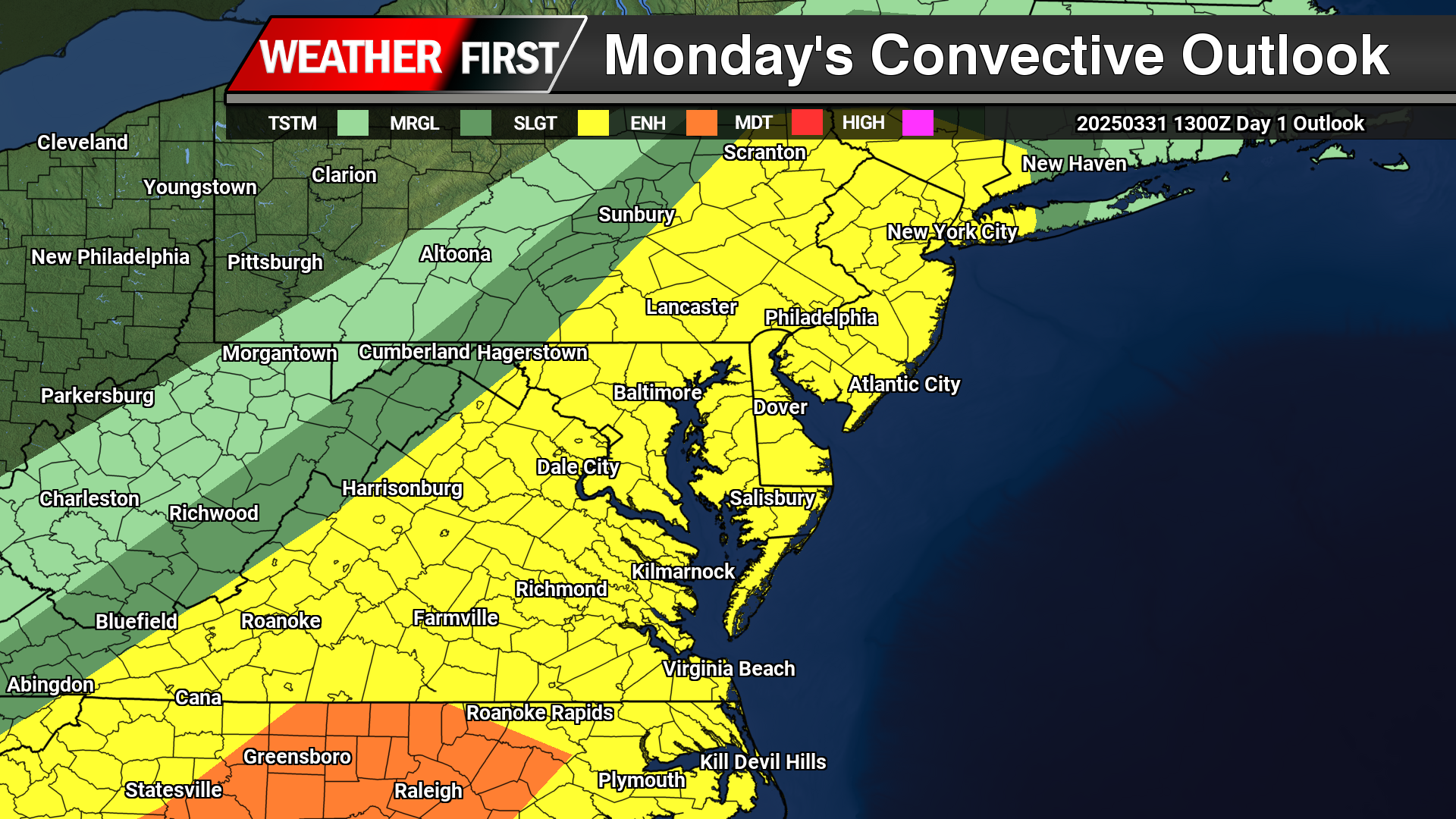
    Strong to severe thunderstorms remain on tap as we venture into the afternoon and evening hours today as a strong cold front advances from the west. A “Slight Risk” of severe weather from the Storm Prediction Center laid across all of the Mid-Atlantic today.

    Looking at satellite this morning over towards our west a nice blanket of sunshine moving into the region to help destabilize the atmosphere with surface heating as temperatures are expected to be well into the 70s as dew points surge into the 60s to have plenty of moisture in place. Well suited for thunderstorm develop later today.

    The first round of storms will begin to develop across the Maryland Western shore around the mid-afternoon hours (4-5PM) which will have the highest chances of larger hail or even an isolated tornado being discrete in nature. Later in the evening hours as the cold front arrives, a squall line likely to develop with the primary threat of damaging straight line winds. Although a quick spin up in the line is always a possibility but those probabilities remain on the low side of things.

    As mentioned before, the primary threat for the storms this afternoon will be indeed damaging straight line winds from the main squall line that moves through towards the evening hours from 7-10PM. Winds gusting as high as 70 mph are possible with the strongest portions of the line. Heavy rainfall from the squall line of 1-3″/hr could lead to some localized flooding in spots. During the mid afternoon hours when a few discrete cells form will have the best shot of large hail to 1″ or locally larger. Tornado threat remains low but not impossible for the first cells to develop in the afternoon hours and then again in the line itself.

  • Severe Weather And High Winds Possible Again This Weekend On Delmarva

    Severe Weather And High Winds Possible Again This Weekend On Delmarva

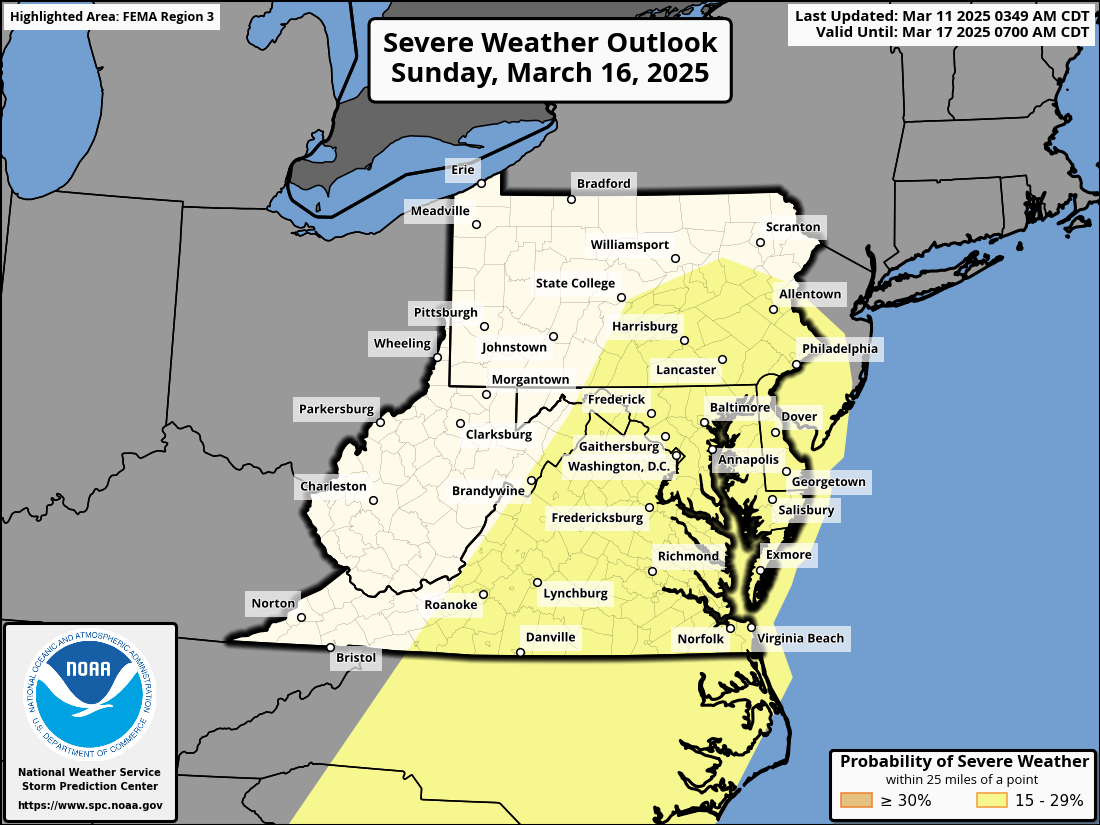
    Once again another powerful storm system is expected to develop across the central lower 48 later this week posing a widespread multi-day severe weather outbreak with damaging winds, large hail, tornadoes, and another high wind event impacting millions across the country. The Storm Prediction Center has highlighted a “Slight Risk” of severe weather across the Mid-Atlantic region on Sunday for thunderstorms capable of producing damaging winds along a powerful cold front to swipe through the area.

    Although areas across Delmarva and the surrounding areas will escape the extreme brunt of the severe weather, gusty thunderstorms are possible during the afternoon hours on Saturday where we have surface temperatures well above average into the lower 70s, sufficient moisture with dew points in the 60s, and not to mention the amount of wind shear available. Although the details remain unclear on the severity of the damaging winds or a tornado threat at this time, we will continue to monitor the threat as time gets closer.

    With or without the presence of thunderstorms, strong non-thunderstorm winds will become a problem yet again with wind gusts 40-60 MPH are very possible when this front arrives. Enough to cause more issues with down tree limbs and sporadic power outages. Thunderstorms will only enhance the wind threat more similar to what we seen from last weeks event.

    With a strong low level Jetstream reaching 50-70mph at 5000ft, some of those stronger winds could reach down to the surface at times with the gusty showers and embedded thunderstorms. We will continue to monitor the latest forecast trends as we approach closer towards the weekend.

  • Severe Weather & High Wind Threat Wednesday

    Severe Weather & High Wind Threat Wednesday

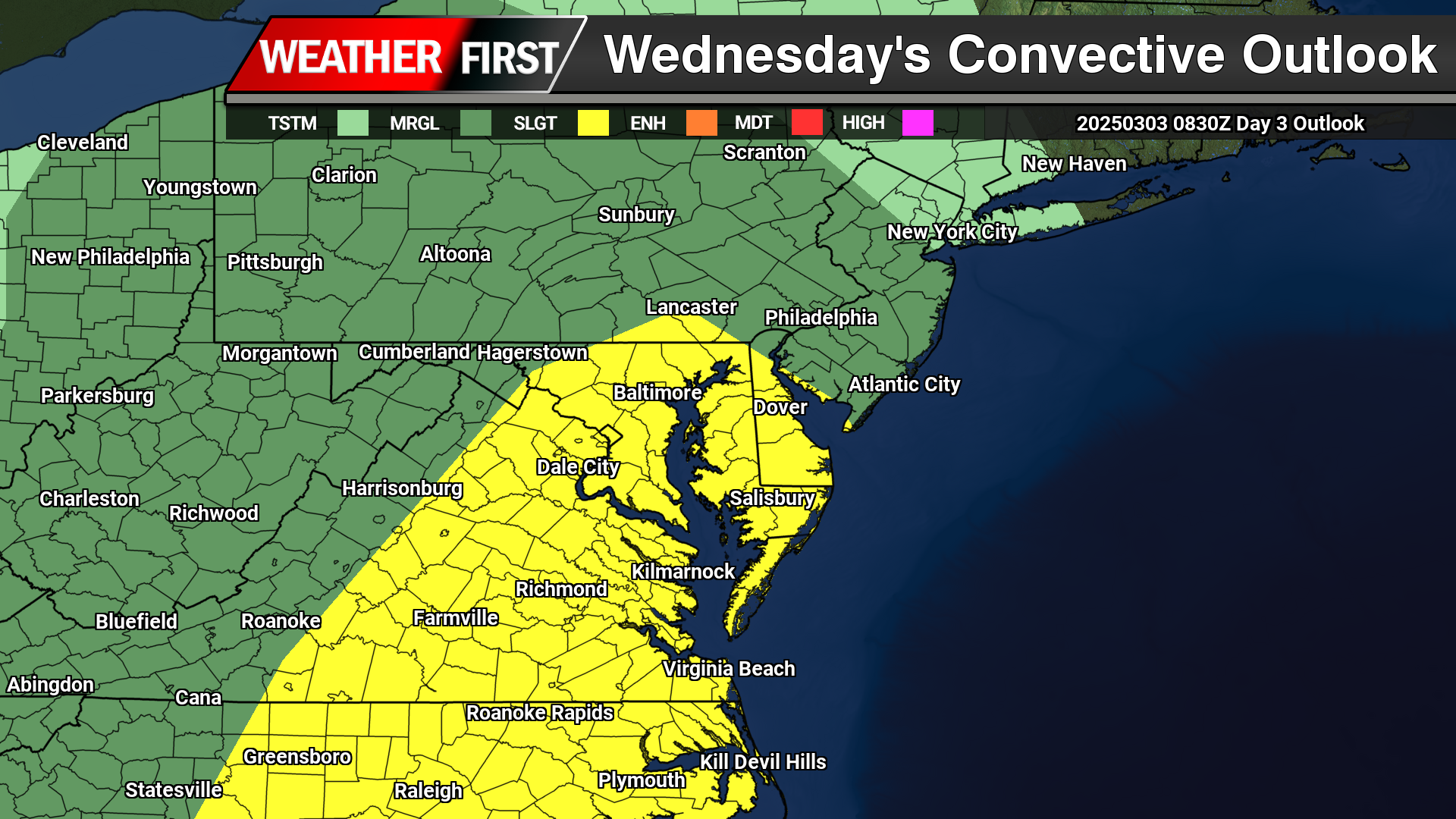
    As a powerful storm system begins to develop across the Central Plains, rounds of severe weather are expected from the deep south towards the Mid-Atlantic. As the month turns a new, we are now in Meteorological Spring and the severe weather threats begin showing up across the country.

    As a strong area of low pressure lifts up towards the Great Lakes, a tight pressure gradient will create tons of wind energy all over the eastern portions of the United States. On the warm side of the system as a powerful cold front advances eastward, instability and moisture coming from the Gulf will create a line of strong to severe thunderstorms to move through the Mid-Atlantic Wednesday afternoon.

    A Slight Risk Of Severe Weather is in place across the Delmarva region down towards areas of the Carolinas. Primary threats will include strong damaging winds and the chance of a isolated tornado can not be ruled out. Storm Prediction Center meteorologist Jeremy Kerr had this to say about the overall threat.

       "Models indicate that surface dew points may increase into the 60s F
    in a corridor across the Carolinas through Virginia during the day.
    Latest NAM forecast soundings suggest that this might occur across
    parts of the Carolina Piedmont into coastal plain prior to the
    arrival of a remnant convective band emerging from the eastern Gulf
    States. Although lower/mid-tropospheric lapse rates are forecast to
    be rather weak, weak near-surface destabilization might become
    sufficient to support a risk for tornadoes and/or damaging straight
    line wind gusts, given forecast very large, clockwise curved
    low-level hodographs.

    In the wake of this initial band of convection, beneath a developing
    dry slot, northward moisture advection and insolation to the lee of
    the Blue Ridge may contribute to modest destabilization by late
    Wednesday afternoon. It appears that this will be aided by the
    leading edge of stronger mid-level cooling spreading to the east of
    the Appalachians, and accompanied by increasing thunderstorm
    development in the presence of strong deep-layer shear. Although
    forecast soundings suggest that low-level hodographs may become more
    modest by this time as the stronger low-level jet core spreads
    offshore, the environment may still become conducive to supercells
    with potential to produce severe wind, hail and perhaps a tornado."

    Including the threat for severe weather, high non-thunderstorm wind damage is possible with a strengthening low level jet stream across the region. Model guidance has been showing very strong low level Jetstream winds of 60-80kts at 5000 feet which can be brought down to the surface from heavy rain or thunderstorms.

    As of this time, strong winds of 45 upwards to 60 mph are possible as this powerful cold front arrives during the afternoon hours on Wednesday. Winds of this magnitude can bring down trees and powerlines to create sporadic areas of power outages. Winds will continue to be strong after the cold front passes through as the pressure gradient remaining strong through Thursday.

  • Fire Weather Watch Issued for Delaware and Eastern Shore of Maryland: Critical Fire Danger Possible

    Fire Weather Watch Issued for Delaware and Eastern Shore of Maryland: Critical Fire Danger Possible

    MOUNT HOLLY, N.J. — The National Weather Service has issued a Fire Weather Watch for Delaware and the Upper Eastern Shore of Maryland, in effect from Saturday morning through Saturday evening.

    The watch covers New Castle, Kent, Inland Sussex, and the Delaware Beaches, as well as Kent, Queen Anne’s, Talbot, and Caroline counties in Maryland.

    Forecasters warn of an increased risk of wildfires due to a combination of strong winds and low relative humidity. Northwest winds are expected to range between 15 to 25 mph, with gusts up to 35 mph. Humidity levels could drop as low as 25%, creating conditions that could cause any fires to ignite and spread quickly.

    Officials strongly discourage outdoor burning during this period.

    A Fire Weather Watch indicates that critical fire weather conditions may develop. Residents should stay updated on the latest forecasts and be prepared for potential Red Flag Warnings.

    For information on wildfire safety, burn restrictions, and prevention, visit your state’s forestry or environmental protection website.

  • Washout Of A Weekend On The Way For The Delmarva Region

    Washout Of A Weekend On The Way For The Delmarva Region

    If you were hoping to have a nice weekend ahead with good weather, this is not the weekend for it. Although the rain is welcomed and very beneficial for the ongoing extreme drought we are in, makes for plans to be remaining indoors. Rain will begin to move into the region during the afternoon hours on Saturday as a warm front lifts through. Rain will be heavy at times after dark through the morning hours.

    There will be a lull in the precipitation heading into the later morning hours on Sunday but we will see a noticeable increase in temperatures surging into the mid 60s. A cold front will be arriving later in the after hours bringing back the heavy rainfall and maybe even a few gusty thunderstorms are possible.

    The Storm Prediction center already highlighting a “Marginal” risk of severe weather for the afternoon hours on Sunday as a potential thing line of storms may form along the cold front. Although not expecting widespread thunderstorm development, a few rogue storms are not out of the question.

    Rainfall on the order of 1-2 inches is very plausible before tapering off Sunday night across the region. Might be some low lying area flooding with the recent rainfall events and the major snow melt from a few days ago.

  • Significant Winter Storm Set to Impact the Delmarva Region Tuesday into Wednesday

    Significant Winter Storm Set to Impact the Delmarva Region Tuesday into Wednesday

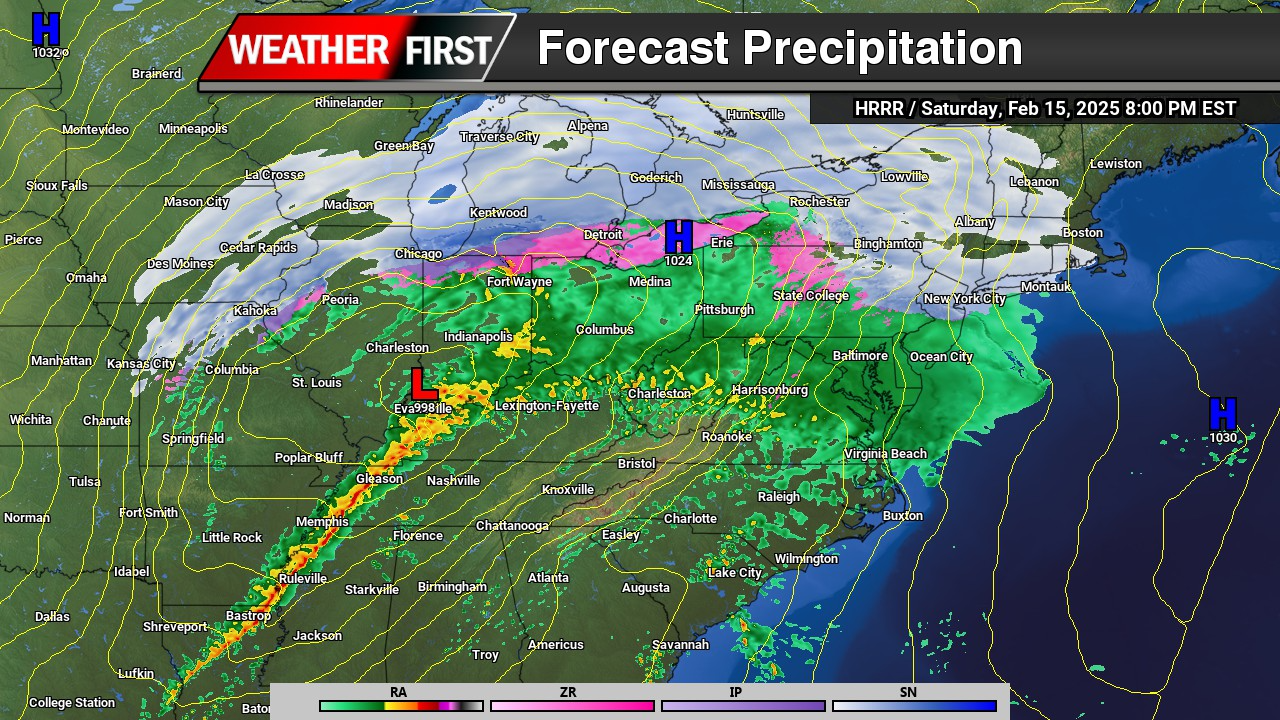
    Another winter storm is set to impact the region as we move into Tuesday and Wednesday, bringing a mix of heavy snow, ice, and rain across the Delmarva Peninsula. Snow and wintry precipitation will begin Tuesday afternoon and continue through Wednesday morning, leading to widespread travel disruptions and hazardous conditions.

    This storm is developing as a new area of low pressure forms over the Deep South and tracks northeastward along a stalled frontal boundary. At the same time, a strong high-pressure system to the north will funnel cold air into the region, setting the stage for a classic overrunning event. In this setup, warm, moisture-laden air from the Gulf of Mexico moves over the dense, cold Arctic air advancing southward from Canada, creating widespread heavy snowfall from the Midwest into the Mid-Atlantic. This process, known in meteorology as isentropic ascent, drives the formation of clouds and precipitation as the warm air rises and cools.

    In a winter storm overrunning setup, isentropic ascent occurs when warm, moist air is forced to rise over a cold, dense air mass at the surface. This typically happens along a stationary front or warm front, where the warm air follows sloping isentropic surfaces (constant potential temperature). As the air rises, it cools adiabatically, leading to cloud formation and precipitation.

    Since winter storms involve subfreezing surface temperatures, this precipitation can fall as snow, sleet, or freezing rain, depending on the temperature profile. Stronger isentropic ascent enhances moisture transport and lift, leading to heavier and more widespread winter precipitation.

    Snowfall Potential and Accumulation Estimates

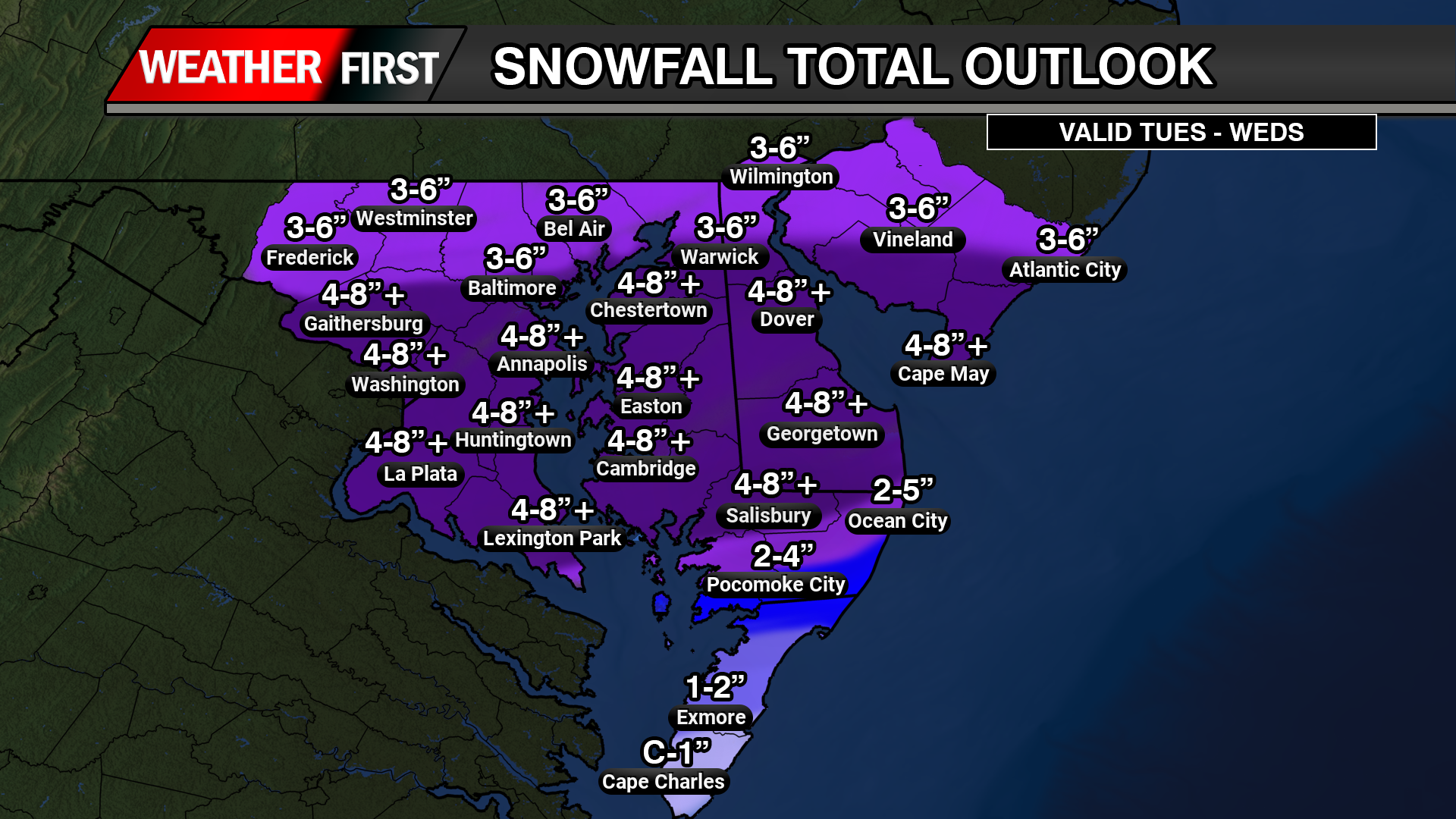
    The latest ensemble model guidance indicates a significant increase in snowfall probabilities across central and northern Delmarva. There is now a 60-90% chance of at least 3 inches of snow north of the Maryland-Delaware state line, with 40-60% probabilities for accumulations exceeding 6 inches from Delmar, DE to Smyrna, DE.

    The heaviest snowfall totals are expected between the MD/DE line and Smyrna, where an average of 4 to 8 inches is forecast. This extends westward toward Washington, D.C.. However, localized snow bands could produce isolated totals up to 10 inches, particularly across central Delmarva.

    Coastal and Southern Delmarva Impacts

    Further south, near the coastal areas including Berlin and Pocomoke City, the storm will begin as snow but may transition to a mix of snow, sleet, and rain as temperatures rise above freezing. This will reduce overall snowfall totals due to melting overnight Tuesday into early Wednesday.

    Meanwhile, areas further north will remain all snow, though the intensity may be slightly lower compared to central Delmarva. Regardless, this storm is shaping up to be a significant winter weather event across the region, bringing hazardous travel conditions and potential disruptions.

    Stay tuned for updates as forecast details continue to evolve.

  • Some Beneficial Rain Arriving Tonight: Drought Conditions Continue To Worsen

    Some Beneficial Rain Arriving Tonight: Drought Conditions Continue To Worsen

    A much-needed round of rainfall is set to arrive across the Delmarva Peninsula late tonight, providing a temporary break from the dry conditions that have persisted for months. A warm front will lift through the region after midnight, bringing light to moderate rain that will continue through much of Friday. While occasional breaks in the precipitation are possible, Friday is expected to be a generally wet day before rain tapers off just before sunrise on Saturday morning.

    Rainfall totals will range between 0.5 to 1 inch on average, with localized areas potentially receiving slightly higher amounts. While this rain will help to wash away accumulated road salt and provide some short-term relief, it will do little to alleviate the severe to extreme drought conditions gripping the region. Rainfall deficits remain substantial, with much of Delmarva running nearly a foot below average for the past several months. This system, though beneficial, will barely make a dent in the long-term precipitation shortfall.

    Nonetheless, the rain will bring some temporary improvements to soil moisture levels and reduce the immediate fire danger that has accompanied the prolonged dry spell. However, with no significant additional rainfall in the extended forecast, drought conditions are likely to persist into February.

  • Rain Chances Increase Later In The Week: Drought Conditions Worsen Here On Delmarva

    Rain Chances Increase Later In The Week: Drought Conditions Worsen Here On Delmarva

    More rain is in the forecast as we approach the weekend, but unfortunately, it is unlikely to significantly alleviate the ongoing drought conditions. Although several snowfall events have occurred this winter—including the major storm on January 5-6—these have not contributed meaningfully to overall precipitation levels. The region remains in a notable deficit, and the upcoming weather system is expected to provide limited relief.

    Later this week, a storm system originating from the Deep South will begin impacting the area. A warm front will approach Friday morning, bringing intermittent light rain throughout the day. This pattern of precipitation will persist into early Sunday morning. Current projections estimate rainfall amounts between 0.50 and 1 inch; however, these figures are subject to change as the system develops. Unfortunately, even this level of precipitation will be insufficient to make a significant dent in the drought conditions.

    Current Precipitation Deficit

    We extend our gratitude to National Weather Service Meteorologist Michael Lee from Mount Holly for providing valuable data and graphical insights into the current precipitation shortfall.

    • Georgetown, DE: From January 28, 2024, to January 27, 2025, the normal precipitation should be 43.98 inches. However, the actual precipitation recorded so far is only 31.66 inches, resulting in a deficit of 12.32 inches.
    • Wilmington, DE: During the same period, normal precipitation is expected to be 45.43 inches, but only 38.37 inches have been recorded, creating a deficit of 7.06 inches.

    These figures highlight the severity of the situation, emphasizing the significant gap that remains to be addressed in the coming months.

    Impacts on Agriculture

    The continued drought is a major concern for local farmers, particularly with the spring growing season fast approaching. Persistent dry conditions are likely to place extreme stress on agricultural operations, potentially affecting crop yields and overall productivity. Addressing this deficit before spring is critical to reducing the strain on farmers who have already faced significant challenges due to drought conditions in recent years.

    While the upcoming rainfall is welcome, it is clear that much more precipitation will be needed to recover from this prolonged dry spell. The hope remains that weather patterns in the next few months will bring sustained rainfall to help close the gap and alleviate some of the burdens facing the region.

  • Light Snow Event Tonight For Areas Of Southern Delmarva: Dangerous Cold Remains

    Light Snow Event Tonight For Areas Of Southern Delmarva: Dangerous Cold Remains

    A minor to light snowfall event on the way tonight as a rare southern US snowstorm is underway. Areas of Delmarva will see the extreme northern extend of the precipitation shield bringing areas of snow showers tonight, in particular across the VA counties. With extremely cold temperatures in place, this will be a very light and fluffy snow as temperatures are expected to be in the teens by the time the snow arrives later this evening. Most of the snowfall accumulations will be occurring across Northampton and Accomack counties where a short duration 1 to 2 inches are possible. Even though the amount of precipitation is very little of a tenth of a inch or less, temperatures are playing a huge role for “high ratio snowfall”

    The snow-to-liquid ratio is a quantitative measurement of how fluffy or heavy new fallen snow is.  It’s reported as the number of inches of snow that comes from 1 inch of liquid precipitation.  Typical snow-to-liquid ratios vary by region and by the weather pattern producing the snowfall. Air temperature, humidity, and wind speed influence how dense new fallen snow is. The highest snow ratios (or lowest density snow) are usually formed by temperatures that are roughly between 0°F and 10°F, in what is called the “Dendritic Growth Zone.”  This is the regime for forming large dendrites that accumulate with abundant air space between crystals.   New snow grains that are smaller and pack together better form denser snow.  Snow that forms outside of the Dendritic Growth Zone regime will be denser, as will snow that falls through warmer layers or is subject to riming.  Stronger winds will batter snowflakes together as they fall, which breaks down snow crystals into smaller, denser grains.

    ...WINTER WEATHER ADVISORY IN EFFECT FROM 5 PM THIS AFTERNOON TO 7
    AM EST WEDNESDAY...
    
    * WHAT...Snow expected. Total snow accumulations of 1 to 2 inches.
    
    * WHERE...Portions of northeast North Carolina and eastern and
      southeast Virginia.
    
    * WHEN...From 5 PM this afternoon to 7 AM EST Wednesday.
    
    * IMPACTS...Plan on slippery road conditions. The hazardous
      conditions could impact the Tuesday evening and Wednesday morning
      commutes.
    
  • Dangerous Cold Invades The Lower 48 Next Week: Coldest Outbreak In Several Years

    Dangerous Cold Invades The Lower 48 Next Week: Coldest Outbreak In Several Years

    🚨 Severe Cold Weather Alert: An Arctic air mass is forecasted to sweep across a significant portion of the United States this weekend! 📉 From the Rockies to the Great Plains, this frigid air will reach the Gulf Coast by Saturday night and move towards the Eastern Seaboard by Sunday evening.  

    ❄️ Extremely Low Wind Chills: The Rockies, northern Plains, and Upper Midwest are expected to experience dangerous wind chills as low as -30°F or even lower from Saturday through Tuesday. This extreme cold poses serious risks of hypothermia and frostbite for individuals exposed to these conditions. If you plan to travel, ensure you have a cold weather survival kit prepared for your safety.  

    🌬️ Furthermore, below-zero wind chills are anticipated to extend into the southern Plains and the Ohio Valley from Sunday night through Tuesday. The hazardous cold is likely to persist along the Gulf Coast and across the Southeast U.S. for much of the following week. Stay warm and take all necessary precautions during this severe cold snap! 🥶

  • New Cold Weather Alerts Aim to Simplify Messaging and Highlight Dangers

    New Cold Weather Alerts Aim to Simplify Messaging and Highlight Dangers

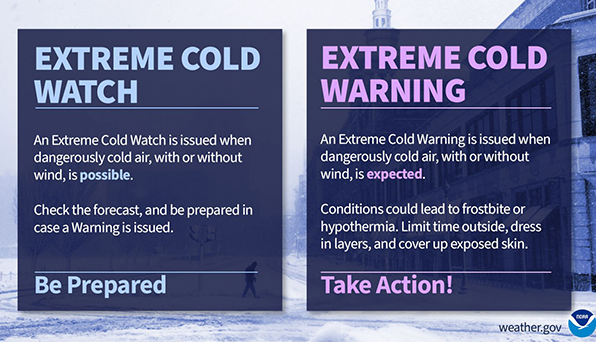
    As winter approaches, significant changes are coming to how extreme cold is communicated to the public. Starting this season, the National Weather Service (NWS) will replace wind chill watches, warnings, and advisories with extreme cold watches, warnings, and advisories. This shift aims to enhance understanding of cold weather hazards and ensure that the dangers of low temperatures are effectively conveyed.

    What’s Changing?

    Previously, wind chill alerts were issued only when wind speeds exceeded 10 mph, focusing solely on the combined effect of wind and low temperatures. However, under the new system, alerts will be based on the apparent temperature, which is the lower value of air temperature or wind chill. This adjustment acknowledges that dangerous cold can occur even in calm conditions.

    For example, if the air temperature drops to life-threatening levels but winds remain light, the new extreme cold warning would still be issued—something the prior system didn’t account for.

    Why the Change?

    The updated system reflects a growing understanding of how cold weather impacts people and communities. By removing the 10 mph wind threshold, the change aims to streamline cold weather alerts and emphasize that frigid temperatures can be dangerous with or without wind.

    Wind chill, however, is not disappearing—it will still be forecasted and reported as a key factor in winter weather conditions. The new terminology is designed to simplify messaging for the public while accounting for broader climatological and health impacts.

    New Guidelines for Alerts

    The thresholds for issuing extreme cold watches, warnings, and advisories have been refined to align with historical climate patterns and their potential impacts. These changes also incorporate insights from recent winters, where dangerously low temperatures have posed threats even in the absence of strong winds.

    • Cold Weather Advisory: Issued for conditions that could cause discomfort or mild health impacts for vulnerable populations.
    • Extreme Cold Watch: Used to signal the potential for dangerous cold weather conditions within a few days.
    • Extreme Cold Warning: Issued when life-threatening cold is imminent or occurring.

    A Clearer Message for Safety

    By simplifying the criteria and expanding the scope of dangerous cold conditions, the new system seeks to reduce confusion and encourage timely action during winter weather events. Whether it’s protecting yourself from frostbite and hypothermia or ensuring pets and pipes are safe, these changes emphasize preparedness for all cold weather scenarios.

  • Delmarva Faces Worsening Drought: Concerns for Agriculture and Fall Foliage

    Delmarva Faces Worsening Drought: Concerns for Agriculture and Fall Foliage

    The Delmarva Peninsula is currently experiencing one of its driest periods on record, with no measurable rainfall for several weeks. Unfortunately, according to the latest outlook, this dry spell is expected to persist for at least another two weeks, potentially placing Delmarva in the top 10 driest periods on record.

    While many areas across the mid-Atlantic are facing moderate drought conditions, parts of Delmarva are nearing severe drought status. Widespread severe drought conditions are likely to develop within the next one to two weeks, raising serious concerns, particularly for agriculture.

    Impact on Agriculture

    For farmers, the lack of rain couldn’t have come at a worse time. This is the season when many crops require adequate moisture to finish strong before harvest. The drought has already caused stress to crops like corn and soybeans, with yields expected to be lower than usual. Many farmers may struggle to bring in a profitable harvest, and this could lead to higher food prices in the coming months.

    Livestock farmers are also feeling the pressure as the dry conditions limit the growth of pasture grasses, forcing them to use stored feed much earlier than planned. Watering livestock is becoming a challenge in some areas as ponds and wells continue to dry up.

    Fall Foliage at Risk

    Beyond agriculture, the drought is likely to have a noticeable impact on Delmarva’s fall foliage. Trees that are under stress from drought often turn color earlier than usual, but the display may be shorter-lived and less vibrant. Instead of the bright reds, oranges, and yellows typical of fall, leaves may brown and fall off prematurely, leaving the landscape looking bare far earlier than normal.

    A Look Ahead

    The Climate Prediction Center’s 6 to 14-day outlook offers little hope for immediate relief, with dry conditions expected to continue in the near term. However, looking further out, there is a chance that wetter weather may return in the next 6 to 14 weeks, which could help bring much-needed moisture to the region.

    For now, though, the focus is on coping with the ongoing drought and its effects on both agriculture and the environment. Residents are encouraged to conserve water where possible and be prepared for potential crop shortages and higher prices in the months ahead.

  • Snowfall Forecast Thursday Night – Friday Morning *Updated*

    Snowfall Forecast Thursday Night – Friday Morning *Updated*

    Current Snowfall Accumulation Forecast

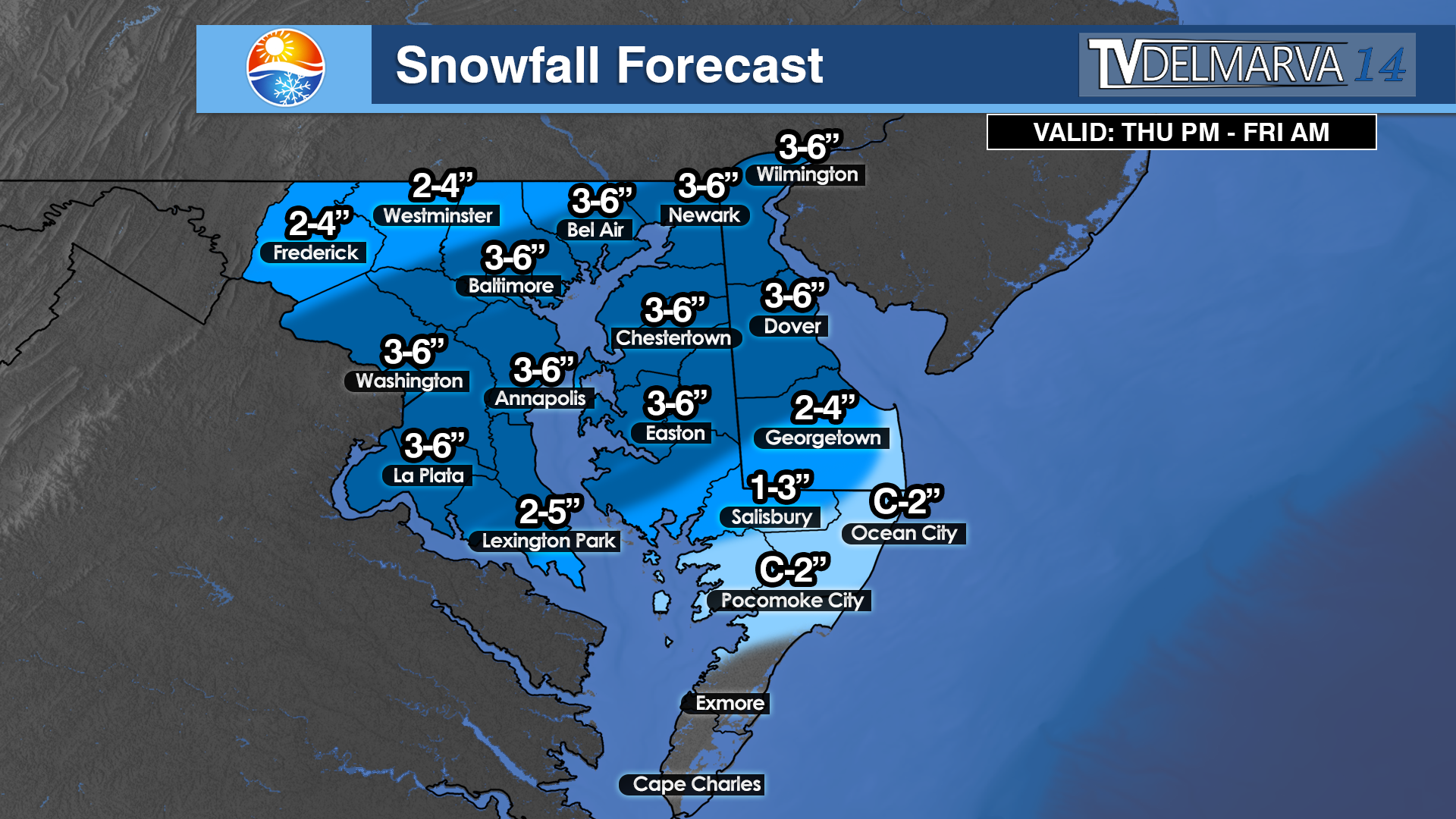
    We are not finished with the snow just yet. With a decent snow cover still on the ground to this date, more will be added beginning tomorrow night into the morning hours on Friday. This should not be a significant event like we saw on Monday, but enough to cause some roadway problems going into the Friday morning rush hour.

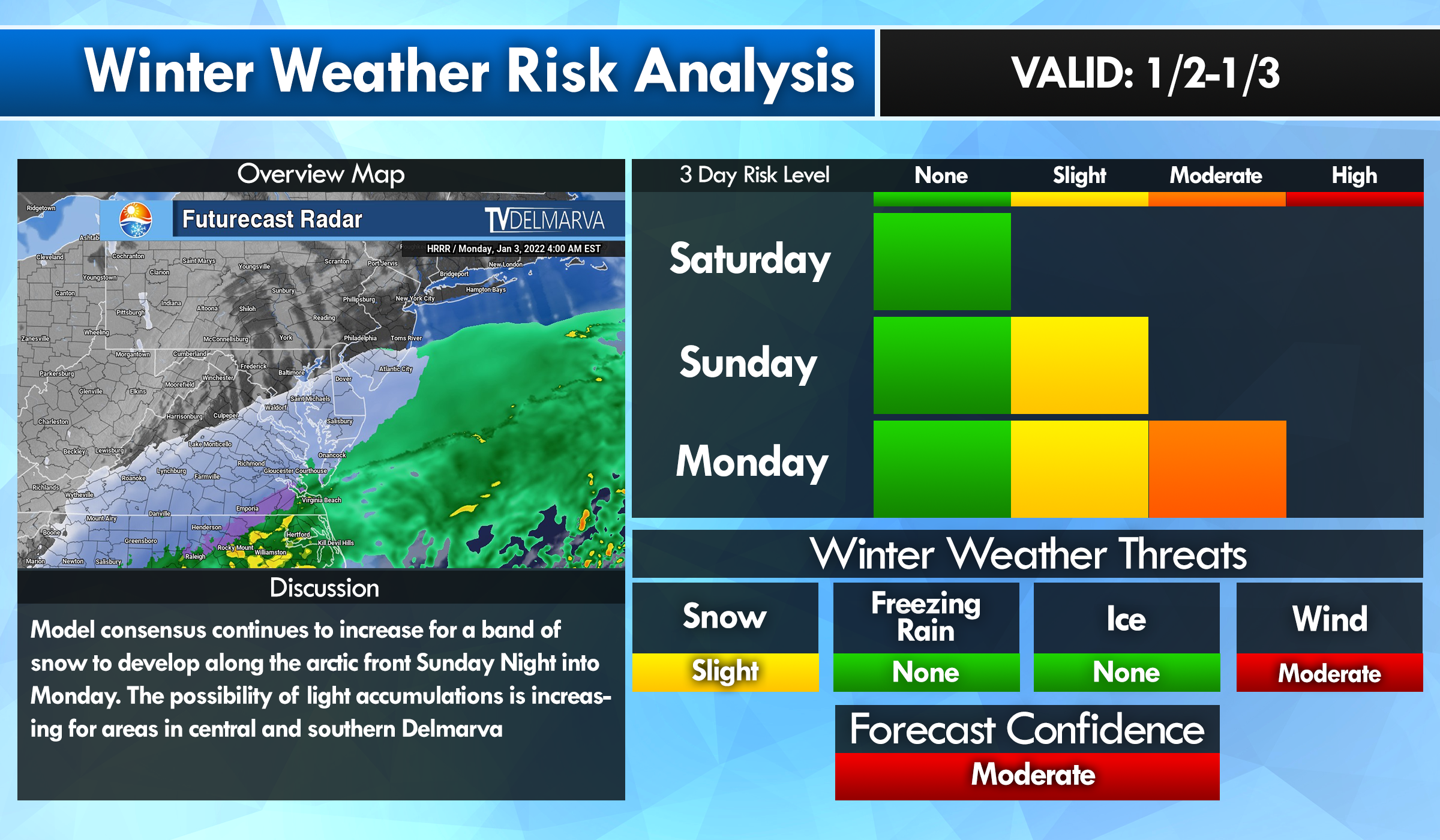
    Risk Analysis Regarding Snow & Travel Over The Next 3 Days

    With light to moderate accumulations on the table, there will be an area of sleet especially near Salisbury, Ocean City, and the Pocomoke City regions where temperatures will be flirting with the 32 degree mark. Locations further north will start out between 32 and 34 degrees before dropping down below freezing, once the precipitation arrives. Another instance of Dynamic Cooling will take place. This will be fairly wet snow just like last time, and it should not have a problem sticking to roadways.

  • Snow May Be Returning Thurs-Fri To Delmarva

    Snow May Be Returning Thurs-Fri To Delmarva

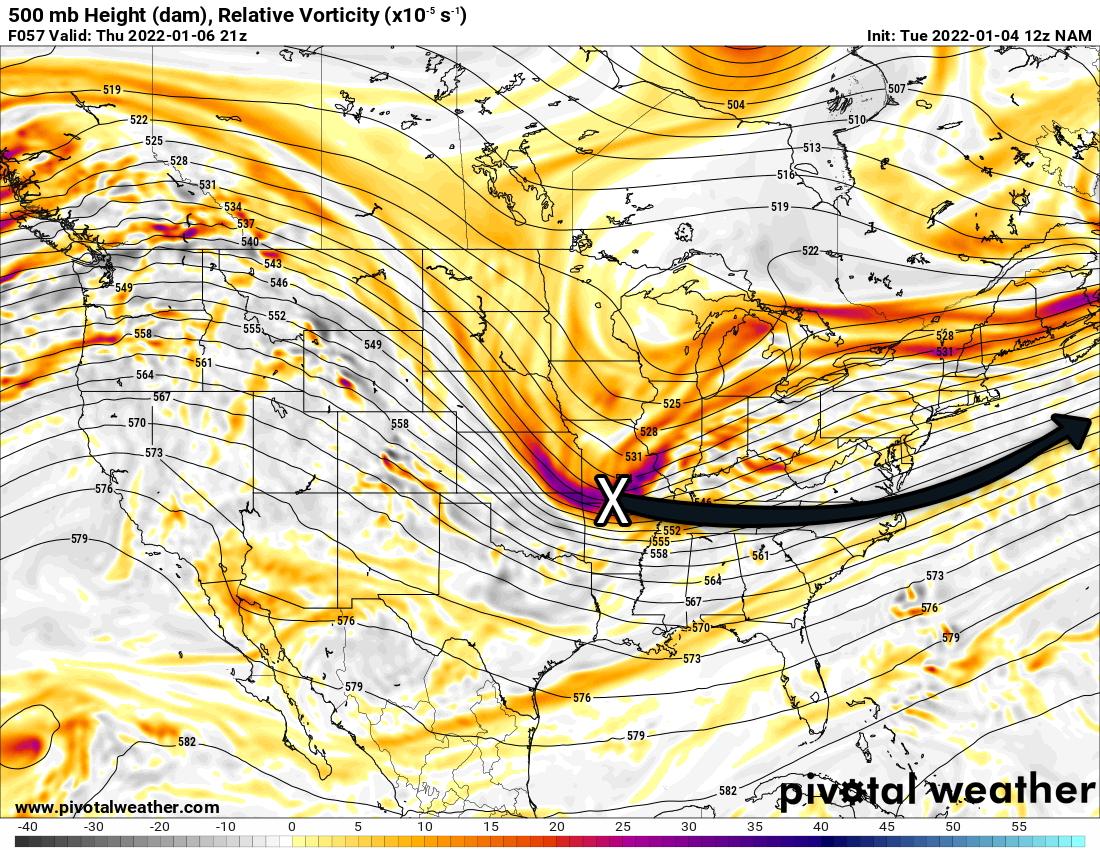
    500MB height and vorticity

    If it wasn’t enough after our past major winter storm, more snow is looking to pay a visit once again overnight Thursday into Friday. Now do not start going into a frenzy thinking its going to be repeat with blizzard conditions, crazy thundersnow, and over 1 foot accumulations. This one is a very quick mover riding along the northern jet stream, not from the subtropical jet. So a massive amount of moisture will not be fed in from the Gulf of Mexico.

    This storm system will be following a similar path like a clipper system would by riding along the northern jet stream. Ejecting down from the central plains moving due east. At this time this area of low pressure plans to slide just south of the Mid-Atlantic region. (If it didn’t then I would be wasting my time even talking about this) Model guidance has been fairly consistent of the low transferring to the coast near Virginia(Miller B). With the cold air already in place and the help with the current snowpack will help keep surface temperatures lower as well. RGEM/GFS has been the more robust solutions with new accumulations of around 6 inches. While the ECMWF/NAM giving us a nice additional 2-4 inch spread.

    Like i mention at this time it does not appear to be a extremely impactful system, but regardless looking to possibility bringing some more of the white stuff later this week. Still have plenty of kinks to work out and to wait for more of the short term model guidance to take a stab at this one going forward.

  • Snowfall Forecast For Monday (Updated (9:30pm)

    Snowfall Forecast For Monday (Updated (9:30pm)

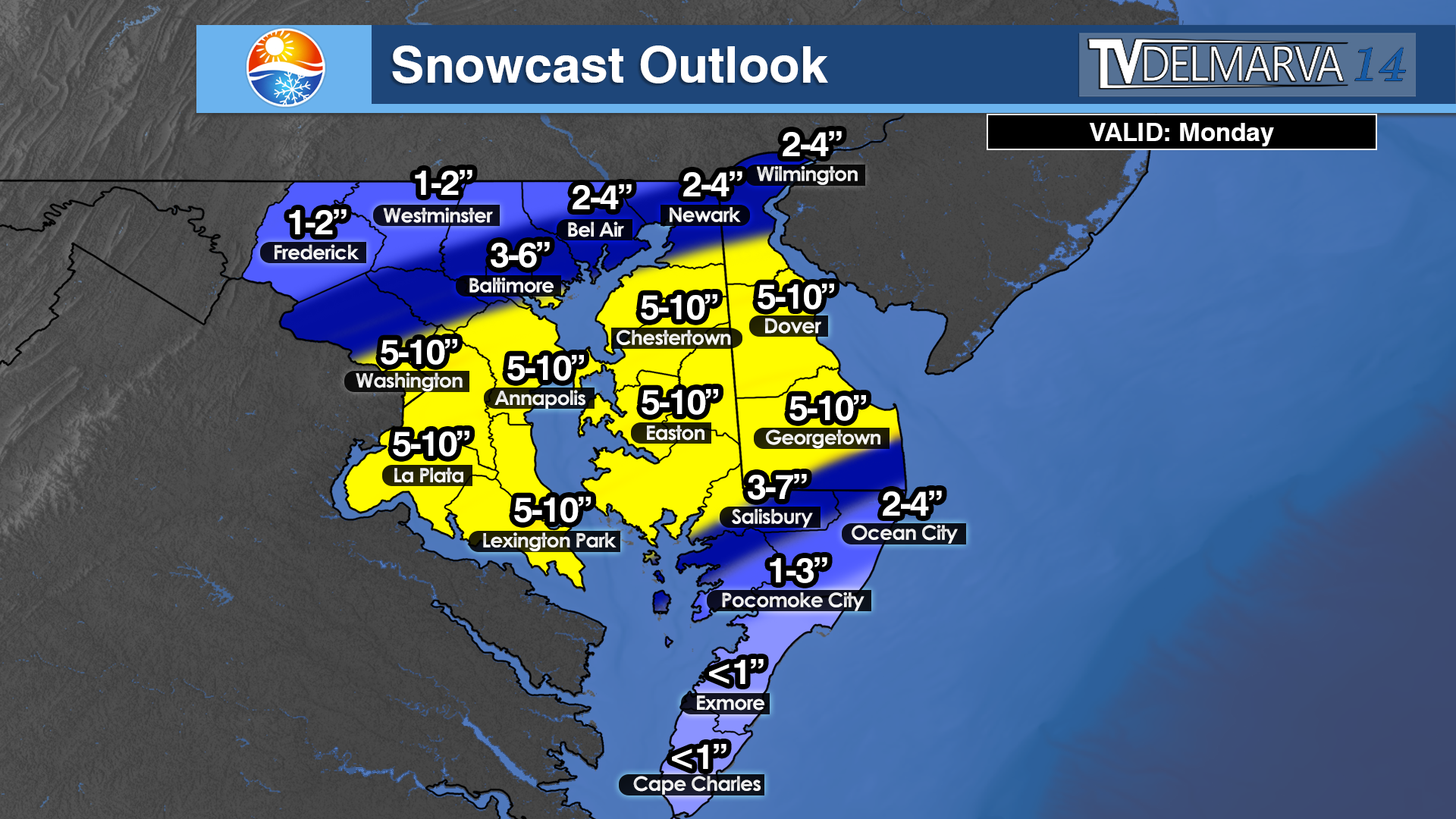
    Snowfall Forecast Valid For Monday (Subject To Change)

    Do not let these warm conditions fool you of the arctic snap that’s on our doorsteps today. With a very significant shift in the forecast trending towards the potential biggest storm in the region since 2019. Around this time in 24 hours, we will see a 30-35 degree temperature drop once the arctic front settles in from the north to the region.

    Futurecast Radar

    The main focus mechanism will be a lobe breaking off from the Sub-Tropical Jet Stream that will begin to interact with the stalling out arctic front. The thermodynamic difference along this front will help generate a strong baroclinic forcing. An area of low pressure will begin to intensify later this evening and track just off the coast of the Carolinas. Moisture will then start running into the arctic air mass (overrunning) creating a fairly narrowband of moderate snow to overspread areas from central Virginia into the Delmarva region.

    500mb Vorticity Forecast ECMWF

    For a rare set of parameters, there has been exceptional agreement between ALL model guidance regarding several inches of snow to the region. Some big contenders like the ECMWF (European model) showing some fairly significant snow to the region. GFS being the most robust out of all them showing a foot plus. Although that’s being really extreme and not likely at this time, but we have a great average of 4-8 blend with all the guidance at this time. Subject to chance of course for the difference in small fluctuations on axis and location.

    Winter Storm Warnings / Winter Weather Advisories

    I get a lot of questions and concerns when it comes to the sudden temperature drop and ground temperatures. On the first onset of precipitation, intensity will be key. Just because we were in the 60’s the last few days, falling snow can quickly cool off ground temperatures with the heavier intensity of snowfall. Same with roadways. Snow will be beginning to fall during the pre dawn hours and continue into the afternoon hours.

    Let’s not forget the night after if we have snow cover on the ground. With the arctic air mass settling in and fresh snow cover, temperatures will tank significantly during the overnight hours with clear skies. The snow will act as a blanket keeping the ground temperatures from warming the surface air temperature. Think of it like a cooler with ice in it, the air above the ice is extremely cold but underneath is above freezing. Depending on snow depth covering the ground, temperatures could drop down into the single digits.

    We will continue to provide updates on this potential winter storm going into tomorrow.

  • Record Heat To Accumulating Snow In 36 Hours

    Record Heat To Accumulating Snow In 36 Hours

    Confidence is increasing for snow on Delmarva Monday Morning

    Going to be in for some wacky weather over the next 36-48 hours. First off off we are dealing with very mild temperatures in the 60’s before a arctic front passage pushing through Sunday evening. The arctic front will push through dropping temperatures down below freezing and then stall just south of the Delmarva region. A piece of southern stream energy with the sub-tropical jet will begin to interact with the arctic front having a redevelopment of precipitation and amplification of an area of low pressure to move off the Carolina coasts.

    A good blend of different solutions showing that areas of central and southern Delmarva to pick up a light accumulation of snowfall. Some extreme solutions like the RAP and GFS showing a significant snowstorm to the region with several inches of snowfall but I’m going against that extreme. But i would not doubt some light accumulations are not out of the question.