Tag: comet

  • Delmarva Skywatchers: Comet Lemmon to Illuminate The Skies Northwest After Sunset

    Delmarva Skywatchers: Comet Lemmon to Illuminate The Skies Northwest After Sunset

    If you’re looking for a celestial treat in the coming nights, keep your eyes on the northwest sky just after sunset — Comet C/2025 A6 (Lemmon) is making its way into evening visibility, and Delmarva is in a prime spot to catch it.

    Discovered in January 2025 by the Mount Lemmon Survey, Comet Lemmon has become one of the most talked-about comets of the year. Originally expected to remain faint, the comet has surprised astronomers by brightening faster than forecast.

    Lemmon will make its closest approach to Earth on October 21, 2025, at about 0.596 AU (roughly 89 million km) away. It reaches perihelion (its closest point to the Sun) on November 8, 2025.

    Currently, the comet is estimated to be around magnitude 5 to 6, making it not quite prominent to the naked eye in most skies — but definitely within reach of binoculars or small telescopes in a dark location. Some predictions are more optimistic, suggesting it might brighten to magnitude ~4 around late October, which would make it more noticeable even to unaided eyes under favorable conditions.

    One of the exciting features now is that Lemmon will be about 42° away from the Sun during its closest approach — meaning it should be visible low in the western sky about an hour after sunset. The star Arcturus (in the constellation Boötes) and the double star Izar are being cited as useful reference points to help find it.

    By mid-to-late October, it should shift from being a dawn object into the evening sky, which greatly improves viewing opportunities for observers who aren’t night-owls.

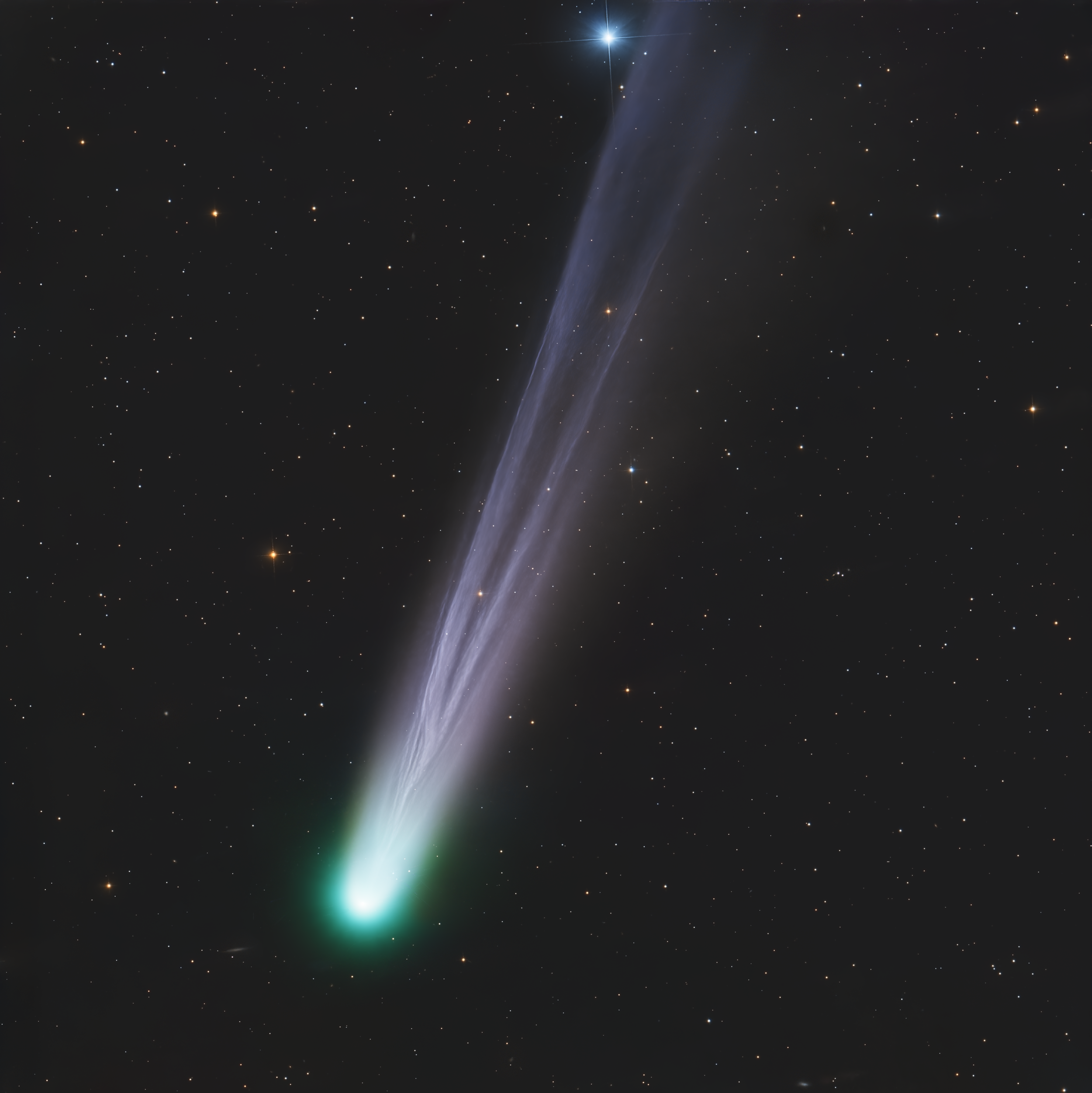
    Photo: Chuck Ayoub

    What Delmarva Observers Need to Know

    When & Where to Look

    • The comet will be best seen just after nautical twilight, once the sky is fairly dark but before it sinks too close to the horizon.
    • Start scanning the northwest to west-northwest horizon — the comet will be relatively low.
    • Use a low horizon (free from trees or buildings) to maximize your view.
    • For timing, expect prime viewing windows roughly 30 to 90 minutes after sunset, though this will shift slightly each evening as the comet’s position changes.

    Sky Conditions

    • Fortunately, forecasts suggest clear skies are likely — ideal conditions for comet watching.
    • Minimize light pollution: try to get to a darker spot (away from street lights or heavy urban glow) to boost your chances of spotting Lemmon.
    • Use apps like Stellarium, SkySafari, or TheSkyLive to track its nightly position against the background stars.

    Tips for Viewing & Photographing Comet Lemmon

    For Visual Observers (Binoculars / Telescopes)

    • Start with 10×50 or 10×60 binoculars — these will likely pick up the comet before your eyes can.
    • Use a low-power eyepiece in a telescope (e.g. 40–60×) to get a wider field of view and more context.
    • Try averted vision (looking slightly to the side of the comet) — your peripheral vision is better at detecting faint objects.
    • Take time to let your eyes acclimate to the dark (about 20–30 minutes).

    For Astrophotographers

    • Use a wide-field lens (e.g. 24–50 mm) on a full-frame or APS-C camera, or a modest focal length if using a telescope.
    • Aim for exposures of 30–120 seconds, depending on your tracking capability and sky conditions.
    • Use a star-track mount or equatorial tracker if possible, so you can lengthen exposure without the stars trailing.
    • Stack multiple frames in post-processing to improve signal-to-noise and bring out tail structure.
    • Consider taking sequences over several nights — the comet’s movement will allow you to show motion or tail changes.
    • Use dark, flat, and bias calibration frames to clean up the images.

    Caution / Tips

    • Because the comet is low, atmospheric extinction and scattering may dim it. Give yourself some margin.
    • Watch for fog, haze, or humidity near the horizon, which could obscure faint details.
    • Be patient — the comet’s brightness can vary, and fainter comets often require persistence and ideal conditions.

    Why This Is a Special Opportunity

    Comet Lemmon is not a frequently returning visitor — its inbound orbital period is estimated at about 1,350 years, and after its perihelion passage that period may shorten to around 1,150 years. It last visited Earth’s vicinity more than a millennium ago, and this may be our best chance to glimpse it in our lifetime.

    If conditions hold, Lemmon could become the brightest comet of 2025 — a rare and beautiful sight in the autumn sky.

    So, clear your evening calendar (or at least a half hour), pack your binoculars or camera gear, and look northwest after sunset over Delmarva. With luck and clear skies, you may witness a stunning visitor from the outer reaches of the solar system.

  • New Brilliant Comet On The Way? Comet C/2024 S1

    New Brilliant Comet On The Way? Comet C/2024 S1

    Comet C/2024 S1 (ATLAS): What to Expect

    Comet C/2024 S1 (ATLAS) is an exciting new discovery in the sky. Found on September 27, 2024, by the ATLAS system, this comet belongs to a special group called Kreutz sungrazers. These comets come incredibly close to the Sun, sometimes within 1.5 million kilometers (900,000 miles)—about the size of the Sun itself.

    While sungrazers have given us spectacular shows in the past, like the Great Comet of 1882 and Ikeya-Seki in 1965, C/2024 S1’s fate remains uncertain. Though originally anticipated to brighten as it nears the Sun, recent data suggest it might be disintegrating.

    Why Is This Comet Special?

    Kreutz sungrazers are particularly intriguing because their close encounters with the Sun make them unpredictable. Sometimes, they light up the sky as they heat up, but other times they disintegrate before they get the chance. C/2024 S1 is set to reach its closest point (perihelion) to the Sun on October 28, 2024. If it survives, there’s potential for it to become bright, possibly visible near sunrise. However, the latest observations show it’s starting to fade, suggesting it may break apart.

    What Does This Mean for Observers?

    If the comet brightens, it will only be for a short time around October 28, but it might be visible near sunrise in the Southern Hemisphere. On October 30 and 31, a thin waning crescent Moon will be in the sky, close to where the comet is expected to appear. While there’s still a chance for a brief show, the disintegration could mean we see very little.

    Warning: Never look directly at the Sun, especially with binoculars or telescopes, as it can cause severe and permanent eye damage.

    Monitoring Efforts

    The Comet Chasers project, involving schoolchildren and research telescopes, has been helping to observe the comet. Scientists are gathering more data to confirm whether C/2024 S1 will survive or disintegrate. Although the early signs are discouraging, comets can change rapidly, and astronomers are keeping a close watch.

    Stay tuned as we learn more in the days leading up to its closest approach!

  • Spectacular Comet C/2023 A3 (Tsuchinshan-ATLAS) Set to Dazzle Northern Hemisphere Skies

    Spectacular Comet C/2023 A3 (Tsuchinshan-ATLAS) Set to Dazzle Northern Hemisphere Skies

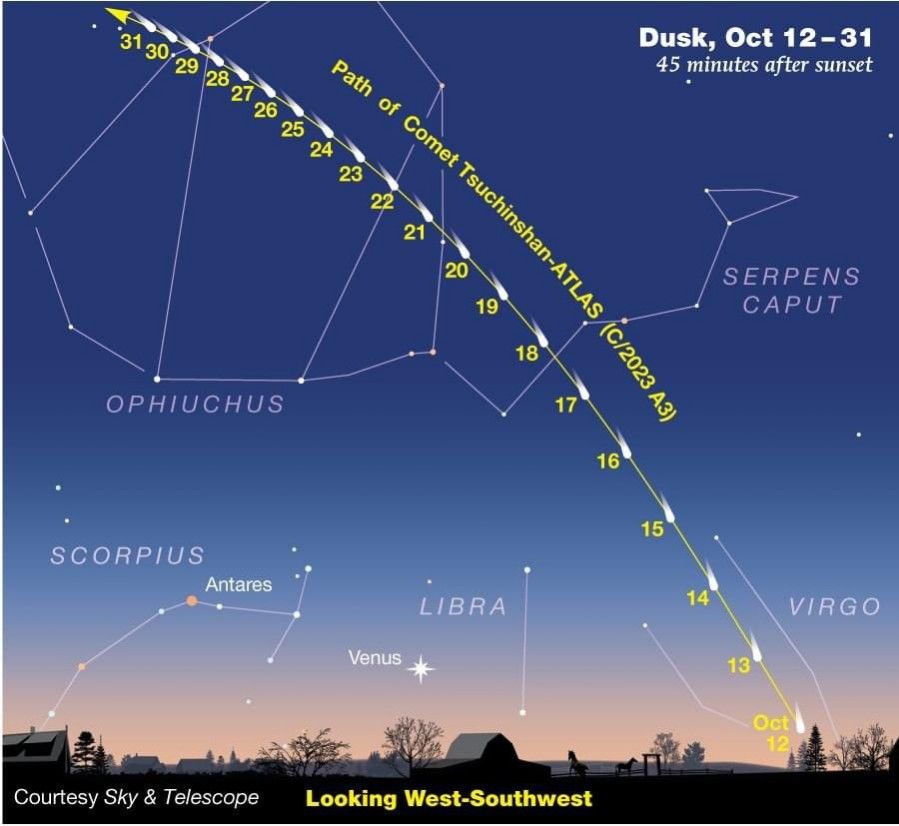
    Astronomy enthusiasts and casual stargazers alike are gearing up for a celestial treat as Comet C/2023 A3 (Tsuchinshan-ATLAS) makes its grand appearance in the evening skies of the Northern Hemisphere following the 12th of October.

    Brightening steadily, C/2023 A3 is already captivating viewers in the Southern Hemisphere, and predictions suggest that it could become one of the most remarkable comets seen in recent years. Experts believe that with a projected brightness potentially exceeding magnitude -5.0, this comet may even outshine the celebrated Comet NEOWISE, which dazzled audiences in the summer of 2020.

    As the comet approaches its closest pass to the Earth on October 12, observers can anticipate a stunning visual display. Initially appearing in the constellation Virgo shortly after sunset, C/2023 A3 promises to be visible to the naked eye, offering a thrilling opportunity for those in dark sky areas.

    • October 10-12: from -3.0 to -1.0 mag, appears in the evening in the Northern Hemisphere shortly after sunset, very low in the western sky in the constellation of Virgo. Short observation window, but visible with the naked eye! Best time to see the comet. Makes its closest approach to Earth on October 12.
    • October 13-14: from -1.0 to 1.0 mag, quickly losing brightness, but moving farther from the Sun and therefore easier to see. Visible with the naked eye in the evening about an hour after sunset. On October 14, C/2023 A3 will pass close to another comet, 13P/Olbers (mag 10).
    • October 15-19: 1.0 to 4.5 mag, moving toward Serpens Caput. May produce an anti-tail, a bright streak that appears to be pointing toward the Sun, opposite the other tails. On October 15, it will pass 1.4° from the M5 globular cluster, providing a good photo opportunity
    • October 20-31: 4.5 to 7.0 mag, moving across the constellation Ophiuchus relatively high in the southwestern sky in the evening. Visible with binoculars and telescopes. During these days, the tail of the comet will begin to grow rapidly, possibly reaching up to 20° long (about 40 times the size of the Full Moon) under dark skies.
    • November: from 7 to 8 mag, visible in the evening. Rises higher in the Northern Hemisphere after sunset.
    • December: from 8 to 10 mag, gradually moves closer to the Sun in our sky, rising lower above the horizon. Not visible from the Southern Hemisphere.

    As the comet moves further from the Sun after its perihelion on September 27, observers can also expect to see a dramatic tail grow, formed by the melting ice and dust particles released as it experiences the Sun’s heat.

    With the comet gaining visibility, schools, observatories, and astronomy clubs are arranging viewing events and educational sessions to celebrate this magnificent astronomical event.

    Stay tuned and prepare your telescopes or cameras! This is a once-in-a-lifetime chance to witness the beauty of Comet C/2023 A3 (Tsuchinshan-ATLAS) as it lights up our night skies.