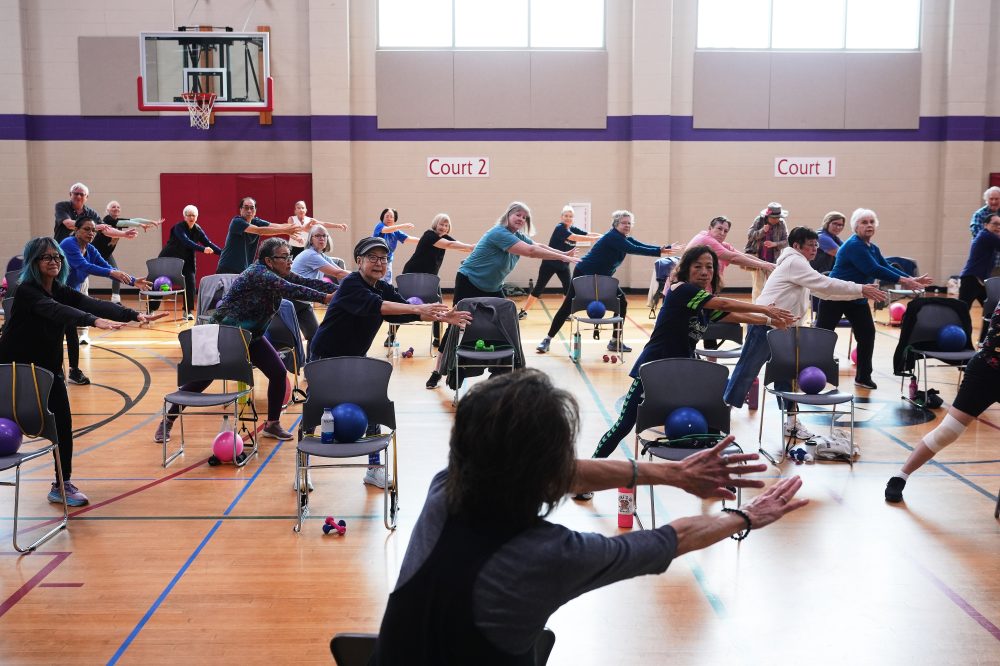

After three decades as a professional dancer and choreographer, Bengie Santos could have easily retired when she reached the age where most performers step away from the spotlight. Instead, she launched a new chapter as a fitness instructor.
Santos, now 72, has spent 14 years leading classes at the YMCA of Greater Seattle, where she’s developed a devoted group of older participants — including many in their 80s and 90s — who attend her stretching, dancing and weight-lifting sessions several times weekly.
Her classes feature everything from Doris Day classics to hip-hop beats and country line dancing, getting participants moving with kicks, pops and spins.
Several of Santos’ participants note that younger instructors — while skilled — don’t connect with them quite the same way.
YMCA coordinators and fitness experts emphasize that older instructors often serve as effective role models, communicating with their age group in ways that make working out more enjoyable.
Sharon Ruff, 81, was drawn to Santos’ sessions because of the diverse musical selections and appreciates the instructor’s vigor and positive attitude. During her teaching career, she rarely exercised consistently. “I didn’t really like it, because it wasn’t fun,” she says.
Her companion Ann Kashiwa, 91, frequently attends back-to-back hour-long sessions. She began participating in Santos’ classes during the pandemic and continued even while receiving pancreatic cancer treatment.
“She is not only a fantastic teacher, but she gets people together,” says Kashiwa, whose YMCA connections have provided support during difficult periods.
Santos describes the motivation as mutual. Her participants encourage her to continue, she explains, and “I’m hoping I inspire them to keep going.”
Physical activity and social interaction are essential for healthy aging, making it important to find ways to make these activities appealing.
“Everybody has to figure out what their barriers are” and develop approaches to make physical activity rewarding, says Daniel E. Lieberman, an evolutionary biologist at Harvard and author of several books, including “Exercised: Why Something We Never Evolved to Do is Healthy and Rewarding.”
Having someone to encourage movement, whether an instructor or companion, can help overcome natural reluctance.
“People who stay active as they get older are important role models for everyone,” Lieberman says.
Harry King, an 83-year-old personal trainer in Greenville, South Carolina, acknowledges that finding motivation for that initial step is challenging for many, becoming even more difficult as mobility decreases.
King maintained an active lifestyle — kayaking, hiking and playing basketball — but after retiring from his career as an insurance executive and business coach, he found himself drawn to relaxing in front of the television. That quickly became tedious, so when he noticed a Help Wanted sign at Planet Fitness, he applied and eventually became a trainer.
The majority of his clients are 50 or older.
“I’ve heard people say I set a good example and I try to,” he says. “At my age, if I can exercise, why can’t other people too?”
The Seattle YMCA recognizes the benefits of having older instructors lead senior programs.
“We don’t put an age limit on our applicants,” says program executive Kerry Ashby, who began there as a younger instructor for the Active Older Adults program. The Y does recruit from within the older adult classes, and a lot of instructors are former participants.
“We know it’s more than just fitness for the majority of our active older adults,” Ashby says. “It’s also the mental and emotional aspect.”
Tom Kleinecke, 67, has belonged to the Y for 18 years and has tried various classes. Younger instructors, he observes, tend to teach their classes, while Santos leads and inspires.
Kleinecke reports that his fitness and stamina have improved significantly since he began attending three of Santos’ weekly classes. Despite being in good shape, he finds it challenging to match her pace.
One session includes a high-energy dance class not specifically designed for older participants. Initially, some movements were difficult to master, he noted, but soon he learned all the choreography, from mambo to moonwalk.
“If you’re worried about being out of sync and uncoordinated, don’t worry about it because nobody is paying attention to you,” Kleinecke says. They’re all watching the instructor.
Now, he and his wife enjoy dancing on weekends.
Santos explains that she considers her students’ ages and experiences when selecting music for her exercise classes.
“I always tell other instructors it isn’t your class, it’s their class,” she says.
She also conducts smaller sessions at three senior living facilities. Those participants range from 80 to 102.
“The caregivers wheel them out. I play their music. It triggers their memory,” from Judy Garland to Louie Armstrong, Santos says. “When they see me they think they’re going to party.”
Some even waltz in their chairs.