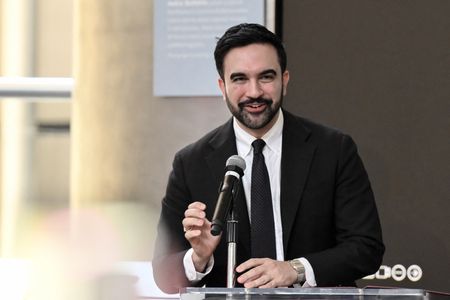

NEW YORK — New York City Mayor Zohran Mamdani is moving forward with plans to broadcast World Cup soccer matches on hundreds of digital screens positioned on street corners throughout the city’s five boroughs, as part of his commitment to making sports more accessible to everyday residents.
The 55-inch LinkNYC digital kiosks, which typically display advertisements or public service announcements, will be used to air a selection of tournament matches. Mamdani previously used the same screens to broadcast two NBA Finals games this month, giving New Yorkers without cable or streaming services a chance to watch the Knicks end a 53-year championship drought.
“Whatever infrastructure we have, we should be using it to make it easier to be a part of the game,” Mamdani told Reuters on Thursday.
“We are going to be broadcasting a few games to hundreds of kiosks across the five boroughs. And it is going to be an opportunity for New Yorkers to really lose themselves in the World Cup, much of the way that we’ve all lost ourselves in this incredible run from the Knicks,” he added.
Politico had previously reported that plans for the public screenings were quietly being put together.
Attending World Cup games in person has become increasingly out of reach for many fans. The United States is co-hosting the tournament alongside Canada and Mexico, and dynamic ticket pricing has driven entry-level prices for games at the New York/New Jersey and Miami venues close to $1,000 ahead of the tournament’s start.
Mamdani, a 34-year-old Democrat who defied the political establishment and energized younger voters during his campaign, partnered with the New York New Jersey Host Committee to make 1,000 World Cup tickets available to New Yorkers at just $50 each, with free round-trip bus service included.
“If we allow sports to become a luxury commodity, we also allow it to become divorced from its roots as also an expression for working people, and not just something to participate in, but also something to be a part of,” said Mamdani, who joined the Knicks’ tickertape parade in downtown Manhattan on Thursday.
“It’s time to actually ensure that we don’t leave any New Yorkers behind as we talk about sports, and we should talk about it in the same breath as we talk about the things that people also build their lives around,” he said.
Earlier this month, the mayor’s office unveiled a line of New York City-themed soccer jerseys timed to the World Cup. Made in Brooklyn, the jerseys were sold at cost — roughly $50 each, according to GQ magazine — a significant difference from the $130 price tag on USA jerseys sold at World Cup stadium kiosks. A spokesperson for the mayor’s office confirmed that the first batch of 1,500 jerseys sold out and that a second run is being planned.
Mamdani wore one of the jerseys to the first World Cup match held at the New York/New Jersey stadium and shared a photo from the affordable seating section, captioning it: “1,000 New Yorkers won our lottery for affordable tickets to the World Cup. Today, we celebrated in the stands for the first NY/NJ game of the tournament. The beautiful game belongs to everyone.”
“We want these tournaments, we want these moments to be things that are also within reach for working people and not just something that they’re trying to figure out how they can stream,” said Mamdani, who is a longtime supporter of English Premier League champions Arsenal.
Not everyone has been on board with the mayor’s approach. Knicks owner James Dolan publicly criticized Mamdani and local officials over security arrangements outside Madison Square Garden during the NBA Finals. Dolan argued that the security perimeter — where a watch party had originally been planned — turned the surrounding streets into “a police state.”
Still, with six additional World Cup games still scheduled at the New York/New Jersey venue and the U.S. Open golf major getting underway Thursday in nearby Southampton, analysts say the mayor’s sports accessibility push is likely to connect with a broad swath of the public.
“Sports traditionally weren’t regarded as something serious,” said Lee Igel, a clinical professor at NYU’s Tisch Institute for Global Sport. “So if you’re in a political position or elected office and started talking about that, come on, it’s the rent, right? It’s the food on the table.”
Igel added that Mamdani “understands the platform, the power of sport” and noted that “anywhere in the world, sports matter to people.”