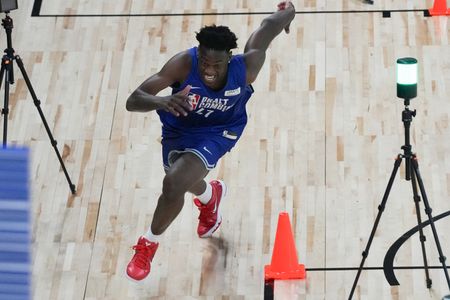

Field Level Media analyst Ethan Ward has taken a closer look at one of the most talked-about players heading into the 2026 NBA Draft — BYU freshman AJ Dybantsa.
Dybantsa has been a household name in basketball circles since his junior year of high school, and his college debut lived up to the hype. He finished the season as the nation’s leading scorer, putting up 25.5 points per game. Standing at a verified 6-foot-9 and 215 pounds — measurements confirmed at the NBA draft combine — he possesses the physical profile of a versatile inside-out swingman. His style of play blends power and finesse, with most of his production coming from within the arc.
What He Does Well: Dybantsa is a smooth wing scorer capable of exploiting weaknesses in halfcourt defenses on his own. He finishes at the rim with authority, converting at a 73.4 percent clip, and can elevate from well beyond the charge circle. He shows three-point range periodically, connecting on 34.7 percent of above-the-break attempts. His offensive approach centers on aggressive drives — either backing defenders down or attacking them face-up. He plays with patience and deliberateness, using ball fakes and shoulder movements to manufacture space rather than relying on pure straight-line speed. He’s comfortable operating in the corner or attacking closeouts on the weak side. As a secondary playmaker, he recognizes defensive attention and delivers the ball to open shooters or cutters. He draws fouls at an elite rate — 7.3 free throw attempts drawn per 36 minutes, which ranks in the 99th percentile among players at his position according to CBB Analytics. Defensively, his length helps him disrupt passing lanes, and he navigates screens reasonably well for someone his size. He’s also a strong long rebounder, often positioned to push in transition.
Areas That Need Work: Dybantsa leans too heavily on back-to-the-basket scoring, which reflects a handle that still needs refinement. His jump shot mechanics are inconsistent — he brings his knees together during his release, which throws off his rhythm and arc. He shot just 7-for-26 from the corner three (26.9 percent) and only 30 percent on catch-and-shoot opportunities overall. There are also concerns about his tendency to initiate contact rather than create clean looks. He can be steered in one direction by physical defenders, and his downhill attacks sometimes stall without a clear plan. According to Draft Ballr, he produced just 0.94 points per possession on post-ups, 0.98 on mid-range attempts, and 0.81 on dribble jumpers. When defenses key in on him, he can be contained. On the defensive end, he struggles in one-on-one coverage, can lose focus away from the ball, and his ability to switch assignments is sometimes slow to develop. Projecting him as a standout defender appears unlikely at this stage — a solid but unspectacular wing defender seems like the more realistic outcome.
Best NBA Fit: Washington Wizards
With Trae Young now committed to staying in Washington, Dybantsa would have the benefit of joining a team without being immediately thrust into a primary offensive role. Some evaluators view him as a polished prospect ready to contribute right away, and those expectations aren’t unreasonable. However, the Wizards understand better than most franchises that even highly touted teenagers face a learning curve when making the jump to professional basketball.