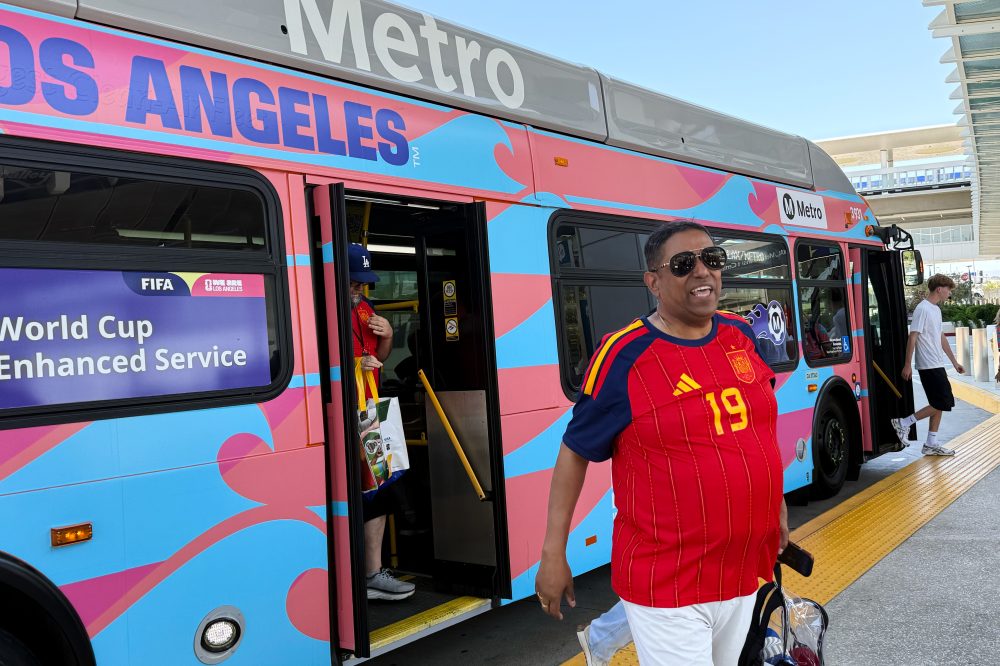

When Matthew Smith brought his five-year-old son to a World Cup match in the Los Angeles area earlier this month, they chose public transit over driving from their nearby coastal community. It was Smith’s first time riding LA Metro in ten years — and he came away impressed.
“Seems like a very functioning transit system, which is somewhat surprising given its reputation,” Smith said.
That kind of reaction is exactly what Metro officials were aiming for. The agency used the eight Los Angeles-area games of the 2026 FIFA World Cup to introduce — or reintroduce — residents to a transit network that often gets overlooked in a city built around the car. The games are also serving as an early trial run for the 2028 Olympics, which organizers have promised will be a “no car” event, with zero parking available for spectators at any venue. Everyone attending will need to use public transit or shuttles to get there.
For the July 2 Spain-Austria game that Smith and his son attended, nearly 50,000 trips were taken on rail lines. While no train runs directly to SoFi Stadium in the LA suburb of Inglewood, Metro added 15 shuttle routes connecting major rail stations and transit hubs to the venue — with the longest route running one hour and 15 minutes. More than 30,000 shuttle rides were taken for that single game, according to the agency.
Metro plans to use a similar model for the Olympics, since many venues aren’t directly connected to the rail network. For the World Cup, the agency borrowed around 200 buses to handle the surge in riders. Officials say they’ll need roughly 3,000 borrowed buses to meet Olympic demand.
For many Angelenos, hopping on a bus or train isn’t part of daily life the way it is in cities like New York or Chicago. LA Metro estimates its system handles about 1 million rides per day — roughly on par with Chicago, which is a smaller city. New York’s system, by comparison, sees well over 3 million weekday riders.
The LA system has long struggled with a reputation for being unreliable and, at times, unsafe. High-profile incidents — including the death of a 67-year-old woman who was stabbed aboard a Metro train in 2024 — have reinforced those concerns. Riders have also raised issues about drug use, cleanliness, and the presence of unhoused individuals on trains and platforms.
In response, Metro launched its own police department in June, with plans to have it fully operational by 2029, replacing the LAPD’s role on the transit system. The agency hopes that pairing sworn officers with homeless outreach and crisis response teams will make riders feel more comfortable. Metro has also pointed to data showing a 13.6% drop in overall crime in March 2026 compared to the same period a year earlier, part of a two-year downward trend.
Martha Banuelos had used the system occasionally in the past but said she typically tried to “avoid it like the plague.” She recently started riding the trains again to travel from North Hollywood into the city for World Cup watch parties.
“It’s a lot cleaner and smells way better,” she said.
To build excitement around transit during the tournament, Metro partnered with FIFA to set up fan zones and watch parties at major transit hubs. Thousands of fans gathered at these locations to drink, dance to DJ sets, and cheer on their favorite teams. The agency also promoted limited edition tap cards featuring different countries and used social media to encourage people to ride public transit during the games.
Metro also updated its payment system ahead of the World Cup, now allowing riders to pay directly with a credit card — eliminating the need for a separate tap card, similar to what other cities have already done.
Those changes helped attract first-time riders like Yasmin Cortez, 32, who boarded a train for the very first time to attend the official FIFA Fan Festival at the LA Memorial Coliseum, where she watched matches and volunteered for FIFA. A week later, she rode the rail again — this time from Cerritos, about 16 miles southwest of Los Angeles — to cheer for Uruguay at the Union Station Fan Zone.
“Especially with gas prices now, yeah I should be taking the Metro,” she said. “There’s a lot to explore, and I bought some new walking shoes.”
The 2024 Paris Summer Olympics set a high bar for transit accessibility, with nearly every venue reachable by Metro, commuter train, tram, or bus. LA is working hard to close that gap before the 2028 Games arrive.
In June, transit fans celebrated the long-awaited extension of the D line, which previously connected downtown LA to Koreatown and now stretches further west to reach popular destinations like the Grove shopping mall, the Los Angeles County Museum of Art, and the La Brea Tar Pits. It was the first heavy rail expansion to open in the United States since 2020. Four additional stations are currently under construction to push the line all the way to the University of California, Los Angeles campus, which is slated to serve as the official Athlete Village for the 2028 Games.
“LA is a transit city,” said Jennifer Vides, Metro’s chief customer experience officer. “People want to try to say that it’s not. Obviously we have a lot more expansion to do and we’re working on it. But people really want transit.”